
Matter–Energy Model without the Gravitational Constant: A Unified Approach to Gravitational and Nuclear Interactions
Article Sidebar
Main Article Content


Abstract
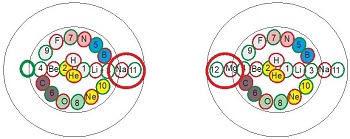
Newton's law of universal gravitation and Einstein's General Theory of Relativity (GTR) face limitations in explaining gravitational anomalies and unifying fundamental physical forces. This study proposes that the gravitational constant G is not constant but distance-dependent (Gvar), establishing a unified theoretical framework for gravitational and nuclear interactions. We first derive the functional form of Gvar calibrated by planetary perihelion shifts, then analyze its impact on the physical unit system, and finally construct a matter--energy model based on the Primordial Energy Matrix (PEM) composed of force points. The results show that Gvar effectively explains gravitational anomalies (e.g., Pioneer anomaly, flyby anomalies) and achieves the unification of gravity with strong/weak nuclear and electromagnetic forces without introducing extra dimensions. The matter--energy model reveals that elementary particles (neutrons, protons, electrons) originate from vortices formed by PEM force points, and atomic/molecular structures are derived from the cascading combination of these vortices. This work provides a new perspective for understanding the nature of gravity and the origin of matter.
Article Details

This work is licensed under a Creative Commons Attribution-NonCommercial 4.0 International License.
References
- Newton, I. (1687). Philosophiae naturalis principia mathematica. https://doi.org/10.5479/sil.52126.39088015628399
- Nojiri, S., & Odintsov, S. D. (2007). Introduction to Modified Gravity and Gravitational Alternative for Dark Energy. International Journal of Geometric Methods in Modern Physics, 04(01), 115–145. https://doi.org/10.1142/s0219887807001928
- Hees, A., Folkner, W. M., Jacobson, R. A., & Park, R. S. (2014). Constraints on modified Newtonian dynamics theories from radio tracking data of the Cassini spacecraft. Physical Review D, 89(10). https://doi.org/10.1103/physrevd.89.102002
- Haug, E. G. (2016). A new approach to gravitational physics. Physics Essays. https://hal.science/hal-03234242
- Haug, E. G. (2020). Relativistic Newtonian Gravitation That Gives the Correct Prediction of Mercury Precession. Journal of High Energy Physics, Gravitation and Cosmology, 06(02), 238–243. https://doi.org/10.4236/jhepgc.2020.62017
- Haug, E. G. (2022). Newton Did Not Invent or Use the So-Called Newton’s Gravitational Constant; G, It Has Mainly Caused Confusion. Journal of Modern Physics, 13(02), 179–205. https://doi.org/10.4236/jmp.2022.132014
- Pitjeva, E. V. (2006). Limitations on some physical parameters from position observations of planets. 26th Meeting of the IAU, Prague, 22–23 August 2006.
- Iorio, L. (2009). The Recently Determined Anomalous Perihelion Precession of Saturn. The Astronomical Journal, 137(3), 3615–3618. https://doi.org/10.1088/0004-6256/137/3/3615
- Weber, H. P. (2019). Schwierige Materie. Independently published. https://www.isbnsearch.org/isbn/9781521016008
- Weber, H. P. (2023). The Perihelion Precession of the Planets Indicates a Variability of the Gravitational Constant. Journal of Modern Physics, 14(05), 670–675. https://doi.org/10.4236/jmp.2023.145038
- Weber, H. P. (2024). Effect of Gravitational Formula Change on Gravitational Anomalies. Journal of Modern Physics, 15(11), 1632–1645. https://doi.org/10.4236/jmp.2024.1511071
