
Validation Under Archetype Shift for Data-Driven Bio-Inspired Lightweight Design: Optimism, Conformal Calibration and Density-Matched Auditing
Article Sidebar
Main Article Content


Abstract
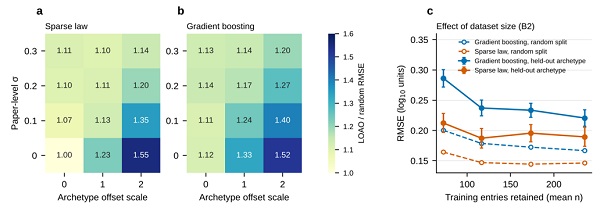
Data-driven design rules for bio-inspired lightweight structures are almost always validated with random train–test splits. That tells a designer little about the question that matters: will a rule learned from known architectures hold for a new one? We examine this on two controlled benchmarks with a known governing law, one inside the model library and one outside it (15 draws each), and organise the findings into a four-part archetype-shift protocol. Holding out whole archetypes raises prediction error by 11–36%. The excess squared error is additive in archetype-offset and paper-level variance (leave-one-setting-out R2 of 0.79–0.92), and flexible models pay an extra extrapolation cost. Conformal intervals calibrated on random folds cover only 80–85% of unseen archetypes at a nominal 90%; calibrating on leave-one-archetype-out residuals keeps coverage within three points of nominal from 50 to 95%, at the price of intervals 18–34% wider, and descriptor-distance flags do not show where the failures occur. In a sparse Gibson–Ashby-type law, only the density exponent and its stretching-fraction interaction are recovered in every refit; secondary terms are selected in 38–90% of refits whether or not they exist. Finally, a break-even density exponent applied to a published study of eight honeycomb designs shows that reported energy-absorption gains of 22-47% came with 1.2- to 3.3-fold more mass, and that only three of seven gains exceed 10% once the study’s model error is allowed for, even if absorption were independent of density. Together, these results turn a general caution about random splits into a concrete validation and reporting protocol for data-driven bio-inspired design.
Article Details

This work is licensed under a Creative Commons Attribution-NonCommercial 4.0 International License.
References
- Meyers MA, Chen P-Y, Lin AY-M, et al. Biological materials: Structure and mechanical properties. Progress in Materials Science. 2008, 53(1): 1-206. https://doi.org/10.1016/j.pmatsci.2007.05.002
- Wegst UGK, Bai H, Saiz E, et al. Bioinspired structural materials. Nature Materials. 2014, 14(1): 23-36. https://doi.org/10.1038/nmat4089
- Bessa MA, Bostanabad R, Liu Z, et al. A framework for data-driven analysis of materials under uncertainty: Countering the curse of dimensionality. Computer Methods in Applied Mechanics and Engineering. 2017, 320: 633-667. https://doi.org/10.1016/j.cma.2017.03.037
- Bastek J-H, Kumar S, Telgen B, et al. Inverting the structure–property map of truss metamaterials by deep learning. Proceedings of the National Academy of Sciences. 2021, 119(1). https://doi.org/10.1073/pnas.2111505119
- Kapoor S, Narayanan A. Leakage and the reproducibility crisis in machine-learning-based science. Patterns. 2023, 4(9): 100804. https://doi.org/10.1016/j.patter.2023.100804
- Roberts DR, Bahn V, Ciuti S, et al. Cross‐validation strategies for data with temporal, spatial, hierarchical, or phylogenetic structure. Ecography. 2017, 40(8): 913-929. https://doi.org/10.1111/ecog.02881
- Meredig B, Antono E, Church C, et al. Can machine learning identify the next high-temperature superconductor? Examining extrapolation performance for materials discovery. Molecular Systems Design & Engineering. 2018, 3(5): 819-825. https://doi.org/10.1039/c8me00012c
- Ploton P, Mortier F, Réjou-Méchain M, et al. Spatial validation reveals poor predictive performance of large-scale ecological mapping models. Nature Communications. 2020, 11(1). https://doi.org/10.1038/s41467-020-18321-y
- Meyer H, Pebesma E. Predicting into unknown space? Estimating the area of applicability of spatial prediction models. Methods in Ecology and Evolution. 2021, 12(9): 1620-1633. https://doi.org/10.1111/2041-210x.13650
- Gibson LJ, Ashby MF. Cellular Solids. Published online May 1, 1997. https://doi.org/10.1017/cbo9781139878326
- Vovk V, Gammerman A, Shafer, G. Algorithmic learning in a random world. Springer, New York, 2005. https://doi.org/10.1007/b106715
- Angelopoulos AN, Bates S. Conformal Prediction: A Gentle Introduction. Foundations and Trends® in Machine Learning. 2023, 16(4): 494-591. https://doi.org/10.1561/2200000101
- Tibshirani RJ, Barber RF, Candès EJ, et al. (2019). Conformal prediction under covariate shift. Advances in Neural Information Processing Systems. 2019, 32: 2530-2540. https://dl.acm.org/doi/abs/10.5555/3454287.3454514
- Barber RF, Candès EJ, Ramdas A, et al. Predictive inference with the jackknife+. The Annals of Statistics. 2021, 49(1): 486-507. https://doi.org/10.1214/20-aos1965
- Lei J, G’Sell M, Rinaldo A, et al. Distribution-Free Predictive Inference for Regression. Journal of the American Statistical Association. 2018, 113(523): 1094-1111. https://doi.org/10.1080/01621459.2017.1307116
- Dunn R, Wasserman L, Ramdas A. Distribution-Free Prediction Sets for Two-Layer Hierarchical Models. Journal of the American Statistical Association. 2022, 118(544): 2491-2502. https://doi.org/10.1080/01621459.2022.2060112
- Brunton SL, Proctor JL, Kutz JN. Discovering governing equations from data by sparse identification of nonlinear dynamical systems. Proceedings of the National Academy of Sciences. 2016, 113(15): 3932-3937. https://doi.org/10.1073/pnas.1517384113
- Cranmer M. Interpretable machine learning for science with PySR and SymbolicRegression.jl. arXiv preprint, 2023. https://doi.org/10.48550/arXiv.2305.01582
- Meinshausen N, Bühlmann P. Stability Selection. Journal of the Royal Statistical Society Series B: Statistical Methodology. 2010, 72(4): 417-473. https://doi.org/10.1111/j.1467-9868.2010.00740.x
- Ashby MF. The properties of foams and lattices. Philosophical Transactions of the Royal Society A: Mathematical, Physical and Engineering Sciences. 2005, 364(1838): 15-30. https://doi.org/10.1098/rsta.2005.1678
- Wierzbicki T. Crushing analysis of metal honeycombs. International Journal of Impact Engineering. 1983, 1(2): 157-174. https://doi.org/10.1016/0734-743x(83)90004-0
- Solak A. Numerical Investigation of Compression Behavior of Bio-Inspired Honeycomb Designs. Firat University Journal of Experimental and Computational Engineering. 2026, 5(1): 250-261. https://doi.org/10.62520/fujece.1796508
- Liu C, Tsang H-H, Xu S, et al. Lateral dynamic crushing of skeletal muscle-inspired hierarchical celled structures. Bioinspiration & Biomimetics. 2025, 20(4): 46003. https://doi.org/10.1088/1748-3190/addc25
- He Z, Yang Y, Hu L, et al. On the Design of Bionic Hierarchical H-Type Whip Restraints for Nuclear Power Plants. Applied Sciences. 2025, 15(10): 5507. https://doi.org/10.3390/app15105507
