
Knowledge and Practice of Breastfeeding Among Lactating Mothers in Ratnanagar Municipality, Chitwan
Article Sidebar
Main Article Content


Abstract
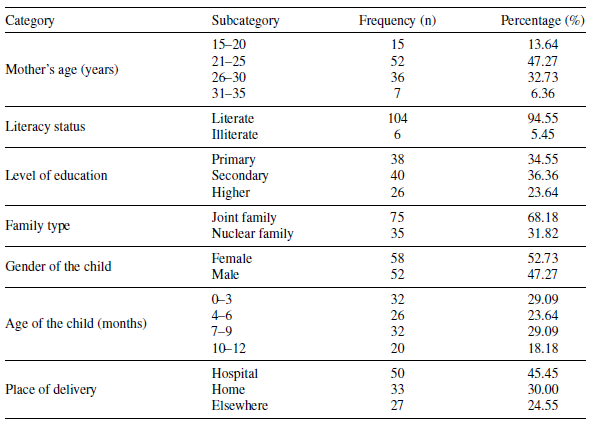
Breastfeeding is a key component of a healthy infant and child nutrition. Breast milk is a crucial source of nutrition and plays a significant role in the growth and development of the infant, both physically and psychologically. The initial milk produced after birth (colostrum) has protective properties which benefit the baby's immune system. This study aimed to explore the knowledge and practices of breastfeeding mothers in Ratnanagar Municipality of Chitwan in Nepal. The study targeted exclusive breastfeeding, colostrum feeding, feeding frequency, complementary feeding, bottle feeding, mothers' hygiene, breastfeeding position and the correlation between the breastfeeding practices and mothers' educational level. This study used a quantitative descriptive research design. Two hundred lactating mothers were studied and the 110 mothers with children under 12 months of age were selected purposefully. Mothers who visited the Ratnanagar Health Post for their children's immunisations were the respondents. An interview schedule was used as the main instrument for the collection of the primary data. The instrument was pre-tested with seven similar informants at Gitanagar VDC of Chitwan and the necessary changes were made in the instrument before final data collection. Data collected were summarized in tables and presented in frequency and percentage. The results show that 94.55% of the respondents were educated, 68.18% were living in joint families. As far as breastfeeding knowledge and practices are concerned, 68.18 percent of the mothers knew about colostrum and 62.73 percent of them used it to feed their babies. Only 41.82% of newborns were breastfed within one hour of birth. Breastfeeding frequencies were high, with 90% breastfeeding more than six times a day, but there were significant gaps in knowledge on exclusive breastfeeding. Only 30.91 percent understood exclusive breastfeeding as the exclusive use of breast milk, and 60.91 percent did not. Likewise, 48.18% bottle fed, and 72.72% of them did not wash or clean their breasts before breastfeeding. About 52.72% started complementary feeding after six months. The results revealed that the knowledge and proper breastfeeding practice was not acquired entirely from general education. The study highlights the need for health education and counselling for pregnant and lactating mothers, community participation and dissemination of specific knowledge about exclusive breastfeeding and child-care practices.
Article Details

This work is licensed under a Creative Commons Attribution-NonCommercial 4.0 International License.
References
- Gurung. Breast feeding practice and its determinants among the mothers attending MCH Clinic of Kathmandu, 2000.
- Bishwokarma. Knowledge, attitude and practice on breast feeding and weaning in Dalit community in Yangshila VDC of Morang District, 2005.
- Bhetwal P. Impact of knowledge and practice in mother of exclusive breast feeding on health status of infants in Kamal Mai Municipality, 2007.
- Baral IB. Common feeding practices among the children of Nangkhel VDC, Bhaktapur District. Unpublished Master’s Degree Thesis, Health, Physical and Population Education, Tribhuvan University, 2005.
- Dharel D, Dhungana R, Basnet S, et al. Breastfeeding practices within the first six months of age in mid-western and eastern regions of Nepal: a health facility-based cross-sectional study. BMC Pregnancy and Childbirth. 2020, 20(1). https://doi.org/10.1186/s12884-020-2754-0
- Dhakal P, Sigdel B, Kumari Ghimire P, et al. Prevalence and Factors Influencing Exclusive Breastfeeding Practice among Breastfeeding Mothers in Kathmandu, Nepal. Journal of Health and Allied Sciences. 2023, 12(1): 20-28. https://doi.org/10.37107/jhas.411
- Tariqujjaman Md, Hasan MdM, Mahfuz M, et al. Between and Within-Country Variations in Infant and Young Child Feeding Practices in South Asia. International Journal of Environmental Research and Public Health. 2022, 19(7): 4350. https://doi.org/10.3390/ijerph19074350
- Wasti SP, Shrestha A, Dhakal P, et al. The prevalence of exclusive breastfeeding practice in the first six months of life and its associated factors in Nepal: A systematic review and meta-analysis. Sexual & Reproductive Healthcare. 2023, 37: 100863. https://doi.org/10.1016/j.srhc.2023.100863
- Singh BK, Khatri RB, Sahani SK, et al. Determinants of exclusive breastfeeding among infants under six months in Nepal: multilevel analysis of nationally representative household survey data. BMC Public Health. 2024, 24(1). https://doi.org/10.1186/s12889-024-19963-z
- Hossain S, Mihrshahi S. Effect of exclusive breastfeeding and other infant and young child feeding practices on childhood morbidity outcomes: associations for infants 0–6 months in 5 South Asian countries using Demographic and Health Survey data. International Breastfeeding Journal. 2024, 19(1). https://doi.org/10.1186/s13006-024-00644-x
- Nai S, Thapa S, Panth A, et al. Social Support and Self Efficacy Towards Exclusive Breastfeeding among Mothers. Journal of Nepal Health Research Council. 2026, 23(03): 475-480. https://doi.org/10.33314/jnhrc.v23i03.4660
