
Playful Adaptation of the Forced Expiratory Technique in Children: A Mechanism-Based Conceptual Framework for Airway Clearance
Article Sidebar
Main Article Content


Abstract
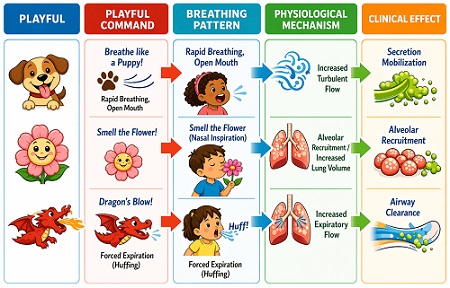
Objective: To propose and analyze a playful adaptation of the Forced Expiratory Technique (FET) in children based on a mechanism-oriented framework for airway clearance.
Methods: This is a descriptive theoretical-conceptual study based on the development and analysis of a pediatric clinical protocol incorporating playful strategies into FET execution. The components of the technique were mapped to their underlying physiological mechanisms according to contemporary classifications of airway clearance techniques.
Results: The proposed model suggests that the playful adaptation of FET is theoretically capable of activating key physiological mechanisms involved in airway clearance, including airflow modulation, increased lung volumes, and secretion mobilization. The integration of these components supports a multimodal physiological approache.
Conclusion: The playful adaptation of FET may represent a feasible and physiologically grounded strategy to enhance adherence and facilitate the execution of therapeutic breathing patterns in pediatric patients.
Article Details

This work is licensed under a Creative Commons Attribution-NonCommercial 4.0 International License.
References
- Reychler G, Audag N, Prieur G, et al. Airway clearance techniques – a proposed classification based on definitions? Expert Review of Respiratory Medicine. 2026: 1–17. https://doi.org/10.1080/17476348.2026.2626079
- Pryor JA, Prasad AS. Physiotherapy for respiratory and cardiac problems: adults and paediatrics. Elsevier Health Sciences, 2008.
- Fink JB. Forced Expiratory Technique, Directed Cough, and Autogenic Drainage. , ed. Respiratory Care. 2007, 52(9): 1210-1223. https://doi.org/10.4187/respcare.07521210
- Button BM, Wilson C, Dentice R, et al. Physiotherapy for cystic fibrosis in Australia and New Zealand: a clinical practice guideline. Respirology. 2016, 21(4): 656-667. https://doi.org/10.1111/resp.12764
- Postiaux G. La kinésithérapie respiratoire du poumon profond. Bases mécaniques d’un nouveau paradigme. Revue des maladies respiratoires. 2014, 31(6): 552-567. https://doi.org/10.1016/j.rmr.2013.11.009
- Belli S, Prince I, Savio G, et al. Airway clearance techniques: the right choice for the right patient. Frontiers in Medicine. 2021, 8: 544826. https://doi.org/10.3389/fmed.2021.544826
- Lee AL, Burge AT, Holland AE. Airway clearance techniques for bronchiectasis. , ed. Cochrane Database of Systematic Reviews. 2015, 2015(11). https://doi.org/10.1002/14651858.cd008351.pub3
- Jones T, Baque E, O'Grady KA, et al. Experiences of children with bronchiectasis and their parents in a novel play-based therapeutic exercise programme: a qualitative analysis. BMJ open. 2024, 14(7): e078994. https://doi.org/10.1136/bmjopen-2023-078994
- Gjærde LK, Hybschmann J, Dybdal D, et al. Play interventions for paediatric patients in hospital: a scoping review. , ed. BMJ Open. 2021, 11(7): e051957. https://doi.org/10.1136/bmjopen-2021-051957
- de Melo Pena LA, de Andrade AFSM, de Santana Teles W, et al. A importância da ludoterapia na assistência pediátrica. Research, Society and Development. 2021, 10(8): e31010817309-e31010817309. https://doi.org/10.33448/rsd-v10i8.17309
