
Green Synthesis of SnO₂/Bentonite Nanocomposite Using Murraya koenigii Leaf Extract for Photocatalytic Degradation of Rhodamine B Dye and Carbofuran Pesticide in Aqueous Solution
Article Sidebar
Main Article Content


Abstract
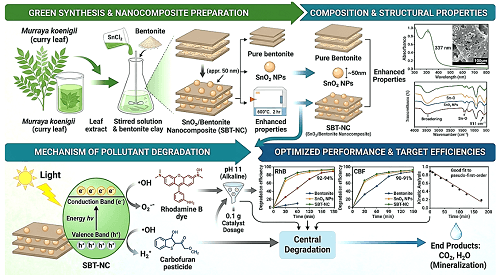
Water contamination by synthetic dyes and pesticides is a major environmental concern because of their persistence, toxicity, and adverse effects on aquatic ecosystems and human health. The present study focused on the green synthesis of SnO₂ nanoparticles and the preparation of a SnO₂/bentonite nanocomposite (SBT-NC) using Murraya koenigii leaf extract and its application for the photocatalytic degradation of Rhodamine B (RhB) dye and Carbofuran (CBF) pesticide in aqueous solutions. Bentonite was used as a supporting material to improve the adsorption capacity, surface area, and dispersion of SnO₂ nanoparticles. The synthesized materials were characterized using UV–visible spectroscopy, scanning electron microscopy (SEM), energy-dispersive X-ray spectroscopy (EDX), and Fourier-transform infrared spectroscopy (FTIR). The characterization results confirmed the successful formation and incorporation of SnO₂ nanoparticles onto the bentonite matrix. The effects of important experimental parameters, including solution pH, initial pollutant concentration, contact time, and catalyst dosage, were investigated under light irradiation. The SBT-NC showed considerably higher photocatalytic degradation efficiency than pure bentonite and SnO₂ nanoparticles. Under optimized conditions, the degradation efficiency of Rhodamine B reached approximately 92–94%, while Carbofuran degradation reached approximately 90–91%. The optimum conditions included alkaline pH for Rhodamine B and acidic pH for Carbofuran, with a catalyst dosage of approximately 0.1 g and a reaction time of about 90–120 min. The enhanced performance of SBT-NC was attributed to the synergistic effect of the adsorption properties of bentonite and the photocatalytic activity of SnO₂, which provided additional active sites and promoted the formation of reactive oxygen species. Kinetic analysis indicated that the degradation of both pollutants was generally better described by the pseudo-first-order kinetic model. Overall, the green-synthesized SnO₂/bentonite nanocomposite demonstrated strong potential as an efficient, economical, and environmentally friendly photocatalyst for the removal of organic pollutants from contaminated water.
Article Details

This work is licensed under a Creative Commons Attribution-NonCommercial 4.0 International License.
References
- Elumalai P, Gao X, Parthipan P, et al. Agrochemical pollution: A serious threat to environmental health. Current Opinion in Environmental Science & Health. 2025, 43: 100597. https://doi.org/10.1016/j.coesh.2025.100597
- Zulfiqar N. Synthesis and Characterization of Pure and Zirconium Doped NiO-ZnO Nanocomposite for the Photodegradation of Brilliant Green Dye. Published online 2023. https://doi.org/10.2139/ssrn.4582129
- Zulfiqar N. Industrial and Agricultural Contributions to Water Pollution in Pakistan: Policy Interventions for Sustainable Water Management , Published online 2025. https://doi.org/10.2139/ssrn.5294649
- Abdel-Messih MF, Ahmed MA, El-Sayed AS. Photocatalytic decolorization of Rhodamine B dye using novel mesoporous SnO2–TiO2 nano mixed oxides prepared by sol–gel method. Journal of Photochemistry and Photobiology A: Chemistry. 2013, 260: 1-8. https://doi.org/10.1016/j.jphotochem.2013.03.011
- Saini J, Garg VK, Gupta RK, et al. Removal of Orange G and Rhodamine B dyes from aqueous system using hydrothermally synthesized zinc oxide loaded activated carbon (ZnO-AC). Journal of Environmental Chemical Engineering. 2017, 5(1): 884-892. https://doi.org/10.1016/j.jece.2017.01.012
- Xu X, Liu Y, Liu S, et al. Real-time detection of potable-reclaimed water pipe cross-connection events by conventional water quality sensors using machine learning methods. Journal of Environmental Management. 2019, 238: 201-209. https://doi.org/10.1016/j.jenvman.2019.02.110
- Amoli-Diva M, Anvari A, Sadighi-Bonabi R. Synthesis of magneto-plasmonic Au-Ag NPs-decorated TiO2-modified Fe3O4 nanocomposite with enhanced laser/solar-driven photocatalytic activity for degradation of dye pollutant in textile wastewater. Ceramics International. 2019, 45(14): 17837-17846. https://doi.org/10.1016/j.ceramint.2019.05.355
- Pathania D, Gupta D, Al-Muhtaseb AH, et al. Photocatalytic degradation of highly toxic dyes using chitosan-g-poly(acrylamide)/ZnS in presence of solar irradiation. Journal of Photochemistry and Photobiology A: Chemistry. 2016, 329: 61-68. https://doi.org/10.1016/j.jphotochem.2016.06.019
- Peng L, Zheng R-r, Feng D-w, et al. Synthesis of eco-friendly porous g-C3N4/SiO2/SnO2 composite with excellent visible-light responsive photocatalysis. Arabian Journal of Chemistry. 2020, 13(2): 4275-4285. https://doi.org/10.1016/j.arabjc.2019.07.009
- Singh J, Kaur N, Kaur P, et al. Piper betle leaves mediated synthesis of biogenic SnO2 nanoparticles for photocatalytic degradation of reactive yellow 186 dye under direct sunlight. Environmental Nanotechnology, Monitoring & Management. 2018, 10: 331-338. https://doi.org/10.1016/j.enmm.2018.07.001
- Sobhani-Nasab A, Behvandi S, Karimi MA, et al. Synergetic effect of graphene oxide and C3N4 as co-catalyst for enhanced photocatalytic performance of dyes on Yb2(MoO4)3/YbMoO4 nanocomposite. Ceramics International. 2019, 45(14): 17847-17858. https://doi.org/10.1016/j.ceramint.2019.05.356
- Thakur M, Sharma G, Ahamad T, et al. Efficient photocatalytic degradation of toxic dyes from aqueous environment using gelatin-Zr(IV) phosphate nanocomposite and its antimicrobial activity. Colloids and Surfaces B: Biointerfaces. 2017, 157: 456-463. https://doi.org/10.1016/j.colsurfb.2017.06.018
- Thangavel S, Venugopal G, Kim S-J. Enhanced photocatalytic efficacy of organic dyes using β-tin tungstate–reduced graphene oxide nanocomposites. Materials Chemistry and Physics. 2014, 145(1-2): 108-115. https://doi.org/10.1016/j.matchemphys.2014.01.046
- Wang Y, Yang Q, Wang X, et al. Photocatalytic degradation of rhodamin B and diclofenac sodium on hollow hierarchical microspheres of BiOBr modified with sepiolite and polyvinyl pyrrolidone (PVP). Materials Science and Engineering: B. 2019, 244: 12-22. https://doi.org/10.1016/j.mseb.2019.04.005
- Huang H, Zhang J, Jiang L, et al. Preparation of cubic Cu2O nanoparticles wrapped by reduced graphene oxide for the efficient removal of rhodamine B. Journal of Alloys and Compounds. 2017, 718: 112-115. https://doi.org/10.1016/j.jallcom.2017.05.132
- Tuzen M, Sarı A, Saleh TA. Response surface optimization, kinetic and thermodynamic studies for effective removal of rhodamine B by magnetic AC/CeO2 nanocomposite. Journal of Environmental Management. 2018, 206: 170-177. https://doi.org/10.1016/j.jenvman.2017.10.016
- Hassanpour M, Safardoust-Hojaghan H, Salavati-Niasari M. Degradation of methylene blue and Rhodamine B as water pollutants via green synthesized Co3O4/ZnO nanocomposite. Journal of Molecular Liquids. 2017, 229: 293-299. https://doi.org/10.1016/j.molliq.2016.12.090
- Singh BR, Shoeb Mohd, Khan W, et al. Synthesis of graphene/zirconium oxide nanocomposite photocatalyst for the removal of rhodamineB dye from aqueous environment. Journal of Alloys and Compounds. 2015, 651: 598-607. https://doi.org/10.1016/j.jallcom.2015.05.231
- Chook SW, Chia CH, Chan CH, et al. A porous aerogel nanocomposite of silver nanoparticles-functionalized cellulose nanofibrils for SERS detection and catalytic degradation of rhodamine B. RSC Advances. 2015, 5(108): 88915-88920. https://doi.org/10.1039/c5ra18806g
- Oyetade OA, Nyamori VO, Martincigh BS, et al. Effectiveness of carbon nanotube–cobalt ferrite nanocomposites for the adsorption of rhodamine B from aqueous solutions. RSC Advances. 2015, 5(29): 22724-22739. https://doi.org/10.1039/c4ra15446k
- Rani S, Aggarwal M, Kumar M, et al. Removal of methylene blue and rhodamine B from water by zirconium oxide/graphene. Water Science. 2016, 30(1): 51-60. https://doi.org/10.1016/j.wsj.2016.04.001
- Khan UA, Liu J, Pan J, et al. Fabrication of floating CdS/EP photocatalyst by facile liquid phase deposition for highly efficient degradation of Rhodamine B (RhB) under visible light irradiation. Materials Science in Semiconductor Processing. 2018, 83: 201-210. https://doi.org/10.1016/j.mssp.2018.04.028
- Sundararajan M, Kennedy LJ. Photocatalytic removal of rhodamine B under irradiation of visible light using Co1Cu Fe2O4 (0 $leq$ $x$ $leq$ 0.5) nanoparticles. Journal of Environmental Chemical Engineering. 2017, 5(4): 4075-4092. https://doi.org/10.1016/j.jece.2017.07.054
- Sharma G, Dionysiou DD, Sharma S, et al. Highly efficient Sr/Ce/activated carbon bimetallic nanocomposite for photoinduced degradation of rhodamine B. Catalysis Today. 2019, 335: 437-451. https://doi.org/10.1016/j.cattod.2019.03.063
- Mohamed Jaffer Sadiq M, Samson Nesaraj A. Soft chemical synthesis and characterization of BaWO4 nanoparticles for photocatalytic removal of Rhodamine B present in water sample. Journal of Nanostructure in Chemistry. 2014, 5(1): 45-54. https://doi.org/10.1007/s40097-014-0133-y
- Belachew N, Rama Devi D, Basavaiah K. Green synthesis and characterisation of L-Serine capped magnetite nanoparticles for removal of Rhodamine B from contaminated water. Journal of Experimental Nanoscience. 2017, 12(1): 114-128. https://doi.org/10.1080/17458080.2017.1279354
- Ji K, Deng J, Zang H, et al. Fabrication and high photocatalytic performance of noble metal nanoparticles supported on 3DOM InVO4–BiVO4 for the visible-light-driven degradation of rhodamine B and methylene blue. Applied Catalysis B: Environmental. 2015, 165: 285-295. https://doi.org/10.1016/j.apcatb.2014.10.005
- Yao S, Xu L, Gao Q, et al. Enhanced photocatalytic degradation of Rhodamine B by reduced graphene oxides wrapped-Cu2SnS3 flower-like architectures. Journal of Alloys and Compounds. 2017, 704: 469-477. https://doi.org/10.1016/j.jallcom.2017.02.069
- Xu W, Fang J, Chen Y, et al. Novel heterostructured Bi2S3/Bi2Sn2O7 with highly visible light photocatalytic activity for the removal of rhodamine B. Materials Chemistry and Physics. 2015, 154: 30-37. https://doi.org/10.1016/j.matchemphys.2015.01.040
- Wu Z, Yuan X, Zhong H, et al. Effective removal of high-chroma rhodamine B over Sn 0.215 In 0.38 S/reduced graphene oxide composite: Synergistic factors and mechanism of adsorption enrichment and visible photocatalytic degradation. Powder Technology. 2018, 329: 217-231. https://doi.org/10.1016/j.powtec.2018.01.046
- Wang S, Yang B, Liu Y. Synthesis of a hierarchical SnS2 nanostructure for efficient adsorption of Rhodamine B dye. Journal of Colloid and Interface Science. 2017, 507: 225-233. https://doi.org/10.1016/j.jcis.2017.07.053
- Manukumar KN, Nagaraju G, Kishore B, et al. Ionic liquid-assisted hydrothermal synthesis of SnS nanoparticles: Electrode materials for lithium batteries, photoluminescence and photocatalytic activities. Journal of Energy Chemistry. 2018, 27(3): 806-812. https://doi.org/10.1016/j.jechem.2017.05.010
- Song Y, Gu J, Xia K, et al. Construction of 2D SnS2/g-C3N4 Z-scheme composite with superior visible-light photocatalytic performance. Applied Surface Science. 2019, 467-468: 56-64. https://doi.org/10.1016/j.apsusc.2018.10.118
- Khandekar DC, Bhattacharyya AR, Bandyopadhyaya R. Role of impregnated nano-photocatalyst (SnxTi(1-x)O2) inside mesoporous silica (SBA-15) for degradation of organic pollutant (Rhodamine B) under UV light. Journal of Environmental Chemical Engineering. 2019, 7(5): 103433. https://doi.org/10.1016/j.jece.2019.103433
- Zulfiqar N, Ali M, Inam F, et al. Synthesis of metal nanoparticles and their role in degradation of pesticides/herbicides: a review. Discover Applied Sciences. 2025, 7(6). https://doi.org/10.1007/s42452-025-07089-9
- Djellabi R, Ghorab MF, Cerrato G, et al. Photoactive TiO2–montmorillonite composite for degradation of organic dyes in water. Journal of Photochemistry and Photobiology A: Chemistry. 2014, 295: 57-63. https://doi.org/10.1016/j.jphotochem.2014.08.017
- Zulfiqar N, Asad Ali M, Rafique F, et al. Sustainable Fabrication of Metal-doped rGO Nanocomposites for Photocatalytic Antibiotic Degradation in Aqueous Systems. Advance in Sustainability. 2025, 5(1): 18-27. https://doi.org/10.26855/as.2025.06.003
- Zulfiqar N, Inam F, Khudayberganov I, et al. Sustainable synthesis and photocatalytic insights into Ag-doped copper oxide nanoparticles: a comparative study. Scientific Reports. 2026, 16(1). https://doi.org/10.1038/s41598-025-32715-2
- Zulfiqar N, Nadeem R, Musaimi OA. Photocatalytic Degradation of Antibiotics via Exploitation of a Magnetic Nanocomposite: A Green Nanotechnology Approach toward Drug-Contaminated Wastewater Reclamation. ACS Omega. Published online February 6, 2024. https://doi.org/10.1021/acsomega.3c08116
- Zulfiqar N, Shariatipour M, Inam F. Sequestration of chromium( vi ) and nickel( ii ) heavy metals from unhygienic water via sustainable and innovative magnetic nanotechnology. Nanoscale Advances. 2024, 6(1): 287-301. https://doi.org/10.1039/d3na00923h
- Santhosh C, Velmurugan V, Jacob G, et al. Role of nanomaterials in water treatment applications: A review. Chemical Engineering Journal. 2016, 306: 1116-1137. https://doi.org/10.1016/j.cej.2016.08.053
- Duran C, Ozdes D, Bulut VN, et al. Cloud-point extraction of rhodamine 6G by using Triton X-100 as the non-ionic surfactant. Journal of AOAC International, 2011, 94(1): 286-292. https://doi.org/10.1093/jaoac/94.1.286
- Yu J-X, He Z-Y, Qi Y-F, et al. Regeneration of Rhodamine B Loaded Modified Biosorbent by a Self-Cleaning Eluent: TiO2 Hydrosol. CLEAN - Soil, Air, Water. 2011, 39(4): 400-405. https://doi.org/10.1002/clen.201000045
- Chen X, Zhou Q, Liu F, et al. Removal of nine pesticide residues from water and soil by biosorption coupled with degradation on biosorbent immobilized laccase. Chemosphere. 2019, 233: 49-56. https://doi.org/10.1016/j.chemosphere.2019.05.144
- Ahmed Ibrahim KE, Şolpan D. Removal of carbofuran in aqueous solution by using UV-irradiation/hydrogen peroxide. Journal of Environmental Chemical Engineering. 2019, 7(1): 102820. https://doi.org/10.1016/j.jece.2018.102820
- Chen J-q, Hu Z-j, Ji R. Removal of carbofuran from aqueous solution by orange peel. Desalination and Water Treatment. 2012, 49(1-3): 106-114. https://doi.org/10.1080/19443994.2012.708205
- Singh RK, Philip L, Ramanujam S. Rapid Removal of Carbofuran from Aqueous Solution by Pulsed Corona Discharge Treatment: Kinetic Study, Oxidative, Reductive Degradation Pathway, and Toxicity Assay. Industrial & Engineering Chemistry Research. 2016, 55(26): 7201-7209. https://doi.org/10.1021/acs.iecr.6b01191
- Roudani A, Mamouni R, Saffaj N, et al. Removal of Carbofuran Pesticide from Aqueous Solution by Adsorption onto Animal Bone Meal as New Low Cost Adsorbent. Chemical and Process Engineering Research. 2014, 28(2014): 32-44. https://iiste.org/Journals/index.php/CPER/article/view/17091/1
- Arya S, Lehana PK, Rana SB. Synthesis of Zinc Oxide Nanoparticles and Their Morphological, Optical, and Electrical Characterizations. Journal of Electronic Materials. 2017, 46(7): 4604-4611. https://doi.org/10.1007/s11664-017-5469-x
- Yang L, Chen S, Hu M, et al. Biodegradation of carbofuran by Pichia anomala strain HQ-C-01 and its application for bioremediation of contaminated soils. Biology and Fertility of Soils. 2011, 47(8): 917-923. https://doi.org/10.1007/s00374-011-0602-0
- Kanan S, Moyet MA, Arthur RB, et al. Recent advances on TiO 2 -based photocatalysts toward the degradation of pesticides and major organic pollutants from water bodies. Catalysis Reviews. 2019, 62(1): 1-65. https://doi.org/10.1080/01614940.2019.1613323
- Keçili R, Büyüktiryaki S, Hussain CM. Advancement in bioanalytical science through nanotechnology: Past, present and future. TrAC Trends in Analytical Chemistry. 2019, 110: 259-276. https://doi.org/10.1016/j.trac.2018.11.012
- Nasrollahzadeh M, Issaabadi Z, Sajjadi M, et al. Types of Nanostructures. An Introduction to Green Nanotechnology. Published online 2019: 29-80. https://doi.org/10.1016/b978-0-12-813586-0.00002-x
- Ullah Z. Nanotechnology and its impact on modern computer. Global Journal of Research In Engineering. 2013, 12(4-J). https://globaljournals.org
- Abdennouri M, Baâlala M, Galadi A, et al. Photocatalytic degradation of pesticides by titanium dioxide and titanium pillared purified clays. Arabian Journal of Chemistry. 2016, 9: S313-S318. https://doi.org/10.1016/j.arabjc.2011.04.005
- Bai S, Chu H, Xiang X, et al. Fabricating of Fe2O3/BiVO4 heterojunction based photoanode modified with NiFe-LDH nanosheets for efficient solar water splitting. Chemical Engineering Journal. 2018, 350: 148-156. https://doi.org/10.1016/j.cej.2018.05.109
- Bajaj G, Soni RK. Synthesis of composite gold/tin-oxide nanoparticles by nano-soldering. Journal of Nanoparticle Research. 2010, 12(7): 2597-2603. https://doi.org/10.1007/s11051-009-9836-2
- Tran TTT, Doan VD, Ho TTT, et al. Novel of TiO 2 /Ag 3 PO 4 /Bentonite Composite Photocatalyst: Preparation, Characterization, and Application for Degradation of Methylene Blue in Aqueous Solution. Environmental Engineering Science. 2019, 36(1): 71-80. https://doi.org/10.1089/ees.2018.0179
- Begum S, Ahmaruzzaman Md. Green Synthesis of SnO 2 Nanoparticles loaded on Activated Carbon and its Application as Photocalayst in the Degradation of Alizarin Red S Dye. Materials Today: Proceedings. 2018, 5(1): 2314-2320. https://doi.org/10.1016/j.matpr.2017.09.235
- Hristodor CM, Vrinceanu N, Copcia VE, et al. Photocatalytic degradation of Eosin Y dye using SnO 2 nanocomposites. https://www.romnet.net
- Absalan S, Nasresfahani Sh, Sheikhi MH. High-performance carbon monoxide gas sensor based on palladium/tin oxide/porous graphitic carbon nitride nanocomposite. Journal of Alloys and Compounds. 2019, 795: 79-90. https://doi.org/10.1016/j.jallcom.2019.04.187
- Cruz A, Couto L, Esplugas S, et al. Study of the contribution of homogeneous catalysis on heterogeneous Fe(III)/alginate mediated photo-Fenton process. Chemical Engineering Journal. 2017, 318: 272-280. https://doi.org/10.1016/j.cej.2016.09.014
- Das PS, Bakuli S, Biswas I, et al. RGO/MgO hybrid nanocomposites with high specific capacitance. Ceramics International. 2018, 44(1): 424-432. https://doi.org/10.1016/j.ceramint.2017.09.194
- Martínez-Costa JI, Rivera-Utrilla J, Leyva-Ramos R, et al. Individual and simultaneous degradation of antibiotics sulfamethoxazole and trimethoprim by UV and solar radiation in aqueous solution using bentonite and vermiculite as photocatalysts. Applied Clay Science. 2018, 160: 217-225. https://doi.org/10.1016/j.clay.2017.12.026
- Rani M, Rachna, Shanker U. Metal oxide-chitosan based nanocomposites for efficient degradation of carcinogenic PAHs. Journal of Environmental Chemical Engineering. 2020, 8(3): 103810. https://doi.org/10.1016/j.jece.2020.103810
- Ferdoush F, Katsumata H, Russel M, et al. Degradation of carbofuran by V(IV)/H2O2 system in aqueous solution. Bangladesh Journal of Scientific and Industrial Research. 2015, 50(3): 211-218. https://doi.org/10.3329/bjsir.v50i3.25588
- Danwittayakul S, Jaisai M, Dutta J. Efficient solar photocatalytic degradation of textile wastewater using ZnO/ZTO composites. Applied Catalysis B: Environmental. 2015, 163: 1-8. https://doi.org/10.1016/j.apcatb.2014.07.042
- Khan H, Khalil AK, Khan A. Photocatalytic degradation of alizarin yellow in aqueous medium and real samples using chitosan conjugated tin magnetic nanocomposites. Journal of Materials Science: Materials in Electronics. 2019, 30(24): 21332-21342. https://doi.org/10.1007/s10854-019-02510-7
- Chu J, Wang X, Wang D, et al. Highly selective detection of sulfur hexafluoride decomposition components H2S and SOF2 employing sensors based on tin oxide modified reduced graphene oxide. Carbon. 2018, 135: 95-103. https://doi.org/10.1016/j.carbon.2018.04.037
- Haritha E, Roopan SM, Madhavi G, et al. Green chemical approach towards the synthesis of SnO2 NPs in argument with photocatalytic degradation of diazo dye and its kinetic studies. Journal of Photochemistry and Photobiology B: Biology. 2016, 162: 441-447. https://doi.org/10.1016/j.jphotobiol.2016.07.010
- Chandran D, Nair LS, Balachandran S, et al. Structural, optical, photocatalytic, and antimicrobial activities of cobalt-doped tin oxide nanoparticles. Journal of Sol-Gel Science and Technology. 2015, 76(3): 582-591. https://doi.org/10.1007/s10971-015-3808-z
