
Vol 7 No 1 (2026)
Vol 7 No 1 (2026)
Published: 2026-03-27
Research Article
Pages 328-344
 Samar Jahan, Raziya Nadeem, Noor Zulfiqar, Muhammad Hamza Sardar
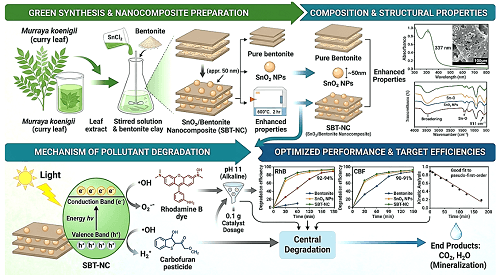
Water contamination by synthetic dyes and pesticides is a major environmental concern because of their persistence, toxicity, and adverse effects on aquatic ecosystems and human health. The present study focused on the green synthesis of SnO₂ nanoparticles and the preparation of a SnO₂/bentonite nanocomposite (SBT-NC) using Murraya koenigii leaf extract and its application for the photocatalytic degradation of Rhodamine B (RhB) dye and Carbofuran (CBF) pesticide in aqueous solutions. Bentonite was used as a supporting material to improve the adsorption capacity, surface area, and dispersion of SnO₂ nanoparticles. The synthesized materials were characterized using UV–visible spectroscopy, scanning electron microscopy (SEM), energy-dispersive X-ray spectroscopy (EDX), and Fourier-transform infrared spectroscopy (FTIR). The characterization results confirmed the successful formation and incorporation of SnO₂ nanoparticles onto the bentonite matrix. The effects of important experimental parameters, including solution pH, initial pollutant concentration, contact time, and catalyst dosage, were investigated under light irradiation. The SBT-NC showed considerably higher photocatalytic degradation efficiency than pure bentonite and SnO₂ nanoparticles. Under optimized conditions, the degradation efficiency of Rhodamine B reached approximately 92–94%, while Carbofuran degradation reached approximately 90–91%. The optimum conditions included alkaline pH for Rhodamine B and acidic pH for Carbofuran, with a catalyst dosage of approximately 0.1 g and a reaction time of about 90–120 min. The enhanced performance of SBT-NC was attributed to the synergistic effect of the adsorption properties of bentonite and the photocatalytic activity of SnO₂, which provided additional active sites and promoted the formation of reactive oxygen species. Kinetic analysis indicated that the degradation of both pollutants was generally better described by the pseudo-first-order kinetic model. Overall, the green-synthesized SnO₂/bentonite nanocomposite demonstrated strong potential as an efficient, economical, and environmentally friendly photocatalyst for the removal of organic pollutants from contaminated water.
Pages 311-327
Ephraim Vunain, Lignet Mulole, Vincent Gwengwe
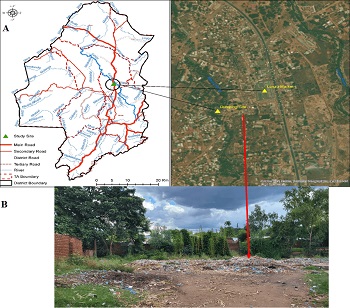
The indiscriminate dumping of municipal solid waste in Malawi, particularly at Lunzu dumpsite in Blantyre, has raised significant environmental concerns due to the potential contamination of surrounding soils and water sources by heavy metals (HMs). This study assessed the concentrations, spatial distribution, and ecological risks of selected heavy metals, cadmium (Cd), lead (Pb), copper (Cu), zinc (Zn), iron (Fe), manganese (Mn), and cobalt (Co) in soil and groundwater around the dumpsite. Samples were collected at varying distances (0-250 m radius from the dumpsite) during both dry and wet seasons and analyzed using Flame Atomic Absorption Spectrophotometry (AAS). In soil, the highest concentrations were recorded at the dumpsite center during the dry season: Cd at 3.08 mg/kg, Cu at 316.18 mg/kg, and Pb at 80.00 mg/kg, exceeding the WHO and EU permissible limits. In the wet season, metal concentrations were lower but still elevated, with Cd at 2.77 mg/kg, Zn at 635.22 mg/kg, and Pb at 72.00 mg/kg. In water samples, the maximum concentrations during the dry season were Cd at 0.02 mg/L, Pb at 0.14 mg/L, and Fe at 1.56 mg/L, which exceeded WHO drinking water standards, particularly for cadmium and lead. Correlation analysis revealed strong positive relationships among most metals and soil organic carbon (SOC), suggesting common pollution sources and the role of organic matter in metal retention. Water samples also revealed elevated concentrations of cadmium and lead, with levels surpassing WHO, EU, and Malawi Bureau of Standards (MBS) guidelines, posing serious health risks to nearby communities. Contamination assessment indices like the contamination factor (CF), geo-accumulation index (Igeo), enrichment factor (EF), and potential ecological risk index (PERI) consistently identified cadmium and mercury as the most ecologically hazardous metals. The spatial trend showed a decline in metal concentrations with increasing distance from the dumpsite, confirming the dumpsite as the primary contamination source.
Pages 302-310
Siyeofori Belema Dede, Pearl Iyaye Daibi Abereton, Adaeze Chidinma Oreh
Background: To maintain the good mental health of a population, the primary healthcare delivery system must be enhanced to provide mental healthcare services (MHS). This study was thus aimed at assessing the adequacy of manpower, equipment, and material resources for providing mental healthcare services in primary healthcare (PHC) facilities in Rivers State, Nigeria.
Methods: This study employed a descriptive cross-sectional design and was conducted in 123 Model Primary Health Care (MPHC) facilities in Rivers State, Nigeria. The heads of facilities provided responses on the availability of manpower, equipment, and material resources necessary for the provision of MHS. Data were collected using an adapted manpower, equipment, and materials checklist, after which evaluation was performed using laid-down PHC standards to determine the adequacy of the assessed resources.
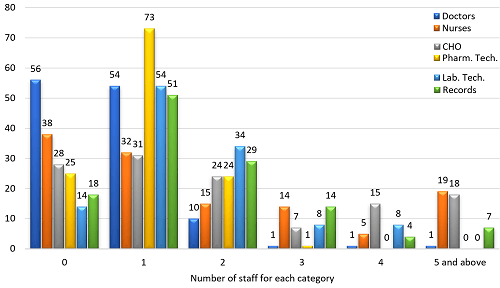
Results: Regarding the manpower working at the health facilities, it was identified that 56 (45.5%) facilities had no doctors and 38 (30.9%) had no nurses, one community health officer (CHO) in 31 (25.2%), among other workers. The various cadres of workers in the PHC facilities were also identified as grossly inadequate. An assessment of equipment and material adequacy, using a 50% cutoff to classify availability as “adequate” or “inadequate”, showed that most facilities (64, 52.0%) experienced inadequacies in these equipment and materials.
Conclusion: The manpower, equipment, and material resources required for the provision of MHS in PHC facilities in Rivers State was found to be inadequate and inequitably distributed. It was thus recommended that the relevant healthcare stakeholders in the State should work to strengthen the capacity of PHC facilities to provide quality MHS to the Rivers populace, thereby improving health outcomes.
Pages 294-301
Pearl Iyaye Daibi Abereton, Siyeofori Belema Dede, Adaeze Chidinma Oreh
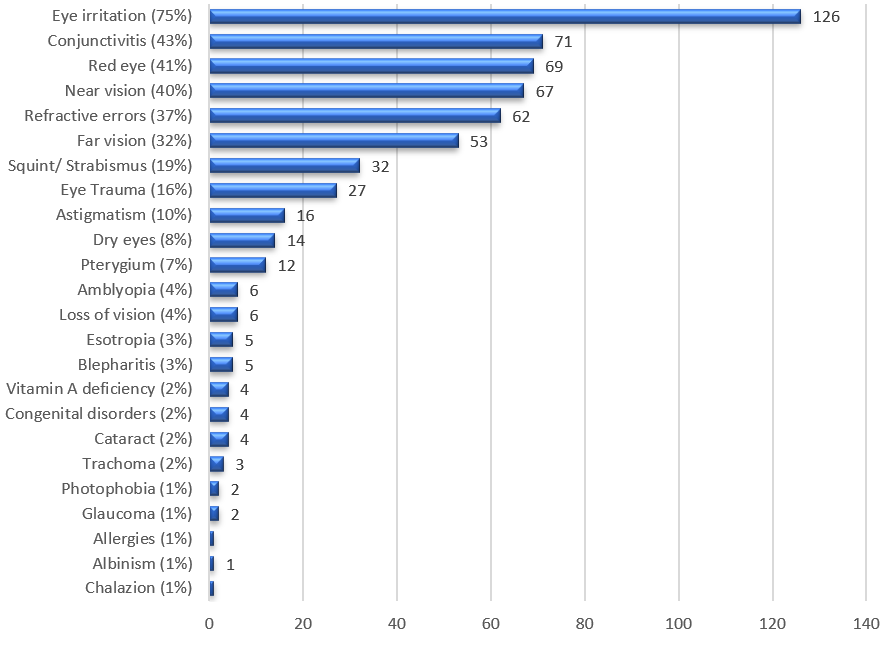
Childhood ocular morbidity encompasses a spectrum of eye diseases that negatively impact mental development, educational attainment, and quality of life. This study aimed to assess the prevalence and pattern of paediatric ocular morbidities in Rivers State between 2019 and 2023. A retrospective design was employed, including all cases of ocular morbidity recorded at Rumuokwurusi Model Primary Health Centre and Obio Cottage Hospital in Obio Akpor Local Government Area (LGA), Rivers State, from 2019 to 2023. Data were analyzed using IBM Statistical Package for the Social Sciences (SPSS) version 23. The findings revealed a prevalence of paediatric ocular morbidity of 94.9% (n = 167). The most common conditions included eye irritation (75%), conjunctivitis (43%), red eye (41%), near vision impairment (40%), refractive errors (37%), and far vision impairment (32%). Significant associations were observed between age and specific ocular morbidities, including conjunctivitis (p < 0.001), far vision impairment (p = 0.030), near vision impairment (p = 0.030), and refractive errors (p = 0.010). A significant association was also identified between sex and dry eye syndrome (p = 0.025). These results indicate that paediatric ocular morbidity constitutes a major public health concern in Rivers State and demands appropriate interventions to address the ocular health needs of the population. Improved eye health service delivery is recommended, including the integration of eye care services into school health programs and the primary healthcare system in Rivers State to ensure accessible and adequate ocular healthcare for children.
