
Cholera in Sub-Saharan Africa: From the Biology of Vibrio Cholerae to the Challenges of Surveillance, with a Focus on the Democratic Republic of the Congo
Article Sidebar
Main Article Content


Abstract
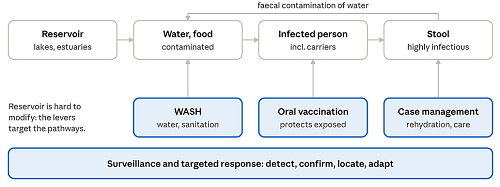
Cholera remains a major public health problem in sub-Saharan Africa, where limited water and sanitation, population displacement, conflict and weak health systems sustain recurrent epidemics. Interpreting its epidemiology requires linking the biology of Vibrio cholerae, antimicrobial resistance, and the performance of surveillance and diagnosis. We conducted a structured narrative review, prioritising meta-analyses, systematic reviews, epidemiological and genomic studies, and WHO and Global Task Force on Cholera Control (GTFCC) documents, with emphasis on sub-Saharan Africa, the Great Lakes region and the Democratic Republic of the Congo (DRC). Cholera in the region is a system combining an aquatic reservoir, foci of person-to-person transmission, structural determinants (water, sanitation and hygiene, rainfall, conflict, displacement) and repeated introductions of seventh-pandemic lineages. In the eastern DRC, genomic data show stable AFR10 sublineages persisting around the Great Lakes, with a ciprofloxacin-reducing parC mutation in one Lake Tanganyika clade. Resistance to historical antibiotics is common but heterogeneous across countries, years and laboratory methods, and data from central Africa are sparse, notably for macrolides. Laboratory surveillance is essential but limited by testing coverage, specimen transport and variable case definitions, which bias confirmed-case counts and positivity rates. Single-dose oral vaccination, water, sanitation and hygiene, and targeted response around cases are complementary, and none is sufficient alone. Understanding and controlling cholera in the DRC requires locally documented, standardised laboratory data reported with explicit denominators, stronger decentralised confirmation and genomic surveillance, and sustained investment in prevention. We identify four research priorities to guide integrated surveillance and outbreak response.
Article Details

This work is licensed under a Creative Commons Attribution-NonCommercial 4.0 International License.
References
- World Health Organization. Global situation report for cholera, 2024. Wkly Epidemiol Rec. 2025, 100(36): 347–64. https://www.who.int/publications/i/item/who-wer10036-347-364
- Harris JB, LaRocque RC, Qadri F, et al. Cholera. The Lancet. 2012, 379(9835): 2466-2476. https://doi.org/10.1016/s0140-6736(12)60436-x
- Global Task Force on Cholera Control. Public health surveillance for cholera: guidance document, 2024. Geneva: GTFCC; 2024.
- Nkoko D, Giraudoux P, Plisnier P-D, et al. Dynamics of Cholera Outbreaks in Great Lakes Region of Africa, 1978–2008. Emerging Infectious Diseases. 2011, 17(11). https://doi.org/10.3201/eid1711.110170
- Ingelbeen B, Hendrickx D, Miwanda B, et al. Recurrent Cholera Outbreaks, Democratic Republic of the Congo, 2008–2017. Emerging Infectious Diseases. 2019, 25(5): 856-864. https://doi.org/10.3201/eid2505.181141
- Kayembe HC, Bompangue D, Linard C, et al. Drivers of the dynamics of the spread of cholera in the Democratic Republic of the Congo, 2000–2018: An eco-epidemiological study. Wanji S PLOS Neglected Tropical Diseases. 2023, 17(8): e0011597. https://doi.org/10.1371/journal.pntd.0011597
- Mukuku O, Govender K. Goma’s unfolding crisis: the humanitarian catastrophe and its devastating public health consequences in the eastern Democratic Republic of the Congo. BMJ Global Health. 2025, 10(8): e019719. https://doi.org/10.1136/bmjgh-2025-019719
- Baethge C, Goldbeck-Wood S, Mertens S. SANRA—a scale for the quality assessment of narrative review articles. Research Integrity and Peer Review. 2019, 4(1). https://doi.org/10.1186/s41073-019-0064-8
- Greenhalgh T, Thorne S, Malterud K. Time to challenge the spurious hierarchy of systematic over narrative reviews? European Journal of Clinical Investigation. 2018, 48(6). https://doi.org/10.1111/eci.12931
- Faruque SM, Albert MJ, Mekalanos JJ. Epidemiology, Genetics, and Ecology of Toxigenic Vibrio cholerae. Microbiology and Molecular Biology Reviews. 1998, 62(4): 1301-1314. https://doi.org/10.1128/mmbr.62.4.1301-1314.1998
- Kaper JB, Morris JG, Levine MM. Cholera. Clinical Microbiology Reviews. 1995, 8(1): 48-86. https://doi.org/10.1128/cmr.8.1.48
- Clemens JD, Nair GB, Ahmed T, et al. Cholera. The Lancet. 2017, 390(10101): 1539-1549. https://doi.org/10.1016/s0140-6736(17)30559-7
- Waldor MK, Mekalanos JJ. Lysogenic Conversion by a Filamentous Phage Encoding Cholera Toxin. Science. 1996, 272(5270): 1910-1914. https://doi.org/10.1126/science.272.5270.1910
- Merrell DS, Butler SM, Qadri F, et al. Host-induced epidemic spread of the cholera bacterium. Nature. 2002, 417(6889): 642-645. https://doi.org/10.1038/nature00778
- Azman AS, Rudolph KE, Cummings DAT, et al. The incubation period of cholera: A systematic review. Journal of Infection. 2013, 66(5): 432-438. https://doi.org/10.1016/j.jinf.2012.11.013
- Leibovici-Weissman Y, Neuberger A, Bitterman R, et al. Antimicrobial drugs for treating cholera. Cochrane Database of Systematic Reviews. 2014, 2014(6). https://doi.org/10.1002/14651858.cd008625.pub2
- World Health Organization. Cholera: fact sheet. Geneva: WHO; 2024. https://www.who.int/news-room/fact-sheets/detail/cholera
- Ali M, Nelson AR, Lopez AL, et al. Updated Global Burden of Cholera in Endemic Countries. Remais JV PLOS Neglected Tropical Diseases. 2015, 9(6): e0003832. https://doi.org/10.1371/journal.pntd.0003832
- Koua EL, Moussana FH, Sodjinou VD, et al. Exploring the burden of cholera in the WHO African region: patterns and trends from 2000 to 2023 cholera outbreak data. BMJ Global Health. 2025, 10(1): e016491. https://doi.org/10.1136/bmjgh-2024-016491
- Global Task Force on Cholera Control. Ending cholera: a global roadmap to 2030. Geneva: GTFCC, 2017.
- Weill F-X, Domman D, Njamkepo E, et al. Genomic history of the seventh pandemic of cholera in Africa. Science. 2017, 358(6364): 785-789. https://doi.org/10.1126/science.aad5901
- Lessler J, Moore SM, Luquero FJ, et al. Mapping the burden of cholera in sub-Saharan Africa and implications for control: an analysis of data across geographical scales. The Lancet. 2018, 391(10133): 1908-1915. https://doi.org/10.1016/s0140-6736(17)33050-7
- Mintz ED, Guerrant RL. A Lion in Our Village — The Unconscionable Tragedy of Cholera in Africa. New England Journal of Medicine. 2009, 360(11): 1060-1063. https://doi.org/10.1056/nejmp0810559
- Rebaudet S, Sudre B, Faucher B, et al. Cholera in Coastal Africa: A Systematic Review of Its Heterogeneous Environmental Determinants. The Journal of Infectious Diseases. 2013, 208(suppl_1): S98-S106. https://doi.org/10.1093/infdis/jit202
- Wolfe M, Kaur M, Yates T, et al. A Systematic Review and Meta-Analysis of the Association between Water, Sanitation, and Hygiene Exposures and Cholera in Case–Control Studies. The American Journal of Tropical Medicine and Hygiene. 2018, 99(2): 534-545. https://doi.org/10.4269/ajtmh.17-0897
- Taylor DL, Kahawita TM, Cairncross S, et al. The Impact of Water, Sanitation and Hygiene Interventions to Control Cholera: A Systematic Review. Bhutta ZA PLOS ONE. 2015, 10(8): e0135676. https://doi.org/10.1371/journal.pone.0135676
- Ayana GM, Firdisa D, Melaku B, et al. Determinants of cholera among affected population of Ethiopia: a systematic review and meta-analysis. BMC Infectious Diseases. 2025, 25(1). https://doi.org/10.1186/s12879-025-12212-7
- Kungu F, Yartey SN-A, Asantewaa AA, et al. Cholera burden in Ghana: a systematic review and meta-analysis of prevalence, antimicrobial resistance and risk factors. International Health. 2025, 17(6): 869-880. https://doi.org/10.1093/inthealth/ihaf069
- Emch M, Feldacker C, Islam MS, et al. Seasonality of cholera from 1974 to 2005: a review of global patterns. International Journal of Health Geographics. 2008, 7(1): 31. https://doi.org/10.1186/1476-072x-7-31
- Pascual M, Bouma MJ, Dobson AP. Cholera and climate: revisiting the quantitative evidence. Microbes and Infection. 2002, 4(2): 237-245. https://doi.org/10.1016/s1286-4579(01)01533-7
- Jutla A, Whitcombe E, Hasan N, et al. Environmental Factors Influencing Epidemic Cholera. The American Society of Tropical Medicine and Hygiene. 2013, 89(3): 597-607. https://doi.org/10.4269/ajtmh.12-0721
- Girotto CD, Behzadian K, Musah A, et al. Analysis of environmental factors influencing endemic cholera risks in sub-Saharan Africa. Science of The Total Environment. 2024, 926: 171896. https://doi.org/10.1016/j.scitotenv.2024.171896
- Bekele BK, Uwishema O, Bisetegn LD, et al. Cholera in Africa: A Climate Change Crisis. Journal of Epidemiology and Global Health. 2025, 15(1). https://doi.org/10.1007/s44197-025-00386-x
- Fiessler C, Pfahlberg AB, Keller AK, et al. Association between month of birth and melanoma risk: fact or fiction? International Journal of Epidemiology. Published online September 20, 2016: dyw226. https://doi.org/10.1093/ije/dyw226
- Bompangue D, Giraudoux P, Handschumacher P, et al. Lakes as Source of Cholera Outbreaks, Democratic Republic of Congo. Emerging Infectious Diseases. 2008, 14(5): 798-800. https://doi.org/10.3201/eid1405.071260
- Kayembe HCN, Linard C, Bompangue D, et al. The spread of cholera in western Democratic Republic of the Congo is not unidirectional from East–West: a spatiotemporal analysis, 1973–2018. BMC Infectious Diseases. 2021, 21(1). https://doi.org/10.1186/s12879-021-06986-9
- Bompangue D, Giraudoux P, Piarroux M, et al. Cholera Epidemics, War and Disasters around Goma and Lake Kivu: An Eight-Year Survey. Ryan ET PLoS Neglected Tropical Diseases. 2009, 3(5): e436. https://doi.org/10.1371/journal.pntd.0000436
- Irenge LM, Ambroise J, Mitangala PN, et al. Genomic analysis of pathogenic isolates of Vibrio cholerae from eastern Democratic Republic of the Congo (2014-2017). Cools P PLOS Neglected Tropical Diseases. 2020, 14(4): e0007642. https://doi.org/10.1371/journal.pntd.0007642
- Hounmanou YMG, Njamkepo E, Rauzier J, et al. Genomic Microevolution of Vibrio cholerae O1, Lake Tanganyika Basin, Africa. Emerging Infectious Diseases. 2023, 29(1): 149-153. https://doi.org/10.3201/eid2901.220641
- Irenge LM, Ambroise J, Bearzatto B, et al. Genomic evolution and rearrangement of CTX-Φ prophage elements in Vibrio cholerae during the 2018–2024 cholera outbreaks in eastern Democratic Republic of the Congo. Emerging Microbes & Infections. 2024, 13(1). https://doi.org/10.1080/22221751.2024.2399950
- George CM, Namunesha A, Endres K, et al. Epidemiologic and Genomic Surveillance of Vibrio cholerae and Effectiveness of Single-Dose Oral Cholera Vaccine, Democratic Republic of the Congo. Emerging Infectious Diseases. 2025, 31(2). https://doi.org/10.3201/eid3102.241777
- Goma Epidemiology Group. Public health impact of Rwandan refugee crisis: what happened in Goma, Zaire, in July, 1994? The Lancet. 1995, 345(8946): 339-344. https://doi.org/10.1016/s0140-6736(95)90338-0
- République démocratique du Congo, Ministère du Plan. Plan stratégique multisectoriel d’élimination du choléra et contrôle des autres maladies diarrhéiques en République démocratique du Congo 2023–2027. Kinshasa: Ministère du Plan, 2023.
- Mercy K, Pokhariyal G, Fongwen NT, et al. A proposed framework for the evaluation of cholera surveillance systems in Africa. Journal of Public Health in Africa. 2025, 16(4). https://doi.org/10.4102/jphia.v16i4.1572
- Olu OO, Usman A, Ameda IM, et al. The Chronic Cholera Situation in Africa: Why Are African Countries Unable to Tame the Well-Known Lion? Health Services Insights. 2023, 16. https://doi.org/10.1177/11786329231211964
- Kitaoka M, Miyata ST, Unterweger D, et al. Antibiotic resistance mechanisms of Vibrio cholerae. Journal of Medical Microbiology. 2011, 60(4): 397-407. https://doi.org/10.1099/jmm.0.023051-0
- Waldor MK, Tschäpe H, Mekalanos JJ. A new type of conjugative transposon encodes resistance to sulfamethoxazole, trimethoprim, and streptomycin in Vibrio cholerae O139. Journal of Bacteriology. 1996, 178(14): 4157-4165. https://doi.org/10.1128/jb.178.14.4157-4165.1996
- Folster JP, Katz L, McCullough A, et al. Multidrug-Resistant IncA/C Plasmid inVibrio choleraefrom Haiti. Emerging Infectious Diseases. 2014, 20(11): 1951-1953. https://doi.org/10.3201/eid2011.140889
- Nateghizad H, Sajadi R, Shivaee A, et al. Resistance of Vibrio cholera to antibiotics that inhibit cell wall synthesis: A systematic review and meta-analysis. Frontiers in Pharmacology. 2023, 14. https://doi.org/10.3389/fphar.2023.1027277
- Ahmadi MH. Global status of tetracycline resistance among clinical isolates of Vibrio cholerae: a systematic review and meta-analysis. Antimicrobial Resistance & Infection Control. 2021, 10(1). https://doi.org/10.1186/s13756-021-00985-w
- Mohammed Y, Aboderin AO, Okeke IN, et al. Antimicrobial resistance of Vibrio cholerae from sub-Saharan Africa: A systematic review. African Journal of Laboratory Medicine. 2018, 7(2). https://doi.org/10.4102/ajlm.v7i2.778
- Miwanda B, Moore S, Muyembe J-J, et al. Antimicrobial Drug Resistance ofVibrio cholerae, Democratic Republic of the Congo. Emerging Infectious Diseases. 2015, 21(5): 847-851. https://doi.org/10.3201/eid2105.141233
- Awuor SO, Omwenga EO, Daud II. Geographical distribution and antibiotics susceptibility patterns of toxigenic Vibrio cholerae isolates from Kisumu County, Kenya. African Journal of Primary Health Care & Family Medicine. 2020, 12(1). https://doi.org/10.4102/phcfm.v12i1.2264
- Mwansa JCL, Mwaba J, Lukwesa C, et al. Multiply antibiotic-resistant Vibrio cholerae O1 biotype El Tor strains emerge during cholera outbreaks in Zambia. Epidemiology and Infection. 2006, 135(5): 847-853. https://doi.org/10.1017/s0950268806007254
- Dengo-Baloi LC, Semá-Baltazar CA, Manhique LV, et al. Antibiotics resistance in El Tor Vibrio cholerae 01 isolated during cholera outbreaks in Mozambique from 2012 to 2015. Zhou D PLOS ONE. 2017, 12(8): e0181496. https://doi.org/10.1371/journal.pone.0181496
- Quilici M-L, Massenet D, Gake B, et al. Vibrio choleraeO1 Variant with Reduced Susceptibility to Ciprofloxacin, Western Africa. Emerging Infectious Diseases. 2010, 16(11): 1804-1805. https://doi.org/10.3201/eid1611.100568
- Chisompola D, Nzobokela J, Moono R, et al. Emerging antibiotic resistance in Vibrio cholerae: a study of cholera prevalence and resistance patterns in Zambia’s Copperbelt Province. BMC Infectious Diseases. 2025, 25(1). https://doi.org/10.1186/s12879-025-11259-w
- Phiri TM, Imamura T, Mwansa PC, et al. Increased Prevalence of Antimicrobial Resistance in Vibrio cholerae in the Capital and Provincial Areas of Zambia, January 2023–February 2024. The American Journal of Tropical Medicine and Hygiene. 2025, 112(4): 845-848. https://doi.org/10.4269/ajtmh.24-0558
- Bitew A, Gelaw A, Wondimeneh Y, et al. Prevalence and antimicrobial susceptibility pattern of Vibrio cholerae isolates from cholera outbreak sites in Ethiopia. BMC Public Health. 2024, 24(1). https://doi.org/10.1186/s12889-024-19621-4
- Samal D, Turuk J, Nayak SR, et al. Genomic insights into the dynamic antibiotic resistance landscape of Vibrio cholerae during the Cholera outbreak 2022 in Odisha, India. Scientific Reports. 2025, 15(1). https://doi.org/10.1038/s41598-024-81596-4
- Ahmed AK, Sijercic VC, Akhtar MS, et al. Cholera rages in Africa and the Middle East: A narrative review on challenges and solutions. Health Science Reports. 2024, 7(5). https://doi.org/10.1002/hsr2.2013
- Clinical and Laboratory Standards Institute. Methods for antimicrobial dilution and disk susceptibility testing of infrequently isolated or fastidious bacteria. 3rd ed. CLSI guideline M45. Wayne (PA): CLSI, 2016.
- European Committee on Antimicrobial Susceptibility Testing. Breakpoint tables for interpretation of MICs and zone diameters. Version 14.0. Växjö: EUCAST, 2024.
- Nadri J, Sauvageot D, Njanpop-Lafourcade B-M, et al. Sensitivity, Specificity, and Public-Health Utility of Clinical Case Definitions Based on the Signs and Symptoms of Cholera in Africa. The American Journal of Tropical Medicine and Hygiene. 2018, 98(4): 1021-1030. https://doi.org/10.4269/ajtmh.16-0523
- Muzembo BA, Kitahara K, Ohno A, et al. Cholera Rapid Diagnostic Tests for the Detection of Vibrio cholerae O1: An Updated Meta-Analysis. Diagnostics. 2021, 11(11): 2095. https://doi.org/10.3390/diagnostics11112095
- Page A-L, Alberti KP, Mondonge V, et al. Evaluation of a Rapid Test for the Diagnosis of Cholera in the Absence of a Gold Standard. Bhutta ZA PLoS ONE. 2012, 7(5): e37360. https://doi.org/10.1371/journal.pone.0037360
- Ontweka LN, Deng LO, Rauzier J, et al. Cholera Rapid Test with Enrichment Step Has Diagnostic Performance Equivalent to Culture. Chaturvedi V PLOS ONE. 2016, 11(12): e0168257. https://doi.org/10.1371/journal.pone.0168257
- Ganesan D, Gupta SS, Legros D. Cholera surveillance and estimation of burden of cholera. Vaccine. 2020, 38: A13-A17. https://doi.org/10.1016/j.vaccine.2019.07.036
- Legros D. Global Cholera Epidemiology: Opportunities to Reduce the Burden of Cholera by 2030. The Journal of Infectious Diseases. 2018, 218(suppl_3): S137-S140. https://doi.org/10.1093/infdis/jiy486
- Opone EO, Jamiu MO, Enitan SS, et al. Towards a Cholera-Free Nigeria: Epidemiological Profile, Diagnostic Approaches, Vaccine Implementation, Challenges and Strategic Framework for Enhanced Coverage. Afro-Egyptian Journal of Infectious and Endemic Diseases. 2025, 0(0): 0. https://doi.org/10.21608/aeji.2025.335181.1428
- Bi Q, Ferreras E, Pezzoli L, et al. Protection against cholera from killed whole-cell oral cholera vaccines: a systematic review and meta-analysis. The Lancet Infectious Diseases. 2017, 17(10): 1080-1088. https://doi.org/10.1016/s1473-3099(17)30359-6
- Luquero FJ, Grout L, Ciglenecki I, et al. Use of Vibrio cholerae Vaccine in an Outbreak in Guinea. New England Journal of Medicine. 2014, 370(22): 2111-2120. https://doi.org/10.1056/nejmoa1312680
- Pezzoli L. Global oral cholera vaccine use, 2013–2018. Vaccine. 2020, 38: A132-A140. https://doi.org/10.1016/j.vaccine.2019.08.086
- World Health Organization. Cholera vaccines: WHO position paper—August 2017. Wkly Epidemiol Rec. 2017, 92(34): 477–98.
- Malembaka EB, Bugeme PM, Hutchins C, et al. Effectiveness of one dose of killed oral cholera vaccine in an endemic community in the Democratic Republic of the Congo: a matched case-control study. The Lancet Infectious Diseases. 2024, 24(5): 514-522. https://doi.org/10.1016/s1473-3099(23)00742-9
- Cholera resurgence in Africa: assessing progress, challenges, and public health response towards the 2030 global elimination target. Infezioni in Medicina. 2024, 32(2). https://doi.org/10.53854/liim-3202-4
