
An Integrated Risk Management Framework for Digital Data Systems and Building Life Cycle Carbon Emissions
Article Sidebar
Main Article Content


Abstract
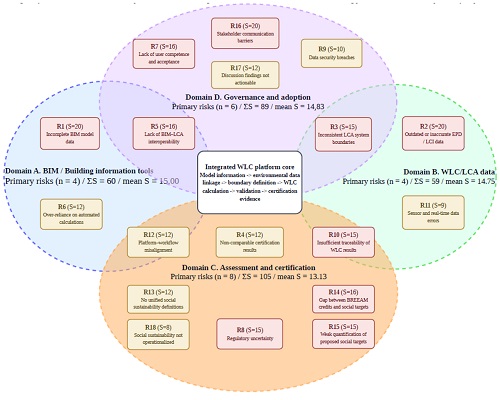
This paper examines the key risks associated with developing digital data systems for managing the carbon footprint of a building over its entire life cycle, or the total carbon dioxide emitted over a building’s entire life cycle. The analysis suggests that these platforms need to integrate 3D building models (BIM), environmental data, and digital building records. As modern research increasingly focuses on the total impact of a building over its entire life cycle, rather than just the carbon dioxide required to manufacture the structures, ensuring data integrity and consistency across multiple devices is becoming increasingly challenging. The literature identifies several key risks, including poor data quality, limited interoperability between software environments, and confusing legal regulations. Currently, the connection between 3D models and most studies, which rely on proprietary software ecosystems, is not fully automated: one recent review found that while some parts are automated, most studies still require manual data reconciliation, and most are stuck using proprietary software rather than open systems. There are also gaps in how product data and building models are synchronized, leading to tracking errors. On the legal side, research into digital building logs shows that it is often unclear who actually owns the data or who has access to it. Addressing these issues requires more than technological improvements alone. We need a solid plan for how data is handled, based on five ideas: using standard data formats, double-checking quality, being clear about what we are measuring, validating results across different tools, and rolling the system out in stages with proper training. The best way forward is to build a platform that reuses existing reliable datasets and carefully adds new project info, rather than attempting to implement an entirely new system without incremental validation. Certification schemes like BREEAM are a primary thing driving the requirement for reliable, integrated whole-life carbon (WLC) data, but this also inherits the data quality and interoperability risks inherent in connecting BIM, LCA, and product declaration systems.
Article Details

This work is licensed under a Creative Commons Attribution-NonCommercial 4.0 International License.
References
- Adewumi, A. S., Opoku, A., & Dangana, Z. (2024). Sustainability assessment frameworks for delivering Environmental, Social, and Governance (ESG) targets: A case of Building Research Establishment Environmental Assessment Method (BREEAM) UK New Construction. Corporate Social Responsibility and Environmental Management, 31(5), 3779–3791. Portico. https://doi.org/10.1002/csr.2768
- Almeida, R., Chaves, L., Silva, M., Carvalho, M., & Caldas, L. (2023). Integration between BIM and EPDs: Evaluation of the main difficulties and proposal of a framework based on ISO 19650:2018. Journal of Building Engineering, 68, 106091. https://doi.org/10.1016/j.jobe.2023.106091
- Alonso, R., Olivadese, R., Ibba, A., & Reforgiato Recupero, D. (2023). Towards the definition of a European Digital Building Logbook: A survey. Heliyon, 9(9), e19285. https://doi.org/10.1016/j.heliyon.2023.e19285
- Aragón, A., Spudys, P., Pupeikis, D., Nieto, Ó., & Garcia Alberti, M. (2025). Bridging Interoperability Gaps Between LCA and BIM: Analysis of Limitations for the Integration of EPD Data in IFC. Buildings, 15(15), 2760. https://doi.org/10.3390/buildings15152760
- Bolognesi, C., Bassorizzi, D., Balin, S., & Manfredi, V. (2025). An Overview on LCA Integration in BIM: Tools, Applications, and Future Trends. Digital, 5(3), 31. https://doi.org/10.3390/digital5030031
- Burgess, M., Wilson, C., & Fan, Y. V. (2026). Adoption drivers and barriers of Building Information Modelling (BIM) in Europe. Energy and Buildings, 355, 116953. https://doi.org/10.1016/j.enbuild.2026.116953
- Cabeza, L. F., Rincón, L., Vilariño, V., Pérez, G., & Castell, A. (2014). Life cycle assessment (LCA) and life cycle energy analysis (LCEA) of buildings and the building sector: A review. Renewable and Sustainable Energy Reviews, 29, 394–416. https://doi.org/10.1016/j.rser.2013.08.037
- Del Rosario, P., Palumbo, E., & Traverso, M. (2021). Environmental Product Declarations as Data Source for the Environmental Assessment of Buildings in the Context of Level(s) and DGNB: How Feasible Is Their Adoption? Sustainability, 13(11), 6143. https://doi.org/10.3390/su13116143
- Dempsey, N., Bramley, G., Power, S., & Brown, C. (2011). The social dimension of sustainable development: Defining urban social sustainability. Sustainable Development, 19(5), 289–300. Portico. https://doi.org/10.1002/sd.417
- Dixit, M. K. (2019). Life cycle recurrent embodied energy calculation of buildings: A review. Journal of Cleaner Production, 209, 731–754. https://doi.org/10.1016/j.jclepro.2018.10.230
- Feng, H., Zhao, J., Zhang, H., Zhu, S., Li, D., & Thurairajah, N. (2022). Uncertainties in whole-building life cycle assessment: A systematic review. Journal of Building Engineering, 50, 104191. https://doi.org/10.1016/j.jobe.2022.104191
- Ferreira, M. T. H. A., Aguiar Costa, A., & Silvestre, J. D. (2026). Integrating life cycle assessment and building information modelling: A purpose-driven approach. Journal of Building Engineering, 118, 115006. https://doi.org/10.1016/j.jobe.2025.115006
- Finnveden, G., Hauschild, M. Z., Ekvall, T., Guinée, J., Heijungs, R., Hellweg, S., Koehler, A., Pennington, D., & Suh, S. (2009). Recent developments in Life Cycle Assessment. Journal of Environmental Management, 91(1), 1–21. https://doi.org/10.1016/j.jenvman.2009.06.018
- Ghasemi, F., Sari, M. H. M., Yousefi, V., Falsafi, R., & Tamošaitienė, J. (2018). Project Portfolio Risk Identification and Analysis, Considering Project Risk Interactions and Using Bayesian Networks. Sustainability, 10(5), 1609. https://doi.org/10.3390/su10051609
- Gómez-Gil, M., Sesana, M. M., Salvalai, G., Espinosa-Fernández, A., & López-Mesa, B. (2023). The Digital Building Logbook as a gateway linked to existing national data sources: The cases of Spain and Italy. Journal of Building Engineering, 63, 105461. https://doi.org/10.1016/j.jobe.2022.105461
- Guízar Dena, A. J., García Hípola, M., & Fernández Bandera, C. (2026). A BIM–LCA Framework for Whole-Life Carbon Assessment Under EPBD: Scope Alignment, Functional Unit Robustness, and Cross-Tool Validation. Applied Sciences, 16(6), 2637. https://doi.org/10.3390/app16062637
- Hatefi, S. M., Ahmadi, H., & Tamošaitienė, J. (2025). Risk Assessment in Mass Housing Projects Using the Integrated Method of Fuzzy Shannon Entropy and Fuzzy EDAS. Sustainability, 17(2), 528. https://doi.org/10.3390/su17020528
- Heijungs, R., & Suh, S. (2002). The Computational Structure of Life Cycle Assessment. In (Editor), Eco-Efficiency in Industry and Science. Springer Netherlands. https://doi.org/10.1007/978-94-015-9900-9
- Hillson, D. (2002). Extending the risk process to manage opportunities. International Journal of Project Management, 20(3), 235–240. https://doi.org/10.1016/s0263-7863(01)00074-6
- International Organization for Standardization. (2006). ISO 14044:2006 Environmental management—Life cycle assessment—Requirements and guidelines. ISO.
- Janssen, C., & Basta, C. (2022). Are good intentions enough? Evaluating social sustainability in urban development projects through the capability approach. European Planning Studies, 32(2), 368–389. https://doi.org/10.1080/09654313.2022.2136936
- Karami, S., de Almeida, J.-P., Ellul, C., & Cardoso, A. (2025). Semantic mapping-based comparison of digital building LogBook and energy performance certificate models - envisaging data reuse. Developments in the Built Environment, 22, 100674. https://doi.org/10.1016/j.dibe.2025.100674
- Kookalani, S., Green, S., Luo, P., Alavi, H., Parn, E., Sun, Z., & Brilakis, I. (2026). Mapping digital twin applications in infrastructure and the built environment across research types, methods, sectors, phases, and scales. Automation in Construction, 182, 106778. https://doi.org/10.1016/j.autcon.2026.106778
- Larimian, T., & Sadeghi, A. (2019). Measuring urban social sustainability: Scale development and validation. Environment and Planning B: Urban Analytics and City Science, 48(4), 621–637. https://doi.org/10.1177/2399808319882950 % NOT USED
- Lenkevičius E., & Tamošaitiene J. (2026) Insights Into the Entire Building Life Cycle Assessment (LCA): Existing Trends, Challenges and Prospective Framework, Journal of Environmental Engineering and Landscape Management.
- Li, Q., Yang, W., Kohler, N., Yang, L., Li, J., Sun, Z., Yu, H., Liu, L., & Ren, J. (2023). A BIM–LCA Approach for the Whole Design Process of Green Buildings in the Chinese Context. Sustainability, 15(4), 3629. https://doi.org/10.3390/su15043629
- Li, X., Jiang, M., Lin, C., Chen, R., Weng, M., & Jim, C. Y. (2025). Integrated BIM-IoT platform for carbon emission assessment and tracking in prefabricated building materialization. Resources, Conservation and Recycling, 215, 108122. https://doi.org/10.1016/j.resconrec.2025.108122
- Lima, M. S. S., Duarte, S., Exenberger, H., Fröch, G., & Flora, M. (2024). Integrating BIM-LCA to Enhance Sustainability Assessments of Constructions. Sustainability, 16(3), 1172. https://doi.org/10.3390/su16031172
- Lu, Q., Xie, X., Parlikad, A. K., & Schooling, J. M. (2020). Digital twin-enabled anomaly detection for built asset monitoring in operation and maintenance. Automation in Construction, 118, 103277. https://doi.org/10.1016/j.autcon.2020.103277
- Marsh, E., Allen, S., & Hattam, L. (2023). Tackling uncertainty in life cycle assessments for the built environment: A review. Building and Environment, 231, 109941. https://doi.org/10.1016/j.buildenv.2022.109941
- Mêda, P., Calvetti, D., Sousa, H., & Moreira, J. (2024). Data Discovery for Digital Building Logbook (DBL): Directly Implementing and Enabling a Smarter Urban Built Environment. Urban Science, 8(4), 160. https://doi.org/10.3390/urbansci8040160
- Olanrewaju, O. I., Enegbuma, W. I., Donn, M., & Oyefusi, O. N. (2025). Assessment of environmental product declaration and databases: Towards ensuring data quality assurance practices. Environmental Impact Assessment Review, 112, 107803. https://doi.org/10.1016/j.eiar.2024.107803
- Olanrewaju, O. I., Enegbuma, W. I., & Donn, M. (2024). Operational, embodied and whole life cycle assessment credits in green building certification systems: Desktop analysis and natural language processing approach. Building and Environment, 258, 111569. https://doi.org/10.1016/j.buildenv.2024.111569
- Opoku, D.-G. J., Perera, S., Osei-Kyei, R., & Rashidi, M. (2021). Digital twin application in the construction industry: A literature review. Journal of Building Engineering, 40, 102726. https://doi.org/10.1016/j.jobe.2021.102726
- Otero, M. S., Garnica, T., Montilla, S., Conde, M., & Tenorio, J. A. (2023). Analysis of Sectoral Environmental Product Declarations as a Data Source for Life Cycle Assessment. Buildings, 13(12), 3032. https://doi.org/10.3390/buildings13123032
- Parece, S., Resende, R., & Rato, V. (2024). A BIM-based tool for embodied carbon assessment using a Construction Classification System. Developments in the Built Environment, 19, 100467. https://doi.org/10.1016/j.dibe.2024.100467
- Parece, S., Resende, R., & Rato, V. (2025). BIM-based life cycle assessment: A systematic review on automation and decision-making during design. Building and Environment, 282, 113248. https://doi.org/10.1016/j.buildenv.2025.113248
- Pomponi, F., & Moncaster, A. (2016). Embodied carbon mitigation and reduction in the built environment – What does the evidence say? Journal of Environmental Management, 181, 687–700. https://doi.org/10.1016/j.jenvman.2016.08.036
- Pärn, E., Ghadiminia, N., García de Soto, B., & Oti-Sarpong, K. (2024). A perfect storm: Digital twins, cybersecurity, and general contracting firms. Developments in the Built Environment, 18, 100466. https://doi.org/10.1016/j.dibe.2024.100466
- Sacks, R., Eastman, C., Lee, G., & Teicholz, P. (2018). BIM Handbook. https://doi.org/10.1002/9781119287568
- Seddiki, M., & Bennadji, A. (2026). Stakeholders’ Perceptions of Barriers, Benefits, and Drivers for Digital Building Logbook Adoption in Building Renovation Projects in Europe. Sustainability, 18(6), 2688. https://doi.org/10.3390/su18062688
- Strelets, K., Zaborova, D., Kokaya, D., Petrochenko, M., & Melekhin, E. (2025). Building Information Modeling (BIM)-Based Building Life Cycle Assessment (LCA) Using Industry Foundation Classes (IFC) File Format. Sustainability, 17(7), 2848. https://doi.org/10.3390/su17072848
- Tamošaitienė, J., Khosravi, M., Cristofaro, M., Chan, D. W. M., & Sarvari, H. (2021). Identification and Prioritization of Critical Risk Factors of Commercial and Recreational Complex Building Projects: A Delphi Study Using the TOPSIS Method. Applied Sciences, 11(17), 7906. https://doi.org/10.3390/app11177906
- Teng, Y., Xu, J., Pan, W., & Zhang, Y. (2022). A systematic review of the integration of building information modeling into life cycle assessment. Building and Environment, 221, 109260. https://doi.org/10.1016/j.buildenv.2022.109260
- Volk, R., Stengel, J., & Schultmann, F. (2014). Building Information Modeling (BIM) for existing buildings — Literature review and future needs. Automation in Construction, 38, 109–127. https://doi.org/10.1016/j.autcon.2013.10.023
- Xu, J., Teng, Y., Pan, W., & Zhang, Y. (2022). BIM-integrated LCA to automate embodied carbon assessment of prefabricated buildings. Journal of Cleaner Production, 374, 133894. https://doi.org/10.1016/j.jclepro.2022.133894
- Xu, J., Zhang, Q., Teng, Y., & Pan, W. (2023). Integrating IoT and BIM for tracking and visualising embodied carbon of prefabricated buildings. Building and Environment, 242, 110492. https://doi.org/10.1016/j.buildenv.2023.110492
- Yao, D., & García de Soto, B. (2024). Assessing cyber risks in construction projects: A machine learning-centric approach. Developments in the Built Environment, 20, 100570. https://doi.org/10.1016/j.dibe.2024.100570
- Zavadskas, E. K., Turskis, Z., & Tamošaitienė, J. (2010). https://journals.vgtu.lt/index.php/JCEM/article/view/5898. Journal of Civil Engineering and Management, 16(1), 33–46. https://doi.org/10.3846/jcem.2010.03
- Železná, J., Felicioni, L., Trubina, N., Vlasatá, B., Růžička, J., & Veselka, J. (2024). Whole Life Carbon Assessment of Buildings: The Process to Define Czech National Benchmarks. Buildings, 14(7), 1936. https://doi.org/10.3390/buildings14071936
- Zhao, Y., Zhang, Y., Wu, X., Wen, X., Chen, C., Teng, Y., & Lau, M. P. B. (2026). A Blockchain-Integrated IoT–BIM Platform for Real-Time Carbon Monitoring in Modular Integrated Construction. Buildings, 16(8), 1587. https://doi.org/10.3390/buildings16081587
- Zou, P. X. W., Zhang, G., & Wang, J. (2007). Understanding the key risks in construction projects in China. International Journal of Project Management, 25(6), 601–614. https://doi.org/10.1016/j.ijproman.2007.03.001
- Zou, Y., Ren, Z., Wang, L., Lei, Q., Li, X., Liang, T., & Chen, W. (2026). A BIM-Based Workflow for Early-Stage Embodied Carbon Assessment Using Reusable Assembly Templates and Rule-Based Mapping. Buildings, 16(4), 710. https://doi.org/10.3390/buildings16040710
