
Heavy Metal Contamination and Ecological Risk Assessment of Soils Around Mzedi Municipal Dumpsite, Blantyre, Malawi: Implications for Food Safety in Subsistence Farming Areas
Article Sidebar
Main Article Content


Abstract
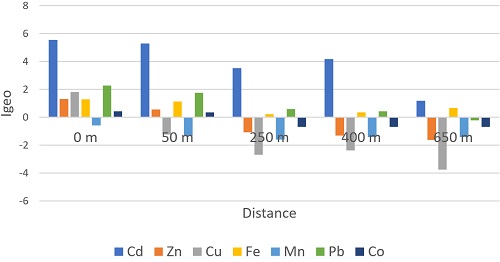
Uncontrolled disposal of municipal solid waste is a growing environmental concern in developing countries, contributing to heavy metal accumulation in surrounding soils and water. This study assessed the concentrations, spatial distribution, and ecological risks of heavy metals around the Mzedi municipal dumpsite in Blantyre, Malawi. Composite soil samples were collected at 0 m, 50 m, 250 m, 400 m, and 650 m from the dumpsite, while surface water samples were taken from a nearby stream receiving runoff. Samples were analyzed for cadmium (Cd), zinc (Zn), copper (Cu), iron (Fe), manganese (Mn), lead (Pb), and cobalt (Co) using atomic absorption spectrophotometry. Contamination and risk levels were evaluated using the Contamination Factor (CF), Geo-accumulation Index (Igeo), Enrichment Factor (EF), and Potential Ecological Risk Index (PERI). Soil metal concentrations decreased with distance from the dumpsite in the order Fe > Mn > Zn > Cu > Pb > Cd > Co. Cadmium exhibited the highest contamination levels, with CF (70.00), Igeo (5.54), and EF (19.17) at 0 m indicating extremely polluted conditions and severe anthropogenic enrichment. PERI values ranged from 2,181 at 0 m to 117 at 650 m, shifting from very high to low ecological risk. Cadmium contributed > 96% of the total ecological risk, confirming it as the dominant contributor to ecological risk. In surface water, Cd (0.006–0.008 mg/L) and Pb (0.025–0.030 mg/L) exceeded WHO drinking water guidelines, confirming leachate-driven contamination of the adjacent stream. While crop metal concentrations were not directly measured, the elevated soil cadmium levels indicate potential for plant uptake and possible human exposure. However, without direct crop analysis, we cannot confirm the extent of food chain transfer, quantify dietary exposure, or assess compliance with food safety standards. This highlights the critical need for targeted crop monitoring studies to validate the inferred human health risks. This study provides the first comprehensive quantitative assessment of ecological risk at the Mzedi dumpsite using multiple contamination indices and robust statistical analysis. The findings support precautionary management measures, including restrictions on farming directly on the dumpsite, upgrading of waste disposal infrastructure, and community awareness programs.
Article Details

This work is licensed under a Creative Commons Attribution-NonCommercial 4.0 International License.
References
- Ferronato N, Torretta V. Waste Mismanagement in Developing Countries: A Review of Global Issues. International Journal of Environmental Research and Public Health. 2019, 16(6): 1060. https://doi.org/10.3390/ijerph16061060
- George MA, Leshota Q, Thoala S. Assessment of groundwater quality near a dumpsite and evaluation of human health risk in southeast Maseru, Lesotho. Discover Water. 2025, 5(1). https://doi.org/10.1007/s43832-025-00274-2
- Sabir M, Baltrėnaitė-Gedienė E, Ditta A, et al. Bioaccumulation of Heavy Metals in a Soil–Plant System from an Open Dumpsite and the Associated Health Risks through Multiple Routes. Sustainability. 2022, 14(20): 13223. https://doi.org/10.3390/su142013223
- Bayata A. Assessment, Accumulation, Toxicity and Importance of Heavy Metals in Agricultural Soil and Living System - Review. American Journal of Environmental Protection. 2020, 9(6): 121. https://doi.org/10.11648/j.ajep.20200906.11
- Adeyemo A, Morenikeji OA. Helminths and heavy metals in soils from a dumpsite in Ibadan city, Nigeria. Journal of Preventive Medicine and Hygiene. 2017, 58: 328-333. https://doi.org/10.15167/2421-4248/jpmh2017.58.4.608
- Rashid A, Schutte BJ, Ulery A, et al. Heavy Metal Contamination in Agricultural Soil: Environmental Pollutants Affecting Crop Health. Agronomy. 2023, 13(6): 1521. https://doi.org/10.3390/agronomy13061521
- Nkop EJ, Ogunmolasuyi AM, Osezua KO, et al. Comparative study of heavy metals in the soil around waste dump sites within University of Uyo. Archives of Applied Science Research. 2016, 8(3): 11-15.
- Njagi JM, Akunga DN, Njagi MM, et al. Heavy metal pollution of the environment by dumpsites: a case of Kadhodeki Dumpsite. Institute of International Journal of Life Sciences. 2016, 2(2): 191-197.
- Esmaeilzadeh M, Mahmodpor E, Haghighat S, et al. Contamination and ecological risk assessment of trace elements in sediments of the Anzali Wetland, Northern Iran. Water Science and Technology. 2021, 84(9): 2578-2590. https://doi.org/10.2166/wst.2021.455
- Kalina M, Tilley E. ‘BAD’ Trash: Problematising Waste in Blantyre, Malawi. Detritus. 2020, (12): 187-200. https://doi.org/10.31025/2611-4135/2020.13994
- Republic of Malawi, Blantyre Water Board, Blantyre City Council. Consultancy Services for Detailed Design and Construction Supervision of Solid Waste Recycling Facility and Engineered Landfill in Blantyre City. Blantyre: Malawi Water and Sanitation Project-1 (MWSP-1), 2023.
- American Public Health Association. Standard Methods for the Examination of Water and Wastewater. American Public Health Association, 2017.
- Mlangeni AT, Raab A, Kumambala P, et al. Evaluation of Metal(loids) Concentrations in Soils of Selected Rice Paddy Fields in Malawi. Agronomy. 2022, 12(10): 2349. https://doi.org/10.3390/agronomy12102349
- Dzinjalamala GD, Kaonga CC, Kumwenda S, et al. Human health risk assessment of microbial contamination and trace metals in water and soils of Chileka Township, Blantyre, Malawi. Discover Environment. 2024, 2(1). https://doi.org/10.1007/s44274-024-00096-4
- Li G, Chen R, Li Z, et al. Ecological Risk and Human Health Assessment of Heavy Metals in Sediments of Datong Lake. Toxics. 2025, 13(7): 560. https://doi.org/10.3390/toxics13070560
- Rozirwan R, Az-Zahra SAF, Khotimah NN, et al. Ecological Risk Assessment of Heavy Metal (Pb, Cu) Contamination in Water, Sediment, and Polychaeta (Neoleanira Tetragona) from Coastal Areas Affected by Aquaculture, Urban Rivers, and Ports in South Sumatra. Journal of Ecological Engineering. 2024, 25(1): 303-319. https://doi.org/10.12911/22998993/175365
- Muller G. Index of geoaccumulation in sediments of the Rhine River. 1969. GEO Journal. 1969, 2(3): 108-118. https://sid.ir/paper/618491/en
- Hakanson L. An ecological risk index for aquatic pollution control.a sedimentological approach. Water Research. 1980, 14(8): 975-1001. https://doi.org/10.1016/0043-1354(80)90143-8
- Faroon O, Ashizawa A, Wright S, et al. Toxicological Profile for Cadmium. Agency for Toxic Substances and Disease Registry (US), Atlanta (GA). 2012. PMID: 24049863.
- Saheed IO, Azeez SO, Jimoh AA, et al. Assessment of some heavy metals concentrations in soil and groundwater around refuse dumpsite in Ibadan Metropolis, Nigeria. Nigerian Journal of Technology. 2020, 39(1): 301-305. https://doi.org/10.4314/njt.v39i1.33
- Edition F. Guidelines for drinking-water quality. WHO chronicle. 2011, 38(4): 104-8.
- Grimason AM, Morse TD, Beattie TK, et al. Classification and quality of groundwater supplies in the Lower Shire Valley, Malawi–Part 1: Physico-chemical quality of borehole water supplies in Chikhwawa, Malawi. Water SA. 2013, 39(4): 563-572. https://doi.org/10.4314/wsa.v39i4.16
- Qadir M, Wichelns D, Raschid-Sally L, et al. The challenges of wastewater irrigation in developing countries. Agricultural Water Management. 2010, 97(4): 561-568. https://doi.org/10.1016/j.agwat.2008.11.004
- Lente I, Ofosu-Anim J, Brimah AK, et al. Heavy metal pollution of vegetable crops irrigated with wastewater 41 Heavy Metal Pollution of Vegetable Crops Irrigated with Wastewater in Accra, Ghana. West African Journal of Applied Ecology. 2014, 22(1): 41-58.
- Obasohan EE, Oronsaye JAO, Obano EE. Heavy metal concentrations in Malapterurus electricus and Chrysichthys nigrodigitatus from Ogba River in Benin City, Nigeria. African Journal of Biotechnology. 2006, 5(10): 974-982.
- Addo-Bediako A. Effects of trace elements on benthic macroinvertebrate distribution in the sediments of two rivers in the Olifants River Basin, South Africa. Journal of Freshwater Ecology. 2023, 38(1). https://doi.org/10.1080/02705060.2023.2172084
- Ne O, Jc I, EC O. Risk and health implications of polluted soils for crop production. African Journal of Biotechnology. 2005, 4(13): 1521-1524. https://www.academicjournals.org/AJB
- Zaynab M, Al-Yahyai R, Ameen A, et al. Health and environmental effects of heavy metals. Journal of King Saud University - Science. 2022, 34(1): 101653. https://doi.org/10.1016/j.jksus.2021.101653
- Mwakalapa EB, Simukoko CK, Mmochi AJ, et al. Heavy metals in farmed and wild milkfish (Chanos chanos) and wild mullet (Mugil cephalus) along the coasts of Tanzania and associated health risk for humans and fish. Chemosphere. 2019, 224: 176-186. https://doi.org/10.1016/j.chemosphere.2019.02.063
- Mansour SA, Sidky MM. Ecotoxicological Studies. 3. Heavy metals contaminating water and fish from Fayoum Governorate, Egypt. Food Chemistry. 2002, 78(1): 15-22. https://doi.org/10.1016/s0308-8146(01)00197-2
- Edogbo B, Okolocha E, Maikai B, et al. Risk analysis of heavy metal contamination in soil, vegetables and fish around Challawa area in Kano State, Nigeria. Scientific African. 2020, 7: e00281. https://doi.org/10.1016/j.sciaf.2020.e00281
- Sanga VF, Pius CF. Heavy metal contamination in soil and food crops and associated human health risks in the vicinity of Iringa Municipal dumpsite, Tanzania. Discover Environment. 2024, 2(1). https://doi.org/10.1007/s44274-024-00137-y
- Ogu G, O. Ojiego B, Bello Z, et al. Health risk of some metals in maize grains cultivated close to Gosa and Gwagwalada solid waste dumpsites. Andalasian International Journal of Applied Science, Engineering and Technology. 2022, 2(03): 159-171. https://doi.org/10.25077/aijaset.v2i03.59
- Awuah E. Heavy metals uptake by vegetables cultivated on urban waste dumpsites: case study of Kumasi, Ghana. Research Journal of Environmental Toxicology, 2008.
- Awino FB. Weighing the pros and cons of dumpsite food production: nutrients and pollutants in edible crops. Environmental Monitoring and Assessment, 2026, 198(1): 34. https://doi.org/10.1007/s10661-025-14809-6
