
Vitamin D Status and Associated Factors among Children and Adolescents with Epilepsy in the Watsa Health Zone, Democratic Republic of the Congo
Article Sidebar
Main Article Content


Abstract
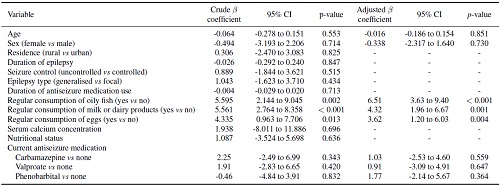
Background: Vitamin D deficiency has been increasingly recognised among children and adolescents with epilepsy, particularly in low-resource settings, where disease-related factors, antiepileptic treatments, and nutritional deficiencies may contribute to reduced serum levels. This study aimed to assess vitamin D status and identify associated factors in children and adolescents with epilepsy in Watsa health zone, Democratic Republic of the Congo. Methods: A cross-sectional study was conducted among 43 children and adolescents with epilepsy. Sociodemographic, clinical, nutritional, and treatment-related data were collected. Serum 25-hydroxyvitamin D [25(OH)D] and calcium levels were measured. Associations were explored using bivariate analyses, correlation tests, and multivariable linear regression models. Results: The mean age was 11.2 ± 6.3 years, and 55.8% were male. Most participants (60.5%) had uncontrolled seizures. Vitamin D insufficiency was highly prevalent (69.8%), while 25.6% had deficiency; only 4.7% had normal levels. Mean serum 25(OH)D was 23.5 ± 4.3 ng/mL. In bivariate analysis, fish (p = 0.002), milk (p < 0.001), and egg consumption (p = 0.013) were associated with higher vitamin D levels. No associations were found with age, sex, epilepsy characteristics, treatment, or calcium levels. In multivariable analysis, fish (β = 6.51; p < 0.001), milk (β = 4.32; p = 0.001), and eggs (β = 3.62; p = 0.004) remained independent predictors of higher serum 25(OH)D. Conclusion: Vitamin D insufficiency is highly prevalent among children and adolescents with epilepsy in Watsa health zone. Dietary intake of fish, milk, and eggs appears to be the main modifiable determinant of serum 25(OH)D levels, highlighting the importance of targeted nutritional interventions in this population.
Article Details

This work is licensed under a Creative Commons Attribution-NonCommercial 4.0 International License.
References
- World Health Organization. Epilepsy -– Fact sheet. 2024. https://www.who.int
- Kaputu-Kalala-Malu C. Epilepsies et crises épileptiques aiguës chez l’enfant en Afrique subsaharienne: défis et espoirs. Pan African Medical Journal. 2016, 23. https://doi.org/10.11604/pamj.2016.23.58.3273
- Holmes GL. Drug Treatment of Epilepsy Neuropsychiatric Comorbidities in Children. Pediatric Drugs. 2020, 23(1): 55-73. https://doi.org/10.1007/s40272-020-00428-w
- Nickels KC, Zaccariello MJ, Hamiwka LD, et al. Cognitive and neurodevelopmental comorbidities in paediatric epilepsy. Nature Reviews Neurology. 2016, 12(8): 465-476. https://doi.org/10.1038/nrneurol.2016.98
- Mukuku O, Nawej P, Bugeme M, et al. Epidemiology of Epilepsy in Lubumbashi, Democratic Republic of Congo. Neurology Research International. 2020, 2020: 1-5. https://doi.org/10.1155/2020/5621461
- Liu J, Li J, Liu Y, et al. Preventive effects of vitamin D on epileptic seizures and its regulation of PTEN and autophagy in acute epilepsy mouse models. Nutritional Neuroscience. 2025, 29(6): 688-709. https://doi.org/10.1080/1028415x.2025.2592265
- Griepp DW, Kim DJ, Ganz M, et al. The effects of antiepileptic drugs on bone health: A systematic review. Epilepsy Research. 2021, 173: 106619. https://doi.org/10.1016/j.eplepsyres.2021.106619
- Gupta Y, Arora E, Singh H. Impact of antiepileptic drugs on bone health: Need for monitoring, treatment, and prevention strategies. Journal of Family Medicine and Primary Care. 2016, 5(2): 248. https://doi.org/10.4103/2249-4863.192338
- Durá-Travé T, Gallinas-Victoriano F, Malumbres-Chacón M, et al. Vitamin D deficiency in children with epilepsy taking valproate and levetiracetam as monotherapy. Epilepsy Research. 2018, 139: 80-84. https://doi.org/10.1016/j.eplepsyres.2017.11.013
- Abdullah AT, Mousheer ZT. Vitamin D status in epileptic children on valproic acid; a case-control study. Archives of academic emergency medicine. 2020, 8(1): e13.
- Bezboruah G, Kalita S. Serum vitamin D status in children with epilepsy on antiepileptic drugs and its relation to the frequency of breakthrough seizures. International Journal of Contemporary Pediatrics. 2023, 10(8): 1262-1267. https://doi.org/10.18203/2349-3291.ijcp20232246
- Al Shaikh AM, Abaalkhail B, Soliman A, et al. Prevalence of Vitamin D Deficiency and Calcium Homeostasis in Saudi Children. Journal of Clinical Research in Pediatric Endocrinology. 2016, 8(4): 461-467. https://doi.org/10.4274/jcrpe.3301
- Likasitthananon N, Nabangchang C, Simasathien T, et al. Hypovitaminosis D and risk factors in pediatric epilepsy children. BMC Pediatrics. 2021, 21(1). https://doi.org/10.1186/s12887-021-02906-7
- Dong N, Guo H-L, Hu Y-H, et al. Association between serum vitamin D status and the anti-seizure treatment in Chinese children with epilepsy. Frontiers in Nutrition. 2022, 9. https://doi.org/10.3389/fnut.2022.968868
- Bezboruah G, Kalita S. Serum vitamin D status in children with epilepsy on antiepileptic drugs and its relation to the frequency of breakthrough seizures. International Journal of Contemporary Pediatrics. 2023, 10(8): 1262–1267. https://doi.org/10.18203/2349-3291.ijcp20232246
- Guo H-L, Sun X-L, Xu Y-Y, et al. An elusive causal link between epilepsy and vitamin D in children: More questions than answers? A narrative review. Neurobiology of Disease. 2025, 213: 107022. https://doi.org/10.1016/j.nbd.2025.107022
- Pattnaik SS, Sarangi SC, Dash Y, et al. Role of vitamin D supplementation and vitamin D receptor in drug‐resistant epilepsy: A double‐blind placebo-controlled trial conducted in India. Epilepsia. 2025, 66(10): 3716-3729. https://doi.org/10.1111/epi.18492
- Chassoux F, Navarro V, Quirins M, et al. Vitamin D deficiency and effect of treatment on seizure frequency and quality of life parameters in patients with drug-resistant epilepsy: A randomized clinical trial. Epilepsia. 2024, 65(9): 2612-2625. https://doi.org/10.1111/epi.18050
- Holló A, Clemens Z, Kamondi A, et al. Correction of vitamin D deficiency improves seizure control in epilepsy: A pilot study. Epilepsy & Behavior. 2012, 24(1): 131-133. https://doi.org/10.1016/j.yebeh.2012.03.011
- Sulena S, Parkash I, Bansal PD, et al. Impact of Vitamin D3 Deficiency on Quality of Life in Epilepsy: A Call for Routine Screening and Intervention. International Journal of Epilepsy. 2025, 11(01): 023-032. https://doi.org/10.1055/s-0044-1800960
- Liu Y, Gong C, Li J, et al. Vitamin D content and prevalence of vitamin D deficiency in patients with epilepsy: a systematic review and meta-analysis. Frontiers in Nutrition. 2024, 11. https://doi.org/10.3389/fnut.2024.1439279
- Holick MF, Binkley NC, Bischoff-Ferrari HA, et al. Evaluation, Treatment, and Prevention of Vitamin D Deficiency: an Endocrine Society Clinical Practice Guideline. The Journal of Clinical Endocrinology & Metabolism. 2011, 96(7): 1911-1930. https://doi.org/10.1210/jc.2011-0385
- Lisimo HA, Mukuku O, Polepole FM, et al. A Pragmatic Framework for Risk-Based Vitamin D Supplementation in Epilepsy Care in Sub-Saharan Africa. Advances in General Practice of Medicine. 2026, 7(1): 9-15. https://doi.org/10.25082/agpm.2026.01.002
- Fong CY, Kong AN, Poh BK, et al. Vitamin D deficiency and its risk factors in Malaysian children with epilepsy. Epilepsia. 2016, 57(8): 1271-1279. https://doi.org/10.1111/epi.13443
- Baek J-H, Seo Y-H, Kim G-H, et al. Vitamin D Levels in Children and Adolescents with Antiepileptic Drug Treatment. Yonsei Medical Journal. 2014, 55(2): 417. https://doi.org/10.3349/ymj.2014.55.2.417
- Holick MF. Vitamin D Deficiency. New England Journal of Medicine. 2007, 357(3): 266-281. https://doi.org/10.1056/nejmra070553
- Saing JH, Sari DK, Supriatmo S, et al. Neuroprotective and inflammatory biomarkers in pediatric drug-resistant epilepsy: Interplay between GDNF, IL-1$beta$ and vitamin D 25-OH. Narra J. 2024, 4(3): e1581. https://doi.org/10.52225/narra.v4i3.1581
- Demay MB, Pittas AG, Bikle DD, et al. Vitamin D for the Prevention of Disease: An Endocrine Society Clinical Practice Guideline. The Journal of Clinical Endocrinology & Metabolism. 2024, 109(8): 1907-1947. https://doi.org/10.1210/clinem/dgae290
- Braegger C, Campoy C, Colomb V, et al. Vitamin D in the Healthy European Paediatric Population. Journal of Pediatric Gastroenterology and Nutrition. 2013, 56(6): 692-701. https://doi.org/10.1097/mpg.0b013e31828f3c05
