
Reading Habits and English Language Achievement among Grade Six Students in a Nepalese Community School: A Correlational Study
Article Sidebar
Main Article Content


Abstract
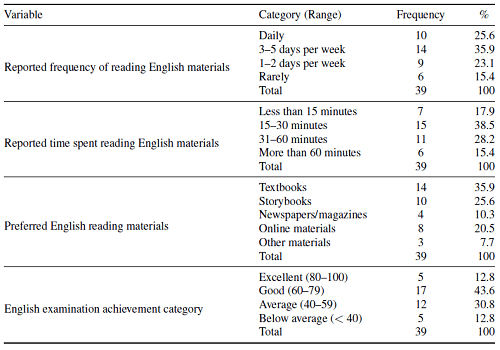
Reading gives learners opportunities to encounter vocabulary, sentence patterns, and ideas beyond those presented in lessons. This study examined the reading habits of Grade Six students and the association between their reading habits and English language achievement at a community school in Makwanpur district, Nepal. A quantitative, non-experimental correlational design was used. The study included all 39 students enrolled in Grade Six at the participating school. Data were collected through a structured questionnaire on reading habits and English examination scores obtained from school records. Frequencies, percentages, means, standard deviations, and Pearson’s product–moment correlation were used to analyse the data. Textbooks were the most commonly selected reading material (35.9%), followed by storybooks (25.6%) and online materials (20.5%). Reading three to five days per week was the most frequently reported routine (35.9%), while 25.6% of students reported reading every day. The mean reading-habit score was 3.23 (SD = 0.74). A positive and statistically significant correlation was found between reading-habit scores and English examination scores, r(37) = 0.64, p < 0.001. The findings indicate that students who reported stronger reading habits tended to achieve higher English examination scores. The study highlights the importance of providing regular opportunities to read accessible English materials in basic-level education.
Article Details

This work is licensed under a Creative Commons Attribution-NonCommercial 4.0 International License.
References
- Grabe W. Reading in a second language: Moving from theory to practice. Cambridge University Press. https://doi.org/10.1017/cbo9781139150484
- Nation ISP. Teaching ESL/EFL Reading and Writing. Routledge, 2008. https://doi.org/10.4324/9780203891643
- Schiefele U, Schaffner E, Möller J, et al. Dimensions of Reading Motivation and Their Relation to Reading Behavior and Competence. Nolen S, Baker L, eds. Reading Research Quarterly. 2012, 47(4): 427-463. https://doi.org/10.1002/rrq.030
- Petscher Y. A meta-analysis of the relationship between student attitudes towards reading and achievement in reading. Journal of Research in Reading. 2009, 33(4): 335-355. https://doi.org/10.1111/j.1467-9817.2009.01418.x
- Nakanishi T. A Meta-Analysis of Extensive Reading Research. TESOL Quarterly. 2014, 49(1): 6-37. https://doi.org/10.1002/tesq.157
- Jeon E-Y, Day RR. The effectiveness of ER on reading proficiency: A meta-analysis. Reading in a Foreign Language. 2016, 28(2): 246-265. https://doi.org/10.64152/10125/66901
- Sangers NL, van der Sande L, Welie C, et al. Learning a Language Through Reading: A Meta-analysis of Studies on the Effects of Extensive Reading on Second and Foreign Language Learning. Educational Psychology Review. 2025, 37(4). https://doi.org/10.1007/s10648-025-10068-6
- Zhang S, Zhang X. The relationship between vocabulary knowledge and L2 reading/listening comprehension: A meta-analysis. Language Teaching Research. 2020, 26(4): 696-725. https://doi.org/10.1177/1362168820913998
- Horst M. Learning L2 Vocabulary through Extensive Reading: A Measurement Study. The Canadian Modern Language Review. 2005, 61(3): 355-382. https://doi.org/10.3138/cmlr.61.3.355
- Pigada M, Schmitt N. Vocabulary acquisition from extensive reading: A case study. Reading in a Foreign Language. 2006, 18(1): 1-28. https://doi.org/10.64152/10125/66611
- Laufer B, Rozovski-Roitblat B. Retention of new words: Quantity of encounters, quality of task, and degree of knowledge. Language Teaching Research. 2014, 19(6): 687-711. https://doi.org/10.1177/1362168814559797
- Adhikari S. inquiry into Reading Habit of Bachelor Level Students: A Case Study of Mahendra Multiple Campus, Nepalguj. Voice: A Biannual & Bilingual Journal. 2023, 15(2): 99-112. https://doi.org/10.3126/voice.v15i2.61454
- Dawadi, S. (2023). EFL students’ test preparation practices in the Nepalese context. European Journal of Educational and Social Sciences, 8(1), 44–63. https://doi.org/10.5281/zenodo.7853752
- Zhu T, Zhang Y, Irwin D. Second and Foreign Language Vocabulary Learning through Digital Reading: A Meta-Analysis. Education and Information Technologies. 2023, 29(4): 4531-4563. https://doi.org/10.1007/s10639-023-11969-1
- Qian DD. Investigating the relationship between vocabulary knowledge and academic reading performance: An assessment perspective. Language Learning. 2002, 52(3): 513-536. https://doi.org/10.1111/0023-8333.00136
- Stæhr LS. Vocabulary size and the skills of listening, reading and writing. Language Learning Journal. 2008, 36(2): 139-152. https://doi.org/10.1080/09571730802389975
- Day RR, Bamford J, Renandya WA, et al. Extensive Reading in the Second Language Classroom. RELC Journal. 1998, 29(2): 187-191. https://doi.org/10.1177/003368829802900211
- Liu J, Zhang J. The Effects of Extensive Reading on English Vocabulary Learning: A Meta-analysis. English Language Teaching. 2018, 11(6): 1. https://doi.org/10.5539/elt.v11n6p1
- Mol SE, Bus AG. To read or not to read: A meta-analysis of print exposure from infancy to early adulthood. Psychological Bulletin. 2011, 137(2): 267-296. https://doi.org/10.1037/a0021890
- Stanovich KE. Matthew Effects in Reading: Some Consequences of Individual Differences in the Acquisition of Literacy. Reading Research Quarterly. 1986, 21(4): 360-407. https://doi.org/10.1598/rrq.21.4.1
- Guthrie JT, Wigfield A, Barbosa P, et al. Increasing Reading Comprehension and Engagement Through Concept-Oriented Reading Instruction. Journal of Educational Psychology. 2004, 96(3): 403-423. https://doi.org/10.1037/0022-0663.96.3.403
- Anderson RC, Pearson PD. A schema-theoretic view of basic processes in reading comprehension (Technical Report No. 306). Center for the Study of Reading, University of Illinois at Urbana-Champaign, 1984. https://hdl.handle.net/2142/31284
- Bista K. Teaching English as a foreign/second language in Nepal: Past and present. English for Specific Purposes World. 2011, 11(32): 1–9. https://eric.ed.gov/?id=ED530898
