
Vol 7 No 1 (2026)
Vol 7 No 1 (2026)
Published: 2026-06-01
Research Article
Pages 375-406
 Satish Prakash Chand
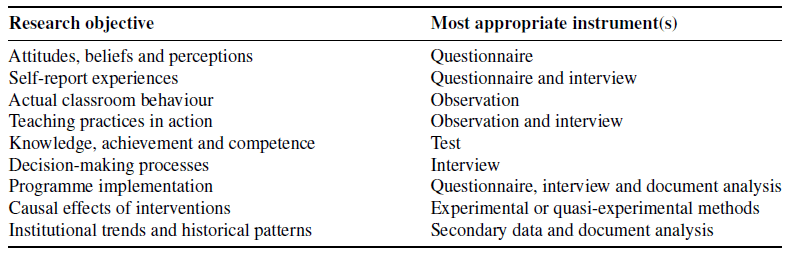
Questionnaires are among the most widely used data collection instruments in educational research because of their efficiency, scalability, standardisation, and capacity to generate data from large and diverse populations. Despite their widespread use, methodological guidance often focuses primarily on questionnaire construction while giving comparatively limited attention to the more fundamental question of whether questionnaires are the most appropriate instrument for addressing a particular research problem. Consequently, researchers may adopt questionnaires without adequately considering the nature of the research question, the characteristics of the construct being investigated, or the type of evidence required. This paper provides a comprehensive examination of questionnaires as data-collection instruments in educational research, addressing both the methodological question of when to use questionnaires and the practical question of how to design, validate, and implement them. Drawing on contemporary literature in educational research, survey methodology, and measurement theory, this paper examines instrument selection, construct-method alignment, self-report measurement, and the assumptions underlying questionnaire data. Particular attention is given to the conditions under which questionnaires are appropriate and the circumstances in which alternative or complementary methods may provide more valid evidence. This paper further discusses the questionnaire structure, item development, validity and reliability, ethical considerations, methodological challenges, and applications in educational research. It argues that questionnaire development should be viewed as a secondary methodological decision, following the prior determination that questionnaires are appropriate for the research objectives and constructs under investigation. The paper further emphasises that methodological rigour depends not only on questionnaire design but also on informed instrument selection, systematic validation, ethical practice, and responsible interpretation of the findings. By integrating theoretical perspectives with practical guidance, this paper provides a framework for determining when questionnaires should be used, how they should be developed, and how their findings should be interpreted in educational research.
