Aims and Scope

ReviewerCreditsResources and Environmental Economics (REE) (eISSN:2630-4457) is an international peer-reviewed journal to discuss, analyze and evaluate the trend of resources economics and environmental economics. With the deterioration of resource shortage and polluted environment, this journal encourages to apply economic theory and method to natural issues. Submissions of original research, review article, commentary, perspective, opinion, as well as critical article in the field addressed would all be welcomed.

Topics of interest include, but are not limited to, the following:
• Resources economics
• Environmental economics
• Sustainable development
• Policy formulation, impact and response
• Management strategies
• Environmental quality indicators
• Modelling and simulation
• Renewable energy commercialization
• Environmental certification and audit

Vol 6 No 1 (2026)

Published: 2026-01-13

Abstract views: 0   PDF downloads: 0  
2026-03-12

Pages 29-54

Teaching AI with Vysikaylo’s Cumulative Political Economy: A Model of States as Social Cumulative-Dissipative Systems and Population Dynamics

blankpage Philipp Ivanovich Vysikaylo

Purpose: This study applies Vysikaylo's paradigm of cumulative-dissipative systems (CDS), originally developed in physics, to the analysis of socio-economic and political processes in states. CDS theory describes open systems in which convective cumulation and dissipation of energy--mass--momentum fluxes (EMMF) occur. The purpose of this research is to reinterpret classical political economy through the CDS framework by modeling the processes of accumulation, transformation, and dissipation of human and economic potential in states using approaches derived from natural statistical sciences.
Methods: Political and economic phenomena--including the cumulation, transformation, and dissipation of capital and social resources--are modeled using mathematical analogies with physical CDS systems. The study introduces androgenic and gynogenic configurators to represent structural mechanisms in economic systems. Two generalized principles are applied: (1) Lomonosov's conservation law (later experimentally confirmed by Lavoisier), and (2) Clausius's Virial Theorem, according to which only part of the potential energy entering a partially open system remains within it while the rest dissipates into the surrounding environment. Dynamic Order Parameters (PDO) are proposed to quantify systemic dynamics in states viewed as living social CDS systems.
Results: The analysis suggests that similar mechanisms of co-organization observed in physical CDS systems also occur in socio-economic structures, including the circulation of capital, resources, and human potential. When the systemic balance between accumulation and dissipation is disrupted, structural crises, institutional instability, or state transformation may occur. The proposed PDO framework enables quantitative assessment of systemic stability and provides analytical tools for evaluating policies aimed at sustaining state development.
Conclusion: Adjustments in the distribution of national production between elites and the broader population, together with economic policy instruments such as customs duties and industrial protection measures, may contribute to the stabilization and revitalization of weakening states. The CDS-based framework also allows demographic and migration dynamics to be analytically evaluated. Case analyses of Russia, Spain, France, Germany, and the United States illustrate the applicability of the proposed approach. The integration of CDS theory with socio-economic analysis offers a potential foundation for further development of a systematic "science of law" governing social CDS systems.

Abstract views: 296   PDF downloads: 48  
2026-03-02

Pages 18-28

Balancing the Scales: The Impact of Externalities on Environmental Markets and the Role of Government Policies

blankpage Muhammad Tayyab Shafi, Noor Zulfiqar, Fawad Inam

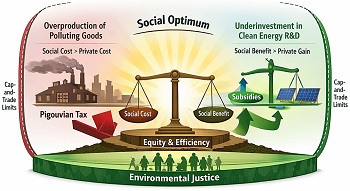
This article explores the critical role of externalities both positive and negative in shaping environmental market dynamics and influencing resource allocation. Positive externalities such as clean energy innovation and public education often lead to underinvestment in beneficial activities due to unaccounted societal gains. Conversely, negative externalities like industrial pollution, deforestation, and overfishing result in market overproduction, imposing environmental and health costs on society. The article assesses various government interventions subsidies, public provision, patent systems, regulations, Pigouvian taxes, and market-based instruments like cap-and-trade to correct these market failures. Drawing on empirical evidence and theoretical frameworks, it evaluates the effectiveness of such policies in promoting sustainability, innovation, and equitable outcomes. Ultimately, the study emphasizes the necessity of well-designed and targeted government action to internalize external costs and benefits, enabling efficient, equitable, and environmentally sustainable market operations.

Abstract views: 1691   PDF downloads: 183  
2026-01-13

Pages 1-17

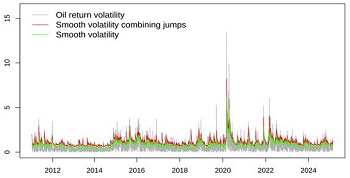
Global Oil Price Jumps and China’s New Energy Sector: New Evidence from Dynamic Volatility Models

blankpage Chuanguo Zhang, Yujie Du

Intensifying geopolitical tensions have recently amplified fluctuations in global crude oil prices, where abrupt price jumps often transmit complex spillovers across energy markets. This paper investigates the asymmetric, heterogeneous, and lagged impacts of oil price jump shocks on China's new energy industry at both aggregate and sub-industry levels spanning the full upstream-midstream-downstream industrial chain. Using an ARMA-EGARCH-ARJI framework, global oil price dynamics are modeled to capture volatility clustering and discrete jumps, while expected/unexpected and lag structures are applied to examine asymmetric and delayed responses. The results reveal a unique asymmetric pattern of dual inhibition/promotion: both expected increases and decreases in oil prices suppress new energy returns, whereas unexpected jumps stimulate the sector. The effects are heterogeneous across sub-industries, with upstream sectors showing weaker sensitivity to anticipated shocks. Moreover, the influence of oil price jumps unfolds with notable time lags. These findings underscore the evolving interplay between market-oriented energy transformation and policy stability, offering implications to enhance the resilience and efficiency of China's new energy transition.

View All Issues
REE Logo  ISSN: 2630-4457
 Abbreviation: Resour Environ Econ
 Editor-in-Chief: Prof. Muammer Kaya(Turkey)
 Publishing Frequency: Semi-annual
 Article Processing Charges (APC): Click here  for more details
 Publishing Model: Open Access