
Torque-Pitch Adaptive Decoupling Control Strategy Near Full-Load Stage for Large-scale Floating Wind Turbines
Article Sidebar
Main Article Content


Abstract
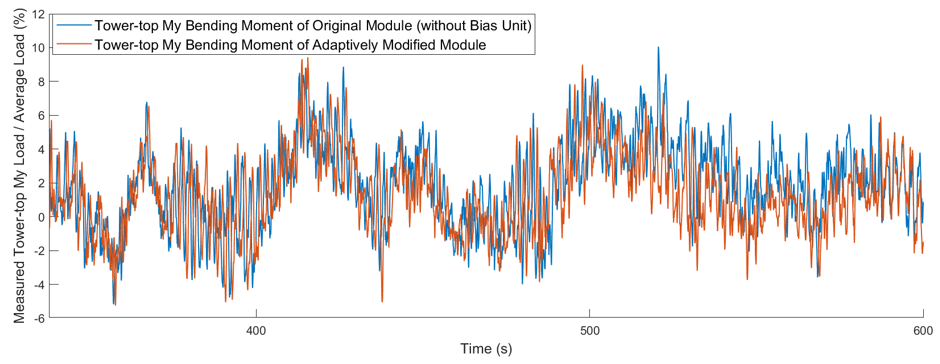
Near the rated wind speed, due to the random variations of wind speed, wind direction, and sea conditions, large-scale floating wind turbines encounter coupled interference between torque control and pitch control. It may result in substantial drops or fluctuations in electrical power. We propose a multi-stage adaptive decoupling control strategy to address the issue of electrical power drops near the full-load operation. It dynamically adjusts the closed-loop input error of PI controllers by correlating the state of the wind turbine with its torque/pitch outputs. The simulation results demonstrate that this strategy can enhance operational stability, significantly increase electrical power generation, and reduce fatigue/extreme loads of key components in large-scale floating wind turbines.
Article Details

This work is licensed under a Creative Commons Attribution-NonCommercial 4.0 International License.
References
- Avarzaman HA, Manzar MN, Badri V. Tuning Variable Speed Wind Turbine Controller Using a Data-Driven Approach: The TD3 Reinforcement Learning Algorithm. 2025 12th Iranian Conference on Renewable Energies and Distributed Generation (ICREDG). IEEE, 2025: 1-6. https://doi.org/10.1109/icredg66184.2025.10966086
- Nyoni KJ, Maronga A, Tuohy PG, et al. Hydro–Connected Floating PV Renewable Energy System and Onshore Wind Potential in Zambia. Energies. 2021, 14(17): 5330. https://doi.org/10.3390/en14175330
- Khan Afridi S, Ali Koondhar M, Ismail Jamali M, et al. Winds of Progress: An In-Depth Exploration of Offshore, Floating, and Onshore Wind Turbines as Cornerstones for Sustainable Energy Generation and Environmental Stewardship. IEEE Access. 2024, 12: 66147-66166. https://doi.org/10.1109/access.2024.3397243
- Kennedy IR, Hodzic M, Crossan AN, et al. Estimating Maximum Power from Wind Turbines with a Simple Newtonian Approach. Archives of Advanced Engineering Science. 2023, 1(1): 38-54. https://doi.org/10.47852/bonviewaaes32021330
- Yuan J, Cheng Z, Liu D. Design of Variable Pitch Control Method for Floating Wind Turbine. Energies. 2023, 16(2): 821. https://doi.org/10.3390/en16020821
- Pham TD, Dinh MC, Kim HM, et al. Simplified Floating Wind Turbine for Real-Time Simulation of Large-Scale Floating Offshore Wind Farms. Energies. 2021, 14(15): 4571. https://doi.org/10.3390/en14154571
- Hall M, Buckham B, Crawford C. Hydrodynamics-based floating wind turbine support platform optimization: A basis function approach. Renewable Energy. 2014, 66: 559-569. https://doi.org/10.1016/j.renene.2013.12.035
- Luo X. An individual pitch control method for floating offshore wind turbine. Journal of Physics: Conference Series. 2022, 2276(1): 012032. https://doi.org/10.1088/1742-6596/2276/1/012032
- Wei J, Li Y, Peng H, et al. Optimal Power Control in Wind Farms for Gearbox Load Reduction. IEEE Transactions on Sustainable Energy. 2025, 16(3): 1990-2001. https://doi.org/10.1109/tste.2025.3543186
- Batablinlè L, Bazyomo SD, Badou FD, et al. Climate, water, hydropower, wind speed and wind energy potential resources assessments using weather time series data, downscaled regional circulation models: A case study for Mono River Basin in the Gulf of Guinea region. Renewable Energy. 2024, 224: 120099. https://doi.org/10.1016/j.renene.2024.120099
- Al-Barashi M, Wang Y, Tang Z, et al. Variable Speed Wind Turbine Control System with Doubly-Fed Induction Generator. 2025 International Conference on Electrical Automation and Artificial Intelligence (ICEAAI). Published online January 10, 2025: 361-367. https://doi.org/10.1109/iceaai64185.2025.10956445
- Kim D, Jeon T, Paek I, et al. A Study on the Improved Power Control Algorithm for a 100 kW Wind Turbine. Energies. 2023, 16(2): 619. https://doi.org/10.3390/en16020619
- Basheer AA, Jeong JH, Lee SR, et al. Power Maximization Using Finite-Control-Set Model Predictive Control Strategy for Wind Turbine Systems. IEEE Journal of Emerging and Selected Topics in Industrial Electronics. 2025, 6(1): 238-247. https://doi.org/10.1109/jestie.2024.3502658
- Jara Ávila FJ, Verstraeten T, Daems PJ, et al. A Methodology for Turbine-Level Possible Power Prediction and Uncertainty Estimations Using Farm-Wide Autoregressive Information on High-Frequency Data. Energies. 2025, 18(14): 3764. https://doi.org/10.3390/en18143764
- Macquart T, Maheri A, Busawon K. A decoupling control strategy for wind turbine blades equipped with active flow controllers. Wind Energy. 2016, 20(4): 569-584. https://doi.org/10.1002/we.2024
- Jabr AA, Sultan AJ, Wali MK. Optimum Design of Doubly Fed Induction Generator for Wind Turbine System. AIP Conference Proceedings. AIP Publishing LLC. 2023, 2804(1): 050038. https://doi.org/10.1063/5.0154858
- Gambier A. Control of Large Wind Energy Systems Throughout the Shutdown Process. Machines. 2024, 12(10): 726. https://doi.org/10.3390/machines12100726
- Guo H, Lao KW, Hao J, et al. Wind Power Short-Term Prediction Method Based on Time-Domain Dual-Channel Adaptive Learning Model. Energies. 2025, 18(14): 3722. https://doi.org/10.3390/en18143722
- Efstathiou C, Tsormpatzoglou I, Tapoglou N. Parametric Modeling of Curvic Couplings and Analysis of the Effect of Coupling Geometry on Contact Stresses in High-Speed Rotation Applications. Machines. 2023, 11(8): 822. https://doi.org/10.3390/machines11080822
- Mannepalli K, Singh SP, Kolli CS, et al. Popularity Prediction Model With Context, Time and User Sentiment Information: An Optimization Assisted Deep Learning Technique. International Journal of Uncertainty, Fuzziness and Knowledge-Based Systems. 2023, 31(02): 283-302. https://doi.org/10.1142/s0218488523500150
- Wang JS, Ning CX, Yang Y. Multivariable PID Decoupling Control Method of Electroslag Remelting Process Based on Improved Particle Swarm Optimization (PSO) Algorithm. Information. 2014, 5(1): 120-133. https://doi.org/10.3390/info5010120
- Farfan AJU, Plata EAC, Tacca HE. A Theoretical Approach for the Evaluation of the Power at Polyphase Electrical Networks. Electric Power Components and Systems. 2011, 39(9): 917-932. https://doi.org/10.1080/15325008.2010.549546
- Zhou X, Yang J, Migliazza G, et al. Improved Speed Extension for Permanent Magnet Synchronous Generators by Means of Winding Reconfiguration. Energies. 2023, 16(2): 899. https://doi.org/10.3390/en16020899
