
Expected Performance, Habit, and Enjoyment as Key Factors Influencing Teachers' Intentions to Use Personal Learning Environments for Educational Purposes
Article Sidebar
Main Article Content


Abstract
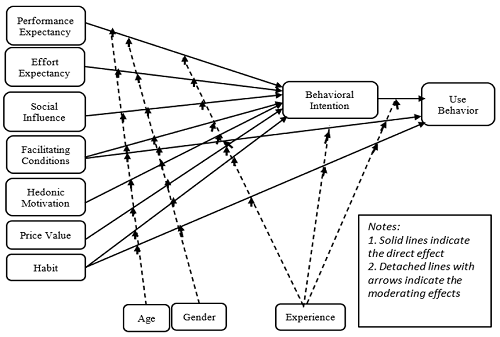
Recent research emphasizes the importance of Personal Learning Environments (PLEs) in the educational process. However, before their integration into school classrooms, it is important to investigate the extent to which teachers accept PLEs for educational purposes---an area that has received limited attention in the existing literature. To this end, this study empirically investigates teachers' intention to use and Use Behavior of PLEs. Drawing on the UTAUT2 model, data from 540 Greek primary and secondary school teachers were analyzed using Partial Least Squares Structural Equation Modeling (PLS-SEM). The findings showed that Performance Expectancy, Habit, and Hedonic Motivation were significantly associated with Behavioral Intention, while Behavioral Intention, Habit, and Facilitating Conditions were significantly associated with Use Behavior. Mediation analysis further showed significant indirect effects of Performance Expectancy, Hedonic Motivation, and Habit on Use Behavior through Behavioral Intention. Behavioral Intention partially mediated the relationship between Habit and Use Behavior, indicating complementary partial mediation. No significant moderating effects of gender, age, or classroom technology-integration experience were found. The findings offer further insight into the mechanisms underlying teachers' use of PLEs and inform their integration into educational practice.
Article Details

This work is licensed under a Creative Commons Attribution-NonCommercial 4.0 International License.
References
- Attwell, G. (2007). Personal Learning Environments—the future of e-Learning. Elearning papers, 2(1), 1–8.
- Benhamdi, S., Babouri, A., & Chiky, R. (2016). Personalized recommender system for e-Learning environment. Education and Information Technologies, 22(4), 1455–1477. https://doi.org/10.1007/s10639-016-9504-y
- Cohen, J. (1977). Statistical power analysis for the behavioral sciences. (Revised). Academic.
- Creswell, J.W. (2012). Educational research: Planning, conducting, and evaluating quantitative and qualitative research. Boston: Pearson.
- Davis, F. D. (1989). Perceived Usefulness, Perceived Ease of Use, and User Acceptance of Information Technology. MIS Quarterly, 13(3), 319–340. https://doi.org/10.2307/249008
- Davis, F. D., Bagozzi, R. P., & Warshaw, P. R. (1989). User Acceptance of Computer Technology: A Comparison of Two Theoretical Models. Management Science, 35(8), 982–1003. https://doi.org/10.1287/mnsc.35.8.982
- Del Barrio-García, S., Arquero, J. L., & Romero-Frías, E. (2015). Personal Learning Environments Acceptance Model: The Role of Need for Cognition, e-Learning Satisfaction and Students’ Perceptions. Educational Technology & Society, 18(3), 129–141.
- Drolia, M., Sifaki, E., Papadakis, S., & Kalogiannakis, M. (2020). An Overview of Mobile Learning for Refugee Students: Juxtaposing Refugee Needs with Mobile Applications’ Characteristics. Challenges, 11(2), 31. https://doi.org/10.3390/challe11020031
- Elfeky, A. I. M. (2019). The effect of personal learning environments on participants’ higher order thinking skills and satisfaction. Innovations in Education and Teaching International, 56(4), 505–516. https://doi.org/10.1080/14703297.2018.1534601
- Ertmer, P. A., Ottenbreit-Leftwich, A. T., Sadik, O., Sendurur, E., & Sendurur, P. (2012). Teacher beliefs and technology integration practices: A critical relationship. Computers & Education, 59(2), 423–435. https://doi.org/10.1016/j.compedu.2012.02.001
- Gunasinghe, A., Hamid, J. A., Khatibi, A., & Azam, S. M. F. (2020). The viability of UTAUT-3 in understanding the lecturer’s acceptance and use of virtual learning environments. International Journal of Technology Enhanced Learning, 12(4), 458. https://doi.org/10.1504/ijtel.2020.110056
- Hair, J.F., Hult, G.T.M., Ringle, C.M., & Sarstedt, M. (2017). A primer on partial least squares structural equation modeling (PLS-SEM) (2nd ed.). Sage.
- Henseler, J., Ringle, C. M., & Sarstedt, M. (2014). A new criterion for assessing discriminant validity in variance-based structural equation modeling. Journal of the Academy of Marketing Science, 43(1), 115–135. https://doi.org/10.1007/s11747-014-0403-8
- Karakose, T., Tülübaş, T., Papadakis, S., & Yirci, R. (2023). Evaluating the Intellectual Structure of the Knowledge Base on Transformational School Leadership: A Bibliometric and Science Mapping Analysis. Education Sciences, 13(7), 708. https://doi.org/10.3390/educsci13070708
- Kim, J., & Lee, K. S.-S. (2020). Conceptual model to predict Filipino teachers’ adoption of ICT-based instruction in class: using the UTAUT model. Asia Pacific Journal of Education, 42(4), 699–713. https://doi.org/10.1080/02188791.2020.1776213
- Kock, N. (2015). Common Method Bias in PLS-SEM. International Journal of E-Collaboration, 11(4), 1–10. https://doi.org/10.4018/ijec.2015100101
- Lavidas, K., Papadakis, S., Manesis, D., Grigoriadou, A. S., & Gialamas, V. (2022). The Effects of Social Desirability on Students’ Self-Reports in Two Social Contexts: Lectures vs. Lectures and Lab Classes. Information, 13(10), 491. https://doi.org/10.3390/info13100491
- Lavidas, K., Petropoulou, A., Papadakis, S., Apostolou, Z., Komis, V., Jimoyiannis, A., & Gialamas, V. (2022). Factors Affecting Response Rates of the Web Survey with Teachers. Computers, 11(9), 127. https://doi.org/10.3390/computers11090127
- Nan Cenka, B. A., Santoso, H. B., & Junus, K. (2022). Using the personal learning environment to support self-regulated learning strategies: a systematic literature review. Interactive Learning Environments, 32(4), 1368–1384. https://doi.org/10.1080/10494820.2022.2120019
- Nikolopoulou, K., Gialamas, V., & Lavidas, K. (2021). Habit, hedonic motivation, performance expectancy and technological pedagogical knowledge affect teachers’ intention to use mobile internet. Computers and Education Open, 2, 100041. https://doi.org/10.1016/j.caeo.2021.100041
- Nitzl, C., Roldan, J. L., & Cepeda, G. (2016). Mediation analysis in partial least squares path modeling. Industrial Management & Data Systems, 116(9), 1849–1864. https://doi.org/10.1108/imds-07-2015-0302
- Papadakis, S., & Kalogiannakis, M. (2019). Evaluating the effectiveness of a game-based learning approach in modifying students’ behavioural outcomes and competence, in an introductory programming course. A case study in Greece. International Journal of Teaching and Case Studies, 10(3), 235. https://doi.org/10.1504/ijtcs.2019.102760
- Pynoo, B., Devolder, P., Tondeur, J., van Braak, J., Duyck, W., & Duyck, P. (2011). Predicting secondary school teachers’ acceptance and use of a digital learning environment: A cross-sectional study. Computers in Human Behavior, 27(1), 568–575. https://doi.org/10.1016/j.chb.2010.10.005
- R Core Team. (2023). R: A language and environment for statistical computing. R Foundation for Statistical Computing, Vienna, Austria. https://www.R-project.org
- Raman, A., & Rathakrishnan, M. (2018). FROG VLE: Teachers’ technology acceptance using UTAUT model. International Journal of Mechanical Engineering and Technology, 9(3), 529–538.
- Rejón-Guardia, F., Polo-Peña, A. I., & Maraver-Tarifa, G. (2019). The acceptance of a personal learning environment based on Google apps: the role of subjective norms and social image. Journal of Computing in Higher Education, 32(2), 203–233. https://doi.org/10.1007/s12528-019-09206-1
- Revelle, W. (2023). Psych: Procedures for Psychological, Psychometric, and Personality Research. R package. https://CRAN.R-project.org/package=psych
- Sanchez, G., Trinchera, L., & Russolillo, G. (2025). plspm: Partial Least Squares Path Modeling (PLS-PM) [Data set]. CRAN: Contributed Packages. The R Foundation. https://doi.org/10.32614/cran.package.plspm
- Serhan, S. A. L., & Yahaya, N. (2022). A Systematic Review and Trend Analysis of Personal Learning Environments Research. International Journal of Information and Education Technology, 12(1), 43–53. https://doi.org/10.18178/ijiet.2022.12.1.1585
- Shaikh, Z. A., & Khoja, S. A. (2012). Role of Teacher in Personal Learning Environments. Digital Education Review, 21, 23–32.
- Teo, T. (2010). Development and validation of the E-learning Acceptance Measure (ElAM). The Internet and Higher Education, 13(3), 148–152. https://doi.org/10.1016/j.iheduc.2010.02.001
- Torres Kompen, R., Edirisingha, P., Canaleta, X., Alsina, M., & Monguet, J. M. (2019). Personal learning Environments based on Web 2.0 services in higher education. Telematics and Informatics, 38, 194–206. https://doi.org/10.1016/j.tele.2018.10.003
- Tzavara, A., Lavidas, K., Komis, V., Misirli, A., Karalis, T., & Papadakis, S. (2023). Using Personal Learning Environments before, during and after the Pandemic: The Case of “e-Me”. Education Sciences, 13(1), 87. https://doi.org/10.3390/educsci13010087
- Venkatesh, V., Morris, M. G., Davis, G. B., & Davis, F. D. (2003). User Acceptance of Information Technology: Toward A Unified View1. MIS Quarterly, 27(3), 425–478. https://doi.org/10.2307/30036540
- Venkatesh, V., Thong, J. Y. L., & Xu, X. (2012). Consumer Acceptance and Use of Information Technology: Extending the Unified Theory of Acceptance and Use of Technology1. MIS Quarterly, 36(1), 157–178. https://doi.org/10.2307/41410412
- Venkatesh, V., Thong, J. Y. L., & Xu, X. (2016). Unified Theory of Acceptance and Use of Technology: A Synthesis and the Road Ahead. Journal of the Association for Information Systems, 17(5), 328–376. https://doi.org/10.17705/1jais.00428
- Yee, M. L. S., & Abdullah, M. S. (2021). A Review of UTAUT and Extended Model as a Conceptual Framework in Education Research. Jurnal Pendidikan Sains Dan Matemaitk Malaysia, 11(Sp), 1–20. https://doi.org/10.37134/jpsmm.vol11.sp.1.2021
