
Digital Game-Based Learning in Early Childhood and Primary Mathematics Education: A Systematic Review
Article Sidebar
Main Article Content


Abstract
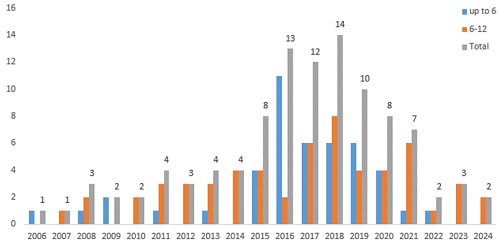
Digital Game-Based Learning (DGBL) has emerged as a promising approach for enhancing mathematics learning across educational contexts. Although previous reviews have examined the effectiveness of digital games in mathematics education, limited attention has been devoted specifically to early childhood and primary education. This systematic review synthesises empirical studies investigating the use of DGBL in mathematics education for children up to 12 years of age. Following PRISMA guidelines, studies published between 2006 and 2024 were identified through searches in Scopus, Web of Science, and Google Scholar. After applying predefined inclusion and exclusion criteria, 103 empirical studies were selected for analysis. The findings reveal a substantial increase in research activity after 2015, with Educational Technology journals being the primary publication venue. Quantitative research designs predominated, while tablets and personal computers were the most frequently used devices. Puzzle games represented the most common game genre. The majority of studies focused on Number and Operations, followed by Algebra, Geometry, and Measurement. Results indicate predominantly positive effects on students' mathematical achievement, particularly in Number and Operations and Geometry. Furthermore, digital games were associated with improvements in motivation, attitudes towards mathematics, and collaborative learning. The review highlights the educational potential of DGBL in mathematics and identifies directions for future research and practice.
Article Details

This work is licensed under a Creative Commons Attribution-NonCommercial 4.0 International License.
References
- Akman, E., & Çakır, R. (2020). The effect of educational virtual reality game on primary school students’ achievement and engagement in mathematics. Interactive Learning Environments, 31(3), 1467–1484. https://doi.org/10.1080/10494820.2020.1841800
- Aladé, F., Lauricella, A. R., Beaudoin-Ryan, L., & Wartella, E. (2016). Measuring with Murray: Touchscreen technology and preschoolers’ STEM learning. Computers in Human Behavior, 62, 433–441. https://doi.org/10.1016/j.chb.2016.03.080
- Alzubi, T., Fernandez, R., Flores, J., Duran, M., & Cotos, J. M. (2018). Improving the Working Memory During Early Childhood Education Through the Use of an Interactive Gesture Game-Based Learning Approach. IEEE Access, 6, 53998–54009. https://doi.org/10.1109/access.2018.2870575
- Amorim, A. N., Jeon, L., Abel, Y., Pape, S., Albuquerque, E. X. S., Soares, M., Silva, V. C., Aguiar, D., Oliveira Neto, J. R., Costin, C., Rodrigues, R. L., Leon, M., de Paula, C. A., Lopes, J., Silva, M. S., do Nascimento, M. V., Patricio, G. A., da Silva, V. F., & Florentino, R. (2023). Exploring the Use of Escribo Play Mobile Learning Games to Foster Early Mathematics for Low-Income First-Grade Children. Computers &Amp; Education, 199, 104759. https://doi.org/10.1016/j.compedu.2023.104759
- Anastasiadis, T., Lampropoulos, G., & Siakas, K. (2018). Digital Game-based Learning and Serious Games in Education. International Journal of Advances in Scientific Research and Engineering, 4(12), 139–144. https://doi.org/10.31695/ijasre.2018.33016
- Ang, C. S., Avni, E., & Zaphiris, P. (2008). Linking pedagogical theory of computer games to their usability. International Journal on E-Learning, 7(3), 533-558. https://www.learntechlib.org/p/24229
- Aragón-Mendizábal, E., Aguilar-Villagrán, M., Navarro-Guzmán, J. I., & Howell, R. (2017). Improving number sense in kindergarten children with low achievement in mathematics. Anales de Psicología, 33(2), 311. https://doi.org/10.6018/analesps.33.2.239391
- Baccaglini-Frank, A., & Maracci, M. (2015). Multi-Touch Technology and Preschoolers’ Development of Number-Sense. Digital Experiences in Mathematics Education, 1(1), 7–27. https://doi.org/10.1007/s40751-015-0002-4
- Baccaglini-Frank, A., Carotenuto, G., & Sinclair, N. (2020). Eliciting preschoolers’ number abilities using open, multi-touch environments. Zdm, 52(4), 779–791. https://doi.org/10.1007/s11858-020-01144-y
- Bakker, M., van den Heuvel-Panhuizen, M., & Robitzsch, A. (2015). Effects of playing mathematics computer games on primary school students’ multiplicative reasoning ability. Contemporary Educational Psychology, 40, 55–71. https://doi.org/10.1016/j.cedpsych.2014.09.001
- Barr, M., & Copeland-Stewart, A. (2021). Playing Video Games During the COVID-19 Pandemic and Effects on Players’ Well-Being. Games and Culture, 17(1), 122–139. https://doi.org/10.1177/15554120211017036
- Beşalti, M., & Kul, Ü. (2021). Uzaktan Eğitim Sürecinde Oyun Tabanlı Bir Uygulamanın İlkokul Öğrencilerinin Kesirleri Öğrenmede Öz-yeterlik ve Başarılarına Olan Etkisi. Türk Psikolojik Danışma Ve Rehberlik Dergisi, 11(63), 505–520. https://doi.org/10.17066/tpdrd.1051383
- Beserra, V., Nussbaum, M., Zeni, R., Rodriguez, W., & Wurman, G. (2014). Practising arithmetic using educational video games with an interpersonal computer. Journal of Educational Technology & Society, 17(3), 343-358. http://www.jstor.org/stable/jeductechsoci.17.3.343
- Beserra, V., Nussbaum, M., & Grass, A. (2016). Using a fine-grained multiple-choice response format in educational drill-and-practice video games. Interactive Learning Environments, 25(6), 717–732. https://doi.org/10.1080/10494820.2016.1172244
- Blumberg, F. C., Flynn, R. M., Homer, B. D., Bailey, J. O., Eng, C. M., Green, C. S., Giannakos, M., Papadakis, S., & Gentile, D. A. (2024). Current state of play: Children’s learning in the context of digital games. Journal of Children and Media, 18(2), 293–299. https://doi.org/10.1080/17482798.2024.2335725
- Brezovszky, B., McMullen, J., Veermans, K., Hannula-Sormunen, M. M., Rodríguez-Aflecht, G., Pongsakdi, N., Laakkonen, E., & Lehtinen, E. (2019). Effects of a mathematics game-based learning environment on primary school students’ adaptive number knowledge. Computers &Amp; Education, 128, 63–74. https://doi.org/10.1016/j.compedu.2018.09.011
- Brown, M., & Harmon, M. T. (2013). iPad intervention with at-risk preschoolers: mobile technology in the classroom. Journal of Literacy and Technology, 14(2), 56-78.
- Bryman, A. (2016). Social research methods. Oxford university press.
- Bui, P., Rodríguez-Aflecht, G., Brezovszky, B., Hannula-Sormunen, M. M., Laato, S., & Lehtinen, E. (2020). Understanding students’ game experiences throughout the developmental process of the number navigation game. Educational Technology Research and Development, 68(5), 2395–2421. https://doi.org/10.1007/s11423-020-09755-8
- Bullock, E. P., Shumway, J. F., Watts, C. M., & Moyer-Packenham, P. S. (2017). Affordance Access Matters: Preschool Children’s Learning Progressions While Interacting with Touch-Screen Mathematics Apps. Technology, Knowledge and Learning, 22(3), 485–511. https://doi.org/10.1007/s10758-017-9312-5
- Byun, J., & Joung, E. (2018). Digital game‐based learning for K–12 mathematics education: A meta-analysis. School Science and Mathematics, 118(3-4), 113–126. Portico. https://doi.org/10.1111/ssm.12271
- Çakıroğlu, Ü., & Taşkın, N. (2016). Okul öncesi öğrencilere etkileşimli çoklu ortamlar ile sayıların öğretimi: Deneysel bir çalışma. Çukurova Üniversitesi Eğitim Fakültesi Dergisi, 45(1), 1-22. https://izlik.org/JA56UP93JW
- Chen, Y. H., Lin, C. P., Looi, C. K., Shao, Y. J., & Chan, T. W. (2012). A Collaborative Cross Number Puzzle Game to Enhance Elementary Students' Arithmetic Skills. Turkish Online Journal of Educational Technology-TOJET, 11(2), 1-14.
- Chen, Z. H., Liao, C. C., Cheng, H. N., Yeh, C. Y., & Chan, T. W. (2012). Influence of game quests on pupils' enjoyment and goal-pursuing in math learning. Journal of Educational Technology & Society, 15(2), 317-327. http://www.jstor.org/stable/jeductechsoci.15.2.317
- Chen, P. Y., Hwang, G. J., Yeh, S. Y., Chen, Y. T., Chen, T. W., & Chien, C. H. (2021). Three decades of game-based learning in science and mathematics education: an integrated bibliometric analysis and systematic review. Journal of Computers in Education, 9, 455–476. https://doi.org/10.1007/s40692-021-00210-y
- Collins, K. L., & Kavanaugh, J. R. (2022). Video Games. https://digitalwellnesslab.org/parents/video-games
- De Freitas, S. (2006). Learning in immersive worlds. London: Joint Information Systems Committee, 3-71.
- Debrenti, E. (2024). Game-Based Learning experiences in primary mathematics education. Frontiers in Education, 9. https://doi.org/10.3389/feduc.2024.1331312
- Dele-Ajayi, O., Strachan, R., Pickard, A. J., & Sanderson, J. J. (2019). Games for Teaching Mathematics in Nigeria: What Happens to Pupils’ Engagement and Traditional Classroom Dynamics? IEEE Access, 7, 53248–53261. https://doi.org/10.1109/access.2019.2912359
- Divjak, B., & Tomić, D. (2011). The impact of game-based learning on the achievement of learning goals and motivation for learning mathematics-literature review. Journal of information and organizational sciences, 35(1), 15-30.
- Eberle, S. G. (2011). Playing with the Multiple Intelligences: How Play Helps Them Grow. American Journal of Play, 4(1), 19-51. https://files.eric.ed.gov/fulltext/EJ985547.pdf
- Egard, H., & Hansson, K. (2021). The digital society comes sneaking in. An emerging field and its disabling barriers. Disability &Amp; Society, 38(5), 761–775. https://doi.org/10.1080/09687599.2021.1960275
- Entertainment Software Association. (2021). 2021 Essential facts about the video games industry. https://www.theesa.com
- Erşen, Z. B., & Ergül, E. (2022). Trends of Game-Based Learning in Mathematics Education: A Systematic Review. International Journal of Contemporary Educational Research, 9(3), 603–623. https://doi.org/10.33200/ijcer.1109501
- Es-Sajjade, A., & Paas, F. (2020). Educational theories and computer game design: lessons from an experiment in elementary mathematics education. Educational Technology Research and Development, 68(5), 2685–2703. https://doi.org/10.1007/s11423-020-09799-w
- Fadda, D., Pellegrini, M., Vivanet, G., & Zandonella Callegher, C. (2021). Effects of digital games on student motivation in mathematics: A meta‐analysis in K‐12. Journal of Computer Assisted Learning, 38(1), 304–325. Portico. https://doi.org/10.1111/jcal.12618
- Fischer, U., Moeller, K., Bientzle, M., Cress, U., & Nuerk, H.-C. (2010). Sensori-motor spatial training of number magnitude representation. Psychonomic Bulletin &Amp; Review, 18(1), 177–183. https://doi.org/10.3758/s13423-010-0031-3
- Fleming, G. (2019). Why math is more difficult for some students. https://www.thoughtco.com
- Fokides, E. (2017). Digital educational games and mathematics. Results of a case study in primary school settings. Education and Information Technologies, 23(2), 851–867. https://doi.org/10.1007/s10639-017-9639-5
- Foster, M. E., Anthony, J. L., Clements, D. H., Sarama, J., & Williams, J. J. (2018). Hispanic dual language learning kindergarten students’ response to a numeracy intervention: A randomized control trial. Early Childhood Research Quarterly, 43, 83–95. https://doi.org/10.1016/j.ecresq.2018.01.009
- Fraga-Varela, F., Vila-Couñago, E., & Rodríguez-Groba, A. (2021). Serious Games and Mathematical Fluency: A Study from the Gender Perspective in Primary Education. Sustainability, 13(12), 6586. https://doi.org/10.3390/su13126586
- Freina, L., Bottino, R., & Ferlino, L. (2020). Visuospatial Abilities Training with Digital Games in a Primary School. International Journal of Serious Games, 5(3), 23–35. https://doi.org/10.17083/ijsg.v5i3.240
- Gecu-Parmaksiz, Z., & Delialioglu, O. (2019). Augmented reality-based virtual manipulatives versus physical manipulatives for teaching geometric shapes to preschool children. British Journal of Educational Technology, 50(6), 3376–3390. Portico. https://doi.org/10.1111/bjet.12740
- Gerholm, T., Kallioinen, P., Tonér, S., Frankenberg, S., Kjällander, S., Palmer, A., & Lenz-Taguchi, H. (2019). A randomized controlled trial to examine the effect of two teaching methods on preschool children’s language and communication, executive functions, socioemotional comprehension, and early math skills. BMC Psychology, 7(1). https://doi.org/10.1186/s40359-019-0325-9
- Gómez, F., Nussbaum, M., Weitz, J. F., Lopez, X., Mena, J., & Torres, A. (2013). Co-located single display collaborative learning for early childhood education. International Journal of Computer-Supported Collaborative Learning, 8(2), 225–244. https://doi.org/10.1007/s11412-013-9168-1
- Hassler Hallstedt, M., Klingberg, T., & Ghaderi, A. (2018). Short and long-term effects of a mathematics tablet intervention for low performing second graders. Journal of Educational Psychology, 110(8), 1127–1148. https://doi.org/10.1037/edu0000264
- Huang, Y.-M., Huang, S.-H., & Wu, T.-T. (2013). Embedding diagnostic mechanisms in a digital game for learning mathematics. Educational Technology Research and Development, 62(2), 187–207. https://doi.org/10.1007/s11423-013-9315-4
- Hulse, T., Daigle, M., Manzo, D., Braith, L., Harrison, A., & Ottmar, E. (2019). From here to there! Elementary: a game-based approach to developing number sense and early algebraic understanding. Educational Technology Research and Development, 67(2), 423–441. https://doi.org/10.1007/s11423-019-09653-8
- Hung, C.-M., Huang, I., & Hwang, G.-J. (2014). Effects of digital game-based learning on students’ self-efficacy, motivation, anxiety, and achievements in learning mathematics. Journal of Computers in Education, 1(2-3), 151–166. https://doi.org/10.1007/s40692-014-0008-8
- Hussain, S. Y. b. S., Hoe, T. W., & Idris, M. Z. b. (2017). Digital game based learning: A new method in teaching and learning mathematics. AIP Conference Proceedings, 1847, 30016. https://doi.org/10.1063/1.4983894
- Hussein, M. H., Ow, S. H., Elaish, M. M., & Jensen, E. O. (2021). Digital game-based learning in K-12 mathematics education: a systematic literature review. Education and Information Technologies, 27(2), 2859–2891. https://doi.org/10.1007/s10639-021-10721-x
- Hwa, S. P. (2018). Pedagogical change in mathematics learning: Harnessing the power of digital game-based learning. Journal of Educational Technology & Society, 21(4), 259-276. http://www.jstor.org/stable/26511553
- Iivari, N., Sharma, S., & Ventä-Olkkonen, L. (2020). Digital transformation of everyday life – How COVID-19 pandemic transformed the basic education of the young generation and why information management research should care? International Journal of Information Management, 55, 102183. https://doi.org/10.1016/j.ijinfomgt.2020.102183
- Jay, T., Habgood, J., Mees, M., & Howard-Jones, P. (2019). Game-Based Training to Promote Arithmetic Fluency. Frontiers in Education, 4. https://doi.org/10.3389/feduc.2019.00118
- Käser, T., Baschera, G.-M., Kohn, J., Kucian, K., Richtmann, V., Grond, U., Gross, M., & von Aster, M. (2013). Design and evaluation of the computer-based training program Calcularis for enhancing numerical cognition. Frontiers in Psychology, 4. https://doi.org/10.3389/fpsyg.2013.00489
- Ke, F., & Grabowski, B. (2006). Gameplaying for maths learning: cooperative or not? British Journal of Educational Technology, 38(2), 249–259. Portico. https://doi.org/10.1111/j.1467-8535.2006.00593.x
- Ke, F. (2008a). A case study of computer gaming for math: Engaged learning from gameplay? Computers &Amp; Education, 51(4), 1609–1620. https://doi.org/10.1016/j.compedu.2008.03.003
- Ke, F. (2008b). Computer games application within alternative classroom goal structures: cognitive, metacognitive, and affective evaluation. Educational Technology Research and Development, 56(5-6), 539–556. https://doi.org/10.1007/s11423-008-9086-5
- Kermani, H. (2018). Computer Mathematics Games and Conditions for Enhancing Young Children’S Learning of Number Sense. Malaysian Journal of Learning and Instruction, 14(2), 23–57. https://doi.org/10.32890/mjli2017.14.2.2
- Kim, H., & Ke, F. (2016). Effects of game-based learning in an OpenSim-supported virtual environment on mathematical performance. Interactive Learning Environments, 25(4), 543–557. https://doi.org/10.1080/10494820.2016.1167744
- Kim, N., Jang, S., & Cho, S. (2018). Testing the Efficacy of Training Basic Numerical Cognition and Transfer Effects to Improvement in Children’s Math Ability. Frontiers in Psychology, 9. https://doi.org/10.3389/fpsyg.2018.01775
- Kocabatmaz, H., & Saraçoğlu, G. K. (2024). The Effect of Educational Digital Games on Academic Success and Attitude in 3rd Grade Mathematics Class. Participatory Educational Research, 11(2), 230–244. https://doi.org/10.17275/per.24.28.11.2
- Kolovou, A., van den Heuvel-Panhuizen, M., & Köller, O. (2013). An Intervention Including an Online Game to Improve Grade 6 Students’ Performance in Early Algebra. Journal for Research in Mathematics Education, 44(3), 510–549. https://doi.org/10.5951/jresematheduc.44.3.0510
- Kubicki, S., Pasco, D., & Arnaud, I. (2015). Using a serious game with a tangible tabletop interface to promote student engagement in a first grade classroom: a comparative evaluation study. International Journal of Computer and Information Technology, 4(2), 381-389.
- Kyriakides, A. O., Meletiou-Mavrotheris, M., & Prodromou, T. (2015). Mobile technologies in the service of students’ learning of mathematics: the example of game application A.L.E.X. in the context of a primary school in Cyprus. Mathematics Education Research Journal, 28(1), 53–78. https://doi.org/10.1007/s13394-015-0163-x
- Lakshmi, D., & Ponnusamy, P. (2021). Working memory enhancement during early childhood based on the utilization of interactive gesture game-based learning technique. Indonesian Journal of Electrical Engineering and Computer Science, 21(2), 768. https://doi.org/10.11591/ijeecs.v21.i2.pp768-775
- Lavidas, K., Apostolou, Z., & Papadakis, S. (2022). Challenges and Opportunities of Mathematics in Digital Times: Preschool Teachers’ Views. Education Sciences, 12(7), 459. https://doi.org/10.3390/educsci12070459
- Lee, H. K., & Choi, A. (2020). Enhancing early numeracy skills with a tablet-based math game intervention: a study in Tanzania. Educational Technology Research and Development, 68(6), 3567–3585. https://doi.org/10.1007/s11423-020-09808-y
- Lin, Y.-H., & Hou, H.-T. (2015). Exploring young children’s performance on and acceptance of an educational scenario-based digital game for teaching route-planning strategies: a case study. Interactive Learning Environments, 24(8), 1967–1980. https://doi.org/10.1080/10494820.2015.1073745
- Lin, C. H., Liu, E. Z. F., Chen, Y. L., Liou, P. Y., Chang, M., Wu, C. H., & Yuan, S. M. (2013). Game-based remedial instruction in mastery learning for upper-primary school students. Journal of Educational Technology & Society, 16(2), 271-281. http://www.jstor.org/stable/jeductechsoci.16.2.271
- Lunardon, M., Lucangeli, D., Zorzi, M., & Sella, F. (2023). Math computerized games in the classroom: A number line training in primary school children. Progress in Brain Research, 276, 1-33. https://doi.org/10.1016/bs.pbr.2022.11.001
- Main, S., & O’Rourke, J. (2011). ‘New Directions for Traditional Lessons’: Can Handheld Game Consoles Enhance Mental Mathematics Skills? Australian Journal of Teacher Education, 36(2). https://doi.org/10.14221/ajte.2011v36n2.4
- Mattoon, C., Bates, A., Shifflet, R., Latham, N., & Ennis, S. (2015). Examining computational skills in Prekindergarteners: The effects of traditional and digital manipulatives in a prekindergarten classroom. Early Childhood Research and Practice, 17(1). https://eric.ed.gov/?id=EJ1072360
- McCarthy, E., Tiu, M., & Li, L. (2018). Learning Math with Curious George and the Odd Squad: Transmedia in the Classroom. Technology, Knowledge and Learning, 23(2), 223–246. https://doi.org/10.1007/s10758-018-9361-4
- McManis, M. H., & McManis, L. D. (2016). Using a Touch-Based, Computer-Assisted Learning System to Promote Literacy and Math Skills for Low-Income Preschoolers. Journal of Information Technology Education: Research, 15, 409–429. https://doi.org/10.28945/3550
- Mera, C., Delgado, C., Aragón, E., Menacho, I., Canto, M. D. C., & Navarro, J. I. (2022). Contributions of the psychology of mathematical cognition in early childhood education using apps. Frontiers in Psychology, 13. https://doi.org/10.3389/fpsyg.2022.913970
- Miller, D. J., & Robertson, D. P. (2010). Using a games console in the primary classroom: Effects of ‘Brain Training’ programme on computation and self‐esteem. British Journal of Educational Technology, 41(2), 242–255. Portico. https://doi.org/10.1111/j.1467-8535.2008.00918.x
- Miller, D. J., & Robertson, D. P. (2011). Educational benefits of using game consoles in a primary classroom: A randomised controlled trial. British Journal of Educational Technology, 42(5), 850–864. Portico. https://doi.org/10.1111/j.1467-8535.2010.01114.x
- Miller, T. (2018). Developing numeracy skills using interactive technology in a play-based learning environment. International Journal of STEM Education, 5(1). https://doi.org/10.1186/s40594-018-0135-2
- Mohd Syah, N. E., Hamzaid, N. A., Murphy, B. P., & Lim, E. (2015). Development of computer play pedagogy intervention for children with low conceptual understanding in basic mathematics operation using the dyscalculia feature approach. Interactive Learning Environments, 24(7), 1477–1496. https://doi.org/10.1080/10494820.2015.1023205
- Moyer-Packenham, P. S., Lommatsch, C. W., Litster, K., Ashby, J., Bullock, E. K., Roxburgh, A. L., Shumway, J. F., Speed, E., Covington, B., Hartmann, C., Clarke-Midura, J., Skaria, J., Westenskow, A., MacDonald, B., Symanzik, J., & Jordan, K. (2019). How design features in digital math games support learning and mathematics connections. Computers in Human Behavior, 91, 316–332. https://doi.org/10.1016/j.chb.2018.09.036
- National Council of Teachers of Mathematics. (2000) Principles and Standards for School Mathematics. Key Curriculum Press. https://www.nctm.org
- Núñez Castellar, E., All, A., de Marez, L., & Van Looy, J. (2015). Cognitive abilities, digital games and arithmetic performance enhancement: A study comparing the effects of a math game and paper exercises. Computers &Amp; Education, 85, 123–133. https://doi.org/10.1016/j.compedu.2014.12.021
- OECD. (2019). PISA 2018 results: Combined executive summaries. https://www.oecd.org
- Ökördi, R., & Molnár, G. (2022). Computer-Based Intervention Closes Learning Gap in Maths Accumulated in Remote Learning. Journal of Intelligence, 10(3), 58. https://doi.org/10.3390/jintelligence10030058
- O'Rourke, J., Main, S., & Hill, S. (2017). Technology in the Classroom: Improving Automaticity in Mental-maths in Primary-aged Students. Australian Journal of Teacher Education, 42(10), 50–70. https://doi.org/10.14221/ajte.2017v42n10.4
- Outhwaite, L. A., Gulliford, A., & Pitchford, N. J. (2017). Closing the gap: Efficacy of a tablet intervention to support the development of early mathematical skills in UK primary school children. Computers &Amp; Education, 108, 43–58. https://doi.org/10.1016/j.compedu.2017.01.011
- Outhwaite, L. A., Faulder, M., Gulliford, A., & Pitchford, N. J. (2019). Raising early achievement in math with interactive apps: A randomized control trial. Journal of Educational Psychology, 111(2), 284–298. https://doi.org/10.1037/edu0000286
- Page, M. J., McKenzie, J. E., Bossuyt, P. M., Boutron, I., Hoffmann, T. C., Mulrow, C. D., Shamseer, L., Tetzlaff, J. M., Akl, E. A., Brennan, S. E., Chou, R., Glanville, J., Grimshaw, J. M., Hróbjartsson, A., Lalu, M. M., Li, T., Loder, E. W., Mayo-Wilson, E., McDonald, S., et al. (2021). The PRISMA 2020 statement: An updated guideline for reporting systematic reviews. International Journal of Surgery, 88, 105906. https://doi.org/10.1016/j.ijsu.2021.105906
- Papadakis, S., Kalogiannakis, M., & Zaranis, N. (2016). Comparing Tablets and PCs in teaching Mathematics: An attempt to improve Mathematics Competence in Early Childhood Education. Preschool and Primary Education, 4(2), 241. https://doi.org/10.12681/ppej.8779
- Papadakis, S., Kalogiannakis, M., & Zaranis, N. (2018). The effectiveness of computer and tablet assisted intervention in early childhood students’ understanding of numbers. An empirical study conducted in Greece. Education and Information Technologies, 23(5), 1849–1871. https://doi.org/10.1007/s10639-018-9693-7
- Pareto, L., Haake, M., Lindström, P., Sjödén, B., & Gulz, A. (2012). A teachable-agent-based game affording collaboration and competition: evaluating math comprehension and motivation. Educational Technology Research and Development, 60(5), 723–751. https://doi.org/10.1007/s11423-012-9246-5
- Park, J., Bermudez, V., Roberts, R. C., & Brannon, E. M. (2016). Non-symbolic approximate arithmetic training improves math performance in preschoolers. Journal of Experimental Child Psychology, 152, 278–293. https://doi.org/10.1016/j.jecp.2016.07.011
- Peralbo-Uzquiano, M., Fernández-Abella, R., Durán-Bouza, M., Brenlla-Blanco, J.-C., & Cotos-Yáñez, J.-M. (2020). Evaluation of the effects of a virtual intervention programme on cognitive flexibility, inhibitory control and basic math skills in childhood education. Computers &Amp; Education, 159, 104006. https://doi.org/10.1016/j.compedu.2020.104006
- Petropoulou, A., Lavidas, K., & Papadakis, S. (2024). Investigation of Preschoolers’ Mathematical Skills: A Systematic Literature Review. Educational Process International Journal, 13(2). https://doi.org/10.22521/edupij.2024.132.3
- Pope, H., & Mangram, C. (2015). Wuzzit Trouble: The Influence of a Digital Math Game on Student Number Sense. International Journal of Serious Games, 2(4). https://doi.org/10.17083/ijsg.v2i4.88
- Ramani, G. B., Daubert, E. N., Lin, G. C., Kamarsu, S., Wodzinski, A., & Jaeggi, S. M. (2019). Racing dragons and remembering aliens: Benefits of playing number and working memory games on kindergartners’ numerical knowledge. Developmental Science, 23(4). Portico. https://doi.org/10.1111/desc.12908
- Räsänen, P., Salminen, J., Wilson, A. J., Aunio, P., & Dehaene, S. (2009). Computer-assisted intervention for children with low numeracy skills. Cognitive Development, 24(4), 450–472. https://doi.org/10.1016/j.cogdev.2009.09.003
- Riconscente, M. M. (2013). Results From a Controlled Study of the iPad Fractions Game Motion Math. Games and Culture, 8(4), 186–214. https://doi.org/10.1177/1555412013496894
- Rocha, M., & Dondio, P. (2021). Effects of a videogame in math performance and anxiety in primary school. International Journal of Serious Games, 8(3), 45–70. https://doi.org/10.17083/ijsg.v8i3.434
- Rodríguez-Aflecht, G., Hannula-Sormunen, M., McMullen, J., Jaakkola, T., & Lehtinen, E. (2016). Voluntary vs Compulsory Playing Contexts. Simulation &Amp; Gaming, 48(1), 36–55. https://doi.org/10.1177/1046878116673679
- Rutherford, T., Farkas, G., Duncan, G., Burchinal, M., Kibrick, M., Graham, J., Richland, L., Tran, N., Schneider, S., Duran, L., & Martinez, M. E. (2014). A Randomized Trial of an Elementary School Mathematics Software Intervention: Spatial-Temporal Math. Journal of Research on Educational Effectiveness, 7(4), 358–383. https://doi.org/10.1080/19345747.2013.856978
- Salminen, J., Koponen, T., Räsänen, P., & Aro, M. (2015). Preventive Support for Kindergarteners Most At-Risk for Mathematics Difficulties: Computer-Assisted Intervention. Mathematical Thinking and Learning, 17(4), 273–295. https://doi.org/10.1080/10986065.2015.1083837
- Schacter, J., & Jo, B. (2016). Improving low-income preschoolers mathematics achievement with Math Shelf, a preschool tablet computer curriculum. Computers in Human Behavior, 55, 223–229. https://doi.org/10.1016/j.chb.2015.09.013
- Schacter, J., & Jo, B. (2017). Improving preschoolers’ mathematics achievement with tablets: a randomized controlled trial. Mathematics Education Research Journal, 29(3), 313–327. https://doi.org/10.1007/s13394-017-0203-9
- Schenke, K., Redman, E. J. K. H., Chung, G. K. W. K., Chang, S. M., Feng, T., Parks, C. B., & Roberts, J. D. (2020). Does “Measure Up!” measure up? Evaluation of an iPad app to teach preschoolers measurement concepts. Computers &Amp; Education, 146, 103749. https://doi.org/10.1016/j.compedu.2019.103749
- Schroeder, E. L., & Kirkorian, H. L. (2016). When Seeing Is Better than Doing: Preschoolers’ Transfer of STEM Skills Using Touchscreen Games. Frontiers in Psychology, 7. https://doi.org/10.3389/fpsyg.2016.01377
- Sella, F., Tressoldi, P., Lucangeli, D., & Zorzi, M. (2016). Training numerical skills with the adaptive videogame “The Number Race”: A randomized controlled trial on preschoolers. Trends in Neuroscience and Education, 5(1), 20–29. https://doi.org/10.1016/j.tine.2016.02.002
- Serrano, K. (2019). The effect of digital game-based learning on student learning: A literature review. Graduate Research Papers. 943. https://scholarworks.uni.edu/grp/943
- Shin, N., Sutherland, L. M., Norris, C. A., & Soloway, E. (2011). Effects of game technology on elementary student learning in mathematics. British Journal of Educational Technology, 43(4), 540–560. Portico. https://doi.org/10.1111/j.1467-8535.2011.01197.x
- Silander, M., Moorthy, S., Dominguez, X., Hupert, N., Pasnik, S., & Llorente, C. (2016). Using Digital Media at Home to Promote Young Children's Mathematics Learning: Results of a Randomized Controlled Trial. Society for Research on Educational Effectiveness. https://www.learntechlib.org/p/194146
- Soydan, S. (2015). Analyzing Efficiency of Two Different Methods involving Acquisition of Operational Skills by Preschool Children. EURASIA Journal of Mathematics, Science and Technology Education, 11(1). https://doi.org/10.12973/eurasia.2014.1036a
- Sung, Y.-T., Chang, K.-E., & Lee, M.-D. (2008). Designing multimedia games for young children’s taxonomic concept development. Computers &Amp; Education, 50(3), 1037–1051. https://doi.org/10.1016/j.compedu.2006.07.011
- Sýkora, T., Stárková, T., & Brom, C. (2020). Can narrative cutscenes improve home learning from a math game? An experimental study with children. British Journal of Educational Technology, 52(1), 42–56. Portico. https://doi.org/10.1111/bjet.12939
- Szkudlarek, E., & Brannon, E. M. (2018). Approximate Arithmetic Training Improves Informal Math Performance in Low Achieving Preschoolers. Frontiers in Psychology, 9. https://doi.org/10.3389/fpsyg.2018.00606
- Tepho, S., & Srisawasdi, N. (2023). Assessing Impact of Tablet-Based Digital Games on Mathematics Learning Performance. Ieee Iceib 2023, 41. https://doi.org/10.3390/engproc2023038041
- Thai, K.-P., Bang, H. J., & Li, L. (2021). Accelerating Early Math Learning with Research-Based Personalized Learning Games: A Cluster Randomized Controlled Trial. Journal of Research on Educational Effectiveness, 15(1), 28–51. https://doi.org/10.1080/19345747.2021.1969710
- Tokac, U., Novak, E., & Thompson, C. G. (2019). Effects of game‐based learning on students’ mathematics achievement: A meta‐analysis. Journal of Computer Assisted Learning, 35(3), 407–420. Portico. https://doi.org/10.1111/jcal.12347
- Tsai, F. H., Yu, K. C., & Hsiao, H. S. (2012). Exploring the factors influencing learning effectiveness in digital gamebased learning. Journal of Educational Technology & Society, 15(3), 240-250. http://www.jstor.org/stable/jeductechsoci.15.3.240
- Tucker, S. I., & Johnson, T. N. (2020). Developing number sense with Fingu: a preschooler’s embodied mathematics during interactions with a multi-touch digital game. Mathematics Education Research Journal, 34(2), 393–417. https://doi.org/10.1007/s13394-020-00349-4
- Tucker, S. I., Lommatsch, C. W., Moyer-Packenham, P. S., Anderson-Pence, K. L., & Symanzik, J. (2017). Kindergarten Children’s Interactions with Touchscreen Mathematics Virtual Manipulatives: An Innovative Mixed Methods Analysis. International Journal of Research in Education and Science, 646. https://doi.org/10.21890/ijres.328097
- van der Ven, F., Segers, E., Takashima, A., & Verhoeven, L. (2017). Effects of a tablet game intervention on simple addition and subtraction fluency in first graders. Computers in Human Behavior, 72, 200–207. https://doi.org/10.1016/j.chb.2017.02.031
- Vanbecelaere, S., Cornillie, F., Sasanguie, D., Reynvoet, B., & Depaepe, F. (2020). The effectiveness of an adaptive digital educational game for the training of early numerical abilities in terms of cognitive, noncognitive and efficiency outcomes. British Journal of Educational Technology, 52(1), 112–124. Portico. https://doi.org/10.1111/bjet.12957
- Vankúš, P. (2021). Influence of Game-Based Learning in Mathematics Education on Students’ Affective Domain: A Systematic Review. Mathematics, 9(9), 986. https://doi.org/10.3390/math9090986
- Volk, M., Cotič, M., Zajc, M., & Istenic Starcic, A. (2017). Tablet-based cross-curricular maths vs. traditional maths classroom practice for higher-order learning outcomes. Computers &Amp; Education, 114, 1–23. https://doi.org/10.1016/j.compedu.2017.06.004
- Voulgari, I., & Lavidas, K. (2020). Student Teachers’ game preferences, game habits, and attitudes towards games as learning tools. 14th European Conference on Games Based Learning, Brighton, UK.
- Wang, F., Xie, H., Wang, Y., Hao, Y., & An, J. (2016). Using Touchscreen Tablets to Help Young Children Learn to Tell Time. Frontiers in Psychology, 7. https://doi.org/10.3389/fpsyg.2016.01800
- Wang, S.-Y., Chang, S.-C., Hwang, G.-J., & Chen, P.-Y. (2017). A microworld-based role-playing game development approach to engaging students in interactive, enjoyable, and effective mathematics learning. Interactive Learning Environments, 26(3), 411–423. https://doi.org/10.1080/10494820.2017.1337038
- Weiss, I., Kramarski, B., & Talis, S. (2006). Effects of multimedia environments on kindergarten children’s mathematical achievements and style of learning. Educational Media International, 43(1), 3–17. https://doi.org/10.1080/09523980500490513
- Wilson, A. J., Dehaene, S., Dubois, O., & Fayol, M. (2009). Effects of an Adaptive Game Intervention on Accessing Number Sense in Low‐Socioeconomic‐Status Kindergarten Children. Mind, Brain, and Education, 3(4), 224–234. Portico. https://doi.org/10.1111/j.1751-228x.2009.01075.x
- Yang, J. C., & Chen, S. Y. (2010). Effects of gender differences and spatial abilities within a digital pentominoes game. Computers &Amp; Education, 55(3), 1220–1233. https://doi.org/10.1016/j.compedu.2010.05.019
- Yang, K. H., Chu, H. C., & Chiang, L. Y. (2018). Effects of a progressive prompting-based educational game on second graders' mathematics learning performance and behavioral patterns. Journal of Educational Technology & Society, 21(2), 322-334. http://www.jstor.org/stable/26388410
- Zaranis, N., & Valla, V. (2018). Tablets in Learning Mathematics for Kindergarten Students. Didactics of Smart Pedagogy, 267–284. https://doi.org/10.1007/978-3-030-01551-0_14
- Zhang, M., Trussell, R. P., Gallegos, B., & Asam, R. R. (2015). Using Math Apps for Improving Student Learning: An Exploratory Study in an Inclusive Fourth Grade Classroom. TechTrends, 59(2), 32–39. https://doi.org/10.1007/s11528-015-0837-y
- Zourmpakis, A.-I., Kalogiannakis, M., & Papadakis, S. (2023). Adaptive Gamification in Science Education: An Analysis of the Impact of Implementation and Adapted Game Elements on Students’ Motivation. Computers, 12(7), 143. https://doi.org/10.3390/computers12070143
- Zourmpakis, A.-I., Kalogiannakis, M., & Papadakis, S. (2024). The Effects of Adaptive Gamification in Science Learning: A Comparison Between Traditional Inquiry-Based Learning and Gender Differences. Computers, 13(12), 324. https://doi.org/10.3390/computers13120324
