
2026-05-31
Aims and Scope
 Advances in Mobile Learning Educational Research (AMLER) (eISSN: 2737-5676), published by Syncsci Publishing, is an open-access, international, refereed journal dedicated to advancing knowledge and understanding of how mobile and emerging technologies transform education, supporting the publication of high-quality, innovative research that bridges theory and practice.
The journal welcomes empirical studies, theoretical papers, systematic reviews, and meta-analyses that explore the pedagogical, technical, and sociocultural dimensions of mobile learning and educational technology, ensuring relevance to a broad education research and practitioner community. In addition to its established focus on mobile technology’s pedagogical applications, AMLER actively invites research on cutting-edge topics in educational technology, including but not limited to:
- The integration of generative artificial intelligence (AI) in mobile learning environments to support personalized, adaptive, and creative learning experiences.
- The design, implementation, and evaluation of immersive technologies (AR, VR, MR) for mobile learning and their impact on learner engagement and cognitive development.
- Applications of blockchain, learning analytics, and IoT in mobile and ubiquitous learning environments.
- Ethical, legal, and societal considerations in the use of AI-powered tools and mobile technologies in education, including data privacy, algorithmic transparency, and equity.
- Strategies to foster computational thinking, digital literacy, and coding skills through mobile learning and educational robotics, with a focus on K-12 and lifelong learning contexts.
- Studies examining inclusive and accessible mobile learning solutions for diverse learners, including learners with disabilities and those in underserved regions.
- Research on teacher professional development and teacher education for the effective integration of mobile learning and emerging technologies.
- Evaluations of educational policies, leadership practices, and innovation management in mobile and digital education contexts.
- The role of mobile learning in STEM education and interdisciplinary learning, exploring how it can address current and future workforce needs.
- Investigations into learner motivation, engagement, and achievement using mobile learning, including culturally responsive pedagogies and gender equity in EdTech.
- Exploration of the intersections between AI, ethics, and sustainability in mobile learning, examining how emerging technologies can contribute to the UN Sustainable Development Goals (SDGs) through education.
We welcome studies that address specific challenges in improving student outcomes, motivation, and engagement, as well as lessons learned from curriculum and instructional changes driven by educational technology.
Topics of interest include, but are not limited to:
- Mobile Learning in Educational Technology
- Mobile Learning Philosophy and Theory
- Mobile Learning Innovation Management
- Mobile Learning Psychology and Cognitive Science
- Mobile Learning Policy and Governance
- Mobile Learning Evaluation and Impact Assessment
- Mobile Learning Economics and Funding Models
- Generative AI in Mobile Learning
- Immersive Technologies and Mobile Learning
- Mobile Learning for STEM, Coding, and Robotics
- Ethics, Privacy, and Equity in Mobile EdTech
AMLER seeks to serve as a rigorous, high-impact platform for researchers, educators, and policymakers aiming to understand and advance the role of mobile and emerging technologies in education, contributing to the field’s theoretical development while addressing practical challenges across diverse learning environments globally.
Publishing timeline:
| 6 days Submission to first decision (days for desk decision) |
55 days Submission to decision after review (days from submission to first editor decision) |
97 days Submission to acceptance (days from submission to accept decision) |
4 days Acceptance to online publication (days from acceptance to online publication) |
Announcements
2026-03-16
Editorial Board Member Renewal & Update
To maintain the academic quality, international vision, and sustainable development of AMLER, and in accordance with the journal’s rule that editorial board members serve a fixed term of 2 years, we hereby announce the completion of the 2026 Editorial Board adjustment and renewal.
2025-09-03
Indexed in the ICI Journals Master List database
It is with great pleasure that we formally announce a modest achievement for our journal: Advances in Mobile Learning Educational Research (ISSN: 2737-5676) has successfully passed the evaluation process and been officially indexed in the ICI Journals Master List for the year 2024.
ICV 2024 = 82.67
2024-04-25
Indexed in ERA
The journal Advances in Mobile Learning Educational Research has been located in the database Educational Research Abstracts - ERA (Taylor & Francis Online).
Current Issue

Vol 6 No 2 (2026)
Published: 2026-12-25
Research Article
Abstract views: 689
PDF downloads: 220
 Xia Yang
2026-07-03
Pages 1845-1856
Xia Yang
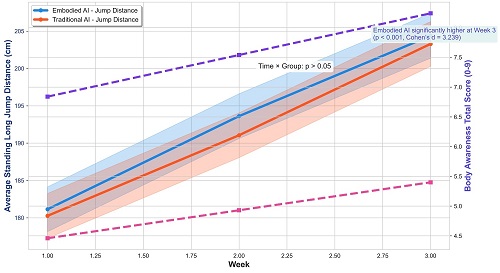
In rural low-resource physical education settings, whether an offline-priority embodied AI feedback protocol is feasible and can improve students' task-specific expression of bodily sensations still requires empirical testing. This quasi-experimental study involved 72 first-year rural high school students (36 males and 36 females) randomly assigned to either the embodied AI group or the traditional AI feedback group. Both groups completed a 3-week standing long jump intervention (one 45--60 minute class per week, with 8 attempts per class). The experimental group used an offline-priority mobile learning ecosystem---teacher smartphone rapid key frame capture, data cable offline upload, local server AI processing, and iFlyTek voice input---to guide the "awareness--prediction--re-practice'' loop, while the control group received only traditional technical feedback. The teacher circulated between the two groups during instruction. Linear mixed-effects models and Bootstrap mediation analysis were employed to examine the effects. Results showed that standing long jump distance improved by approximately 13% in both groups (embodied AI group: +13.13%; traditional AI group: +13.11%), with a non-significant time × group interaction (p > 0.05). However, the embodied AI group demonstrated significantly higher task-specific body-awareness expression scores than the control group (Cohen's d = 3.239, p < 0.001). Mediation analysis indicated that task-specific body-awareness expression did not significantly mediate the relationship between group assignment and improvement in jump performance. The findings suggest that an offline-priority embodied AI feedback protocol is feasible in rural low-resource environments and effectively enhances students' ability to describe, monitor, and predict bodily sensations in the specific context of standing long jump practice. However, it did not produce superior short-term gains in standing long jump performance compared with traditional AI feedback. Because the embodied protocol necessarily involved more dialogue turns and reflection time, future studies should employ yoked designs to isolate the independent effects of feedback type and interaction dosage.
Review
Abstract views: 1831
PDF downloads: 358
 Stamatina Kolovou, Konstantinos Lavidas, Anastasia Misirli, Warren Kidd, Vassilis Komis, Panagiotis Gridos
2026-07-14
Pages 1875-1903
Stamatina Kolovou, Konstantinos Lavidas, Anastasia Misirli, Warren Kidd, Vassilis Komis, Panagiotis Gridos
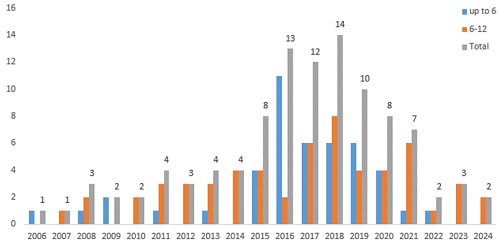
Digital Game-Based Learning (DGBL) has emerged as a promising approach for enhancing mathematics learning across educational contexts. Although previous reviews have examined the effectiveness of digital games in mathematics education, limited attention has been devoted specifically to early childhood and primary education. This systematic review synthesises empirical studies investigating the use of DGBL in mathematics education for children up to 12 years of age. Following PRISMA guidelines, studies published between 2006 and 2024 were identified through searches in Scopus, Web of Science, and Google Scholar. After applying predefined inclusion and exclusion criteria, 103 empirical studies were selected for analysis. The findings reveal a substantial increase in research activity after 2015, with Educational Technology journals being the primary publication venue. Quantitative research designs predominated, while tablets and personal computers were the most frequently used devices. Puzzle games represented the most common game genre. The majority of studies focused on Number and Operations, followed by Algebra, Geometry, and Measurement. Results indicate predominantly positive effects on students' mathematical achievement, particularly in Number and Operations and Geometry. Furthermore, digital games were associated with improvements in motivation, attitudes towards mathematics, and collaborative learning. The review highlights the educational potential of DGBL in mathematics and identifies directions for future research and practice.
Abstract views: 4302
PDF downloads: 504
 Krishna Kumari Upadhayaya
2026-05-18
Pages 1833-1844
Krishna Kumari Upadhayaya
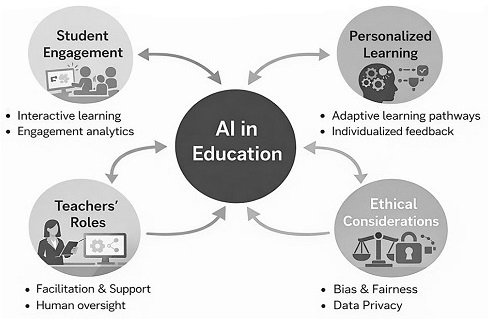
Generative artificial intelligence (AI) is changing teaching, learning, evaluation, and feedback methods in educational settings. An increasing body of research indicates that while AI-supported technologies improve efficiency, customisation, and access to learning resources, they may also reduce evidence of meaningful learning while simultaneously improving observable academic performance. Using interrelated pedagogical, cognitive, ethical, assessment, and policy viewpoints, this study critically investigates AI in education. The study provides an integrative understanding of AI integration in education by synthesizing literature from empirical investigations (n = 21), conceptual papers (n = 19), policy reports (n = 5), and one review study using a critical narrative review design. The results show that although AI improves feedback, student engagement, instructional support, and chances for adaptive learning, it also creates issues with cognitive dependence, academic integrity, algorithmic bias, data privacy, inequality, and assessment validity. The review's main conclusion is that there is a growing conflict between meaningful learning and visible academic achievement since AI-mediated outputs might not always demonstrate prolonged cognitive engagement or conceptual grasp. The study contends that pedagogical design, teacher involvement, AI literacy, institutional governance, and technological competence all play a role in the educational usefulness of AI. The paper emphasizes the necessity of learning and assessment systems that support responsible, egalitarian, and learner-centered AI integration in educational settings while preserving learner agency and making thinking visible.
Case Study
Abstract views: 885
PDF downloads: 216
 Daniel Danso Essel
2026-07-08
Pages 1857-1874
Daniel Danso Essel
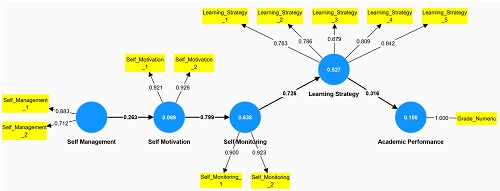
This study investigates how mobile learning supports self-directed learning (SDL) in programming education through a case study of SoloLearn. A cross-sectional survey of 708 undergraduate students at the University of Education, Winneba examined app usage, perceptions, and programming confidence, framed by Knowles’ (1975) SDL Theory and Fredricks et al.’s (2004) Student Engagement Framework. Partial least squares structural equation modeling (PLS-SEM) revealed a sequential pathway from self-management to motivation, monitoring, strategy use, and academic performance. Most participants (46.8%) reported increased confidence, while 38.4% reported improvements in real-world application skills, though challenges included limited advanced content, ad disruptions, and insufficient feedback. The findings suggest that SoloLearn effectively develops foundational SDL skills but requires adaptive features, project-based modules, and improved collaborative tools to support deeper learning. Results should be interpreted cautiously due to the single-institution, male-dominated sample. Overall, the study makes three contributions: it provides empirical evidence of a sequential SDL pathway from self-management to academic performance in mobile programming education; it demonstrates the value of combining objective grade data with self-report measures in mobile learning research; and it offers practical guidance for integrating mobile coding platforms into programming instruction across diverse educational contexts.
| eISSN: 2737-5676 Abbreviation: Adv Mobile Learn Educ Res Editor-in-Chief: Prof. Nikolaos Zaranis (Greece) Publishing Frequency: Half-Yearly Article Processing Charges (APC): 0 Publishing Model: Open Access |

