
A Pragmatic Framework for Risk-Based Vitamin D Supplementation in Epilepsy Care in Sub-Saharan Africa
Article Sidebar
Main Article Content


Abstract
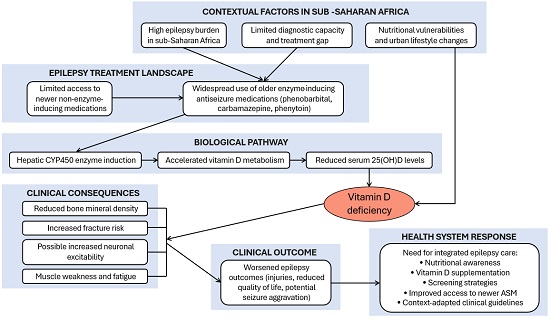
Epilepsy remains a major public health challenge in sub-Saharan Africa, where treatment options are often limited to older, low-cost enzyme-inducing antiseizure medications such as phenobarbital, carbamazepine, and phenytoin. Although these medications are essential for seizure control in resource-constrained settings, prolonged use may accelerate vitamin D metabolism and contribute to hypovitaminosis D, impaired bone mineralization, reduced bone mineral density, osteomalacia, and increased fracture risk. Despite these potential complications, vitamin D assessment is rarely integrated into epilepsy care in the region, and evidence regarding the burden of deficiency among people with epilepsy remains limited. This paper proposes a pragmatic framework for risk-based vitamin D supplementation in epilepsy care adapted to sub-Saharan African contexts. Given the limited availability and affordability of serum 25-hydroxyvitamin D testing, routine laboratory-guided screening is often not feasible. We therefore advocate for a clinically oriented risk-stratification approach prioritizing preventive supplementation among patients at highest risk of deficiency and skeletal complications. High-risk groups may include individuals receiving long-term enzyme-inducing antiseizure medications, children and adolescents, older adults, pregnant women, and patients with malnutrition, reduced sunlight exposure, or physical disability. The framework emphasizes integration of low-cost empirical vitamin D supplementation into routine epilepsy services, particularly at the primary-care level. It also highlights the need for context-adapted clinical algorithms, healthcare provider awareness, patient education, and implementation research to evaluate feasibility, safety, and cost-effectiveness in African settings. Integrating bone health into epilepsy management may represent a feasible and scalable strategy to reduce preventable morbidity and improve long-term outcomes among people living with epilepsy in sub-Saharan Africa.
Article Details

This work is licensed under a Creative Commons Attribution-NonCommercial 4.0 International License.
References
- World Health Organization. Epilepsy. 2024. https://www.who.int/news-room/fact-sheets/detail/epilepsy
- Newton CR, Garcia HH. Epilepsy in poor regions of the world. , ed. The Lancet. 2012, 380(9848): 1193-1201. https://doi.org/10.1016/s0140-6736(12)61381-6
- Meyer A-CL, Dua T, Boscardin WJ, et al. Critical determinants of the epilepsy treatment gap: A cross‐national analysis in resource‐limited settings. , ed. Epilepsia. 2012, 53(12): 2178-2185. https://doi.org/10.1111/epi.12002
- Mbuba CK, Ngugi AK, Newton CR, et al. The epilepsy treatment gap in developing countries: A systematic review of the magnitude, causes, and intervention strategies. , ed. Epilepsia. 2008, 49(9): 1491-1503. https://doi.org/10.1111/j.1528-1167.2008.01693.x
- Liu Y, Gong C, Li J, et al. Vitamin D content and prevalence of vitamin D deficiency in patients with epilepsy: a systematic review and meta-analysis. , ed. Frontiers in Nutrition. 2024, 11. https://doi.org/10.3389/fnut.2024.1439279
- Bouillon R, Carmeliet G, Verlinden L, et al. Vitamin D and Human Health: Lessons from Vitamin D Receptor Null Mice. , ed. Endocrine Reviews. 2008, 29(6): 726-776. https://doi.org/10.1210/er.2008-0004
- Teagarden DL, Meador KJ, Loring DW. Low vitamin D levels are common in patients with epilepsy. , ed. Epilepsy Research. 2014, 108(8): 1352-1356. https://doi.org/10.1016/j.eplepsyres.2014.06.008
- Sourbron J, Auvin S, Cabral‐Lim L, et al. Vitamin D prophylaxis in persons with epilepsy? , ed. Epilepsia. 2024, 65(9): 2567-2579. https://doi.org/10.1111/epi.18046
- AlGhamdi SA. Effectiveness of Vitamin D on Neurological and Mental Disorders. , ed. Diseases. 2024, 12(6): 131. https://doi.org/10.3390/diseases12060131
- Lebedev AS, Shevlyakov AD, Ilyin NP, et al. The Neurosteroid Hormone Vitamin D: Modern Prospects. , ed. Journal of Evolutionary Biochemistry and Physiology. 2024, 60(6): 2152-2171. https://doi.org/10.1134/s0022093024060024
- Liu J, Li J, Liu Y, et al. Preventive effects of vitamin D on epileptic seizures and its regulation of PTEN and autophagy in acute epilepsy mouse models. , ed. Nutritional Neuroscience. Published online December 2025: 1-22. https://doi.org/10.1080/1028415x.2025.2592265
- Bashiri FA, Hudairi A, Hamad MH, et al. Vitamin D Supplementation for Children with Epilepsy on Antiseizure Medications: A Randomized Controlled Trial. , ed. Children. 2024, 11(10): 1187. https://doi.org/10.3390/children11101187
- Aghoram R, Nair S, Nair P, et al. Pharmacological interventions for bone health in people with epilepsy. , ed. Cochrane Database of Systematic Reviews. 2024, 2024(1). https://doi.org/10.1002/14651858.cd014880
- Griepp DW, Kim DJ, Ganz M, et al. The effects of antiepileptic drugs on bone health: A systematic review. , ed. Epilepsy Research. 2021, 173: 106619. https://doi.org/10.1016/j.eplepsyres.2021.106619
- Mogire RM, Mutua A, Kimita W, et al. Prevalence of vitamin D deficiency in Africa: a systematic review and meta-analysis. , ed. The Lancet Global Health. 2020, 8(1): e134-e142. https://doi.org/10.1016/s2214-109x(19)30457-7
- Ba-Diop A, Marin B, Druet-Cabanac M, et al. Epidemiology, causes, and treatment of epilepsy in sub-Saharan Africa. , ed. The Lancet Neurology. 2014, 13(10): 1029-1044. https://doi.org/10.1016/s1474-4422(14)70114-0
- Kassahun Bekele B, Nebieridze A, Moses Daniel I, et al. Epilepsy in Africa: a multifaceted perspective on diagnosis, treatment, and community support. , ed. Annals of Medicine & Surgery. 2023, 86(1): 624-627. https://doi.org/10.1097/ms9.0000000000001536
- Stelzle D, Kaducu J, Schmidt V, et al. Characteristics of people with epilepsy in three Eastern African countries – a pooled analysis. , ed. BMC Neurology. 2022, 22(1). https://doi.org/10.1186/s12883-022-02813-z
- Menninga N, Koukounas Y, Margolis A, et al. Effects of enzyme-inducing antiseizure medication on vitamin D dosing in adult veterans with epilepsy. , ed. Epilepsy Research. 2020, 161: 106287. https://doi.org/10.1016/j.eplepsyres.2020.106287
- Gaete PV, Cuellar-Rodríguez V, Mendivil CO. Antiseizure Medications and Bone Health. , ed. Neurology and Therapy. 2025, 14(5): 1827-1844. https://doi.org/10.1007/s40120-025-00805-y
- Ramasamy I. Vitamin D Metabolism and Guidelines for Vitamin D Supplementation. , ed. Clinical Biochemist Reviews. 2020, 41(3): 103-126. https://doi.org/10.33176/aacb-20-00006
