
Vol 7 No 1 (2026)

Vol 7 No 1 (2026)
Published: 2026-02-27
Research Article
Pages 16-31
 Eugénie Bukasa Tshiami, Jacques Mbaz Musung, Patrick Tshibang Mutombo, Ernest Menshe Mukuba, Harvey Kabulo Kapya, Serge Muleka Ngoie, Levit Nvita Nsibu, Dede Lubamba, Christian Kakisingi, Olivier Mukuku, Emmanuel Kiyana Muyumba
Background: Prediabetes is an important early marker of dysglycaemia and an established risk state for the subsequent development of type 2 diabetes and cardiovascular disease. However, evidence on prediabetes among young adults in sub-Saharan Africa remains limited. This study aimed to estimate the prevalence of prediabetes and identify factors associated with prediabetes among university students in Lubumbashi, Democratic Republic of the Congo (DRC).
Methods: We conducted a descriptive cross-sectional study among students aged 18–34 years enrolled at the University of Lubumbashi during the 2025–2026 academic year. Participants were selected using simple random sampling. Sociodemographic, behavioural, anthropometric and clinical data were collected using a structured questionnaire and standardised measurement procedures. Fasting plasma glucose, glycated haemoglobin (HbA1c), lipid profile and serum creatinine were measured. Prediabetes was defined as an HbA1c level of 5.7–6.4%, while values ≥6.5% were considered compatible with probable diabetes. Participants with probable diabetes were excluded from analyses of factors associated with prediabetes. Associations were assessed using bivariate and multivariable logistic regression models, with results expressed as odds ratios (ORs) and 95% confidence intervals (CIs).
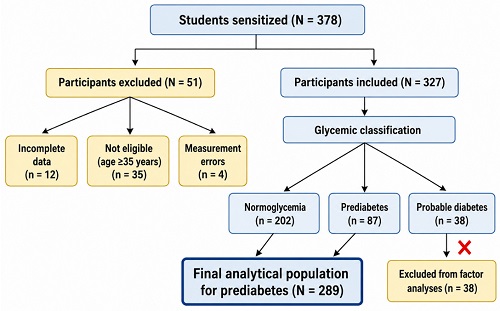
Results: Among 378 students sensitised to the study, 327 participated, corresponding to a participation rate of 86.5%. Of these, 202 (61.8%; 95% CI, 56.4–66.9) were normoglycaemic, 87 (26.6%; 95% CI, 22.1–31.7) had prediabetes, and 38 (11.6%; 95% CI, 8.6–15.6) had HbA1c values compatible with probable diabetes. Thus, 38.2% of participants had dysglycaemia. Among the 289 participants included in the comparative analysis of normoglycaemia versus prediabetes, the mean age was 22.96 ± 2.89 years, and the prevalence of prediabetes was 30.1%. Most sociodemographic, anthropometric, behavioural and clinical characteristics were not significantly associated with prediabetes. Prediabetic participants had lower mean HDL-cholesterol concentrations than normoglycaemic participants (42.92 ± 11.80 vs 49.82 ± 14.77 mg/dL; p < 0.001). In multivariable analysis, HDL-cholesterol remained independently associated with prediabetes (adjusted OR, 0.97; 95% CI, 0.94–0.99; p = 0.012), corresponding to approximately 3% lower odds of prediabetes per 1 mg/dL increase in HDL-cholesterol.
Conclusion: Prediabetes was common among university students in Lubumbashi, affecting approximately one in four students overall and nearly one in three participants after exclusion of those with probable diabetes. HDL-cholesterol was the only factor independently associated with prediabetes. The high burden of dysglycaemia observed in this young population highlights the importance of early metabolic risk assessment and prevention strategies among young adults in the DRC.
Review
Pages 9-15
Hilaire Abwa Lisimo, Olivier Mukuku, François Maheshe Polepole, Archippe Muhandule Birindwa, Célestin Kaputu Kalala Malu, Stanislas Okitotsho Wembonyama
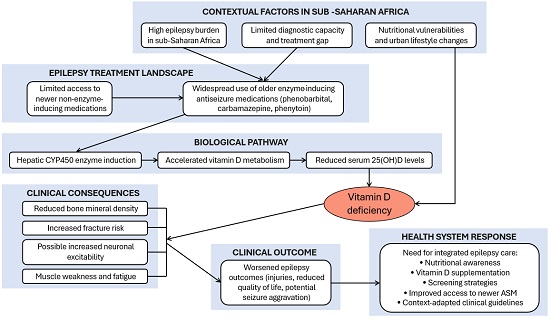
Epilepsy remains a major public health challenge in sub-Saharan Africa, where treatment options are often limited to older, low-cost enzyme-inducing antiseizure medications such as phenobarbital, carbamazepine, and phenytoin. Although these medications are essential for seizure control in resource-constrained settings, prolonged use may accelerate vitamin D metabolism and contribute to hypovitaminosis D, impaired bone mineralization, reduced bone mineral density, osteomalacia, and increased fracture risk. Despite these potential complications, vitamin D assessment is rarely integrated into epilepsy care in the region, and evidence regarding the burden of deficiency among people with epilepsy remains limited. This paper proposes a pragmatic framework for risk-based vitamin D supplementation in epilepsy care adapted to sub-Saharan African contexts. Given the limited availability and affordability of serum 25-hydroxyvitamin D testing, routine laboratory-guided screening is often not feasible. We therefore advocate for a clinically oriented risk-stratification approach prioritizing preventive supplementation among patients at highest risk of deficiency and skeletal complications. High-risk groups may include individuals receiving long-term enzyme-inducing antiseizure medications, children and adolescents, older adults, pregnant women, and patients with malnutrition, reduced sunlight exposure, or physical disability. The framework emphasizes integration of low-cost empirical vitamin D supplementation into routine epilepsy services, particularly at the primary-care level. It also highlights the need for context-adapted clinical algorithms, healthcare provider awareness, patient education, and implementation research to evaluate feasibility, safety, and cost-effectiveness in African settings. Integrating bone health into epilepsy management may represent a feasible and scalable strategy to reduce preventable morbidity and improve long-term outcomes among people living with epilepsy in sub-Saharan Africa.
Pages 1-8
The Management of Atopic Dermatitis in Primary Care Paediatrics
Hiba Al-Rawi
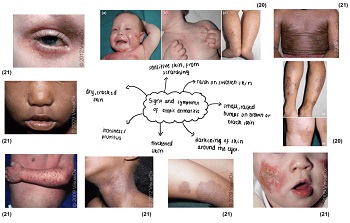
Atopic dermatitis in children is a common presentation within the primary care setting. Atopic dermatitis has general symptoms, but presentation may vary among individuals. A systematic approach of treatment for atopic dermatitis is explored- topical emollients, corticosteroids and calcineurin inhibitors, as well as phototherapy, immunosuppression and immunotherapy. Owing to limited dermatological experience and condition-specific expertise, primary care doctors are reluctant to use specific treatments, particularly when it comes to children. The first stage of atopic dermatitis management is its diagnosis. Following this, comes treatment. Recognising and having familiarity with the condition in both these aspects is essential. It is a lifelong condition, hence optimising its management should be a priority. All recommended treatments show great efficacy when it comes to management. Knowing when to use what treatment, depending on circumstance and severity is essential for improving its overall prognosis. An area with growing research in particular is the use of immunotherapy for its management, with studies proving its significant improvements on patient outcomes.
