
Vol 9 No 1 (2026)

Vol 9 No 1 (2026)
Published: 2026-02-10
Research Article
Pages 321-333
 Hugh Klein, Thomas Alex Washington
Purpose: Very little research has examined the issue of visual conformity with one's affirmed gender (commonly referred to as "passing'') among transgender persons. This paper examines this phenomenon and its relationship to psychological distress in a sample of transgender adults.
Methods: Data from the 2015 U.S. National Transgender Survey were used to examine the relationship between visual conformity with one's gender-of-identity (dichotomous measure) and overall level of psychological distress (scale measure) in a sample of 26,649 transgender Americans aged 18 or older. Multivariate and structural equation analyses were preformed to examine the data.
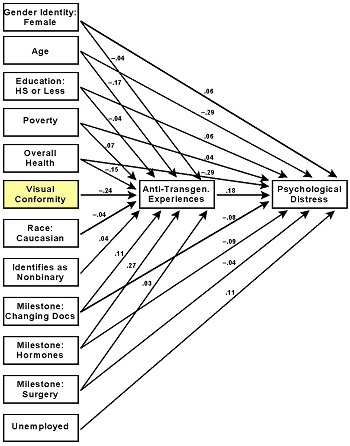
Results: 55% of the study participants reported attaining visual conformity with their affirmed gender. Visual conformity was related to psychological distress in bivariate analysis, but its effects were rendered statistically nonsignificant in a multivariate analysis. Structural equation analysis showed that visual conformity has a significant, inverse impact upon the number of anti-transgender experiences people incur and those experiences, in turn, are related directly and strongly to psychological distress.
Conclusions: Visual conformity with one's gender-of-identity is an important consideration when trying to understand the extent to which transgender persons experience psychological distress. Its effects operate indirectly, though, principally through their impact upon the number of anti-transgender acts of discrimination, harassment, and violence that people incurred.
