Aims and Scope

ReviewerCreditsJournal of Pharmaceutical and Biopharmaceutical Research (JPBR) (eISSN:2630-533X)  is an open access, continuously published, international, refereed  journal. The aim of the journal is to provide the authors a timely and peer reviewed process for evaluation and publication of their manuscripts. All articles submitted to JPBR will undergo a rigorous double-blind peer review, and all published articles can be downloaded and read for free. JPBR will pay wide attention to the trends in related fields and insist on publishing original research work of highest quality.

JPBR publishes high quality original research work, reviews, and short communications in the following areas:
Pharmaceutical Sciences:
• Pharmaceutics
• Pharmacology and Toxicology
• Medicinal Chemistry
• Physical Pharmacy
• Pharmaceutical Analysis
• Chromatography and Hyphenated Techniques
• Pharmacognosy and Phytochemistry
• Nanotechnology for Pharmaceutical Drug Formulations
Biopharmaceutical Sciences:
• Biochemistry
• Biotechnology
• Molecular Biology
• Immunology and Microbiology

2024-01-16

Call for papers for the special issue: Beta coronaviruses

The Special Issue wish to cover the widest range of research with the different beta coronaviruses, focusing on the SARS-CoV-2. To encourage researchers both from the academia and the industry, the journal offers 100% waiver for those authors who submit their manuscript before May 31, 2024. We wish to ask researchers who know the field and are active practitioners of any field segment to participate.

Vol 8 No 1 (2026)

Published: 2026-05-22

Abstract views: 435   PDF downloads: 106  
2026-05-22

Pages 535-550

Pharmaceutical Design, Formulation Optimization, and In Vitro Performance Profiling of Generic Lymecycline Capsules Using Validated Analytical Methods

blankpage Ali Raza, Asma Nawaz Khaskheli, Noor Zulfiqar, Muhammad Asad Ali
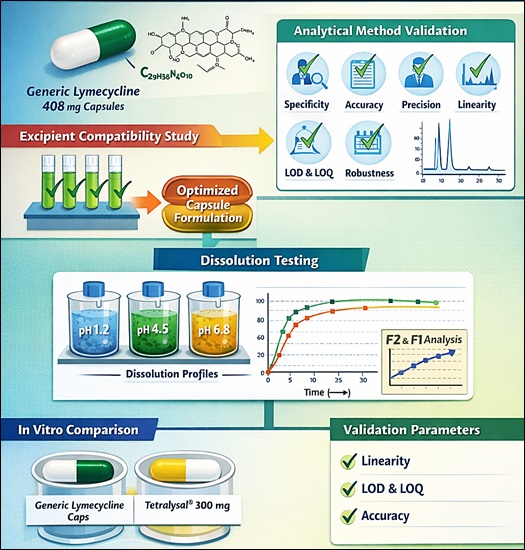
This study documents the stepwise development and evaluation of a generic Lymecycline 408 mg hard gelatin capsule manufactured locally in Pakistan. The formulation process began with the selection of suitable pharmacopeial excipients after conducting accelerated compatibility testing to ensure that no undesirable physical or chemical interactions occurred with the active ingredient. Based on these preliminary investigations, a stable capsule composition was finalized. The finished capsules were evaluated according to British Pharmacopoeia requirements. All tested quality attributes, including assay, dissolution behavior, content uniformity, and moisture content, were found to comply with the specified limits. These results confirmed the consistency and integrity of the developed dosage form. Quantitative analysis of Lymecycline was carried out using a high-performance liquid chromatography method that was validated prior to routine application. During validation, parameters such as specificity, precision under repeat and intermediate conditions, accuracy through recovery assessment, robustness against minor variations, and system suitability were carefully examined. The method demonstrated reliable and reproducible performance in line with internationally accepted regulatory standards. To assess comparative in-vitro performance, dissolution testing was performed using the USP paddle method in media representing gastric and intestinal pH conditions (pH 1.2, 4.5, and 6.8). In all cases, more than 85% of the drug was released within one hour. Statistical comparison with the reference product, Tetralysal® 300 mg, showed acceptable similarity and difference factor values, indicating comparable release profiles. Overall, the data support that the developed formulation performs equivalently to the reference product and may be considered suitable for local production and further regulatory processing.

Abstract views: 213   PDF downloads: 38  
2026-07-13

Pages 551-568

A Review on Resmetirom: An Oral Thyroid Hormone Receptor-β Agonist for the Treatment of Metabolically dysfunction-Associated Steatohepatitis (MASH)

blankpage Sakshi Mahalpure, Gaurav Sanjay Mahalpure, Vandana Daga, Hemal Nehete

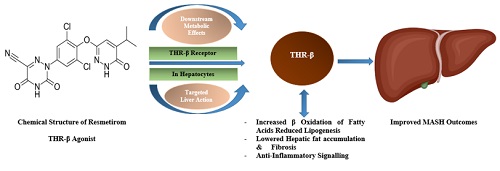
Metabolically dysfunction-associated steatohepatitis (MASH) is a progressive liver condition associated with type 2 diabetes (T2D), obesity, and dyslipidaemia, all of which are components of metabolic syndrome. In 2024, resmetirom, a selective thyroid hormone receptor-β (THR-β) agonist, became the first treatment for non-cirrhotic MASH with mild to advanced fibrosis to receive FDA approval, and in 2025, it was conditionally approved by the European Medicines Agency (EMA) for fibrotic MASH. Resmetirom enhances β-oxidation and lipid metabolism, leading to a reduction in hepatic fat, inflammation, and fibrosis, while minimizing systemic effects on the thyroid or heart. It is intended to be used alongside lifestyle modifications, such as dietary changes and exercise, to optimize patient outcomes. Nevertheless, discrepancies between clinical trial populations and real-world payer criteria reveal access challenges that necessitate policy reform. Effective screening programs rely on educating healthcare providers from various disciplines and establishing consistent standards. Future research should investigate the potential of resmetirom in combination with agents such as GLP-1 receptor agonists, SGLT2 inhibitors, and statins, particularly in light of recent long-term safety data regarding these drug classes and their effects on the thyroid axis. Achieving equitable access will require fair payer endpoints, cost-effectiveness evaluations, and consideration of patient-reported outcomes. Resmetirom signifies a significant advancement in the management of MASH, providing metabolic advantages in conjunction with clinical and lifestyle interventions. Metabolically-dysfunctional-associated steatotic liver disease (MASLD) impacts nearly one-third of adults globally, with 10–30% of cases progressing to MASH or fibrosis, especially in individuals with obesity or type 2 diabetes. Current guidelines endorse resmetirom for non-cirrhotic fibrotic MASH (typically LSM-VCTE 10–20 kPa or MRE 3.1–4.4 kPa), while excluding patients with cirrhosis, active liver disease, substantial alcohol consumption, or untreated thyroid disorders. Monitoring protocols include assessing hepatic safety, thyroid function when necessary, and evaluating response through non-invasive tests and ALT measurements after 6–12 months. Data from the real world indicate a swift adoption of non-invasive eligibility tools, initial enhancements in liver stiffness, and a common concurrent use of GLP-1 receptor agonists, with the response being independent of weight-loss therapies. With the recent approval of semaglutide for fibrotic MASH, determining the optimal integration of resmetirom within treatment algorithms, exploring combination strategies with GLP-1 receptor agonists, and assessing the long-term impacts on liver and cardiometabolic outcomes are essential priorities. This review consolidates the evidence supporting the conditional approval of resmetirom, delineates current clinical guidelines, shares early real-world experiences, and emphasizes the ongoing challenges and future directions in the management of fibrotic MASH.

View All Issues
JPBR-cover-logo  ISSN: 2630-533X
 Abbreviation: J Pharm Biopharm Res
 Editor-in-Chief: Prof. Pal Perjesi (Hungary)
 Publishing Frequency: Continuous publication
 Article Processing Charges (APC):
Click  here  for more details
 Publishing Model:
Open Access