
Dynamic Visualization and Conceptual Understanding of Circle Theorems Through Teacher-Mediated GeoGebra Use: An Action Research in a Grade 10 Classroom in Nepal
Article Sidebar
Main Article Content


Abstract
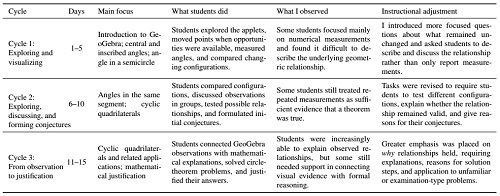
Developing conceptual understanding in geometry remains challenging when circle theorems are learned primarily through memorization, static diagrams, and procedural exercises. Dynamic geometry environments may provide opportunities for students to explore geometric relationships, but how such exploration contributes to mathematical reasoning requires closer qualitative examination. This study explored how Grade 10 students developed conceptual understanding of circle theorems during GeoGebra-supported learning activities in a secondary mathematics classroom in Pokhara, Nepal. A qualitative action-research design was conducted over 15 instructional days with 32 students, with six focal participants selected for detailed analysis. The intervention comprised three cycles of planning, action, observation, and reflection. GeoGebra applets were projected using a single teacher-operated laptop, with limited shared student manipulation during selected group activities. Data were generated through classroom observations, student worksheets and reflective responses, semi-structured interviews, and a reflective journal, and were analyzed thematically. Three interconnected themes emerged: developing conceptual understanding through dynamic visualization; moving from dynamic observation to mathematical reasoning and justification; and peer interaction and teacher scaffolding in mathematical reasoning. Students increasingly recognized invariants, explored conjectures, and connected visual observations with mathematical explanations, although some initially relied on visual appearance or repeated measurements without sufficient justification. The findings position GeoGebra as a teacher-mediated resource rather than an independent cause of conceptual learning. Its educational value depended on purposeful task design, teacher questioning, peer interaction, and opportunities to connect dynamic exploration with mathematical reasoning, particularly in resource-constrained classrooms.
Article Details

This work is licensed under a Creative Commons Attribution-NonCommercial 4.0 International License.
References
- Arbain, N., & Shukor, N. A. (2015). The Effects of GeoGebra on Students Achievement. Procedia - Social and Behavioral Sciences, 172, 208–214. https://doi.org/10.1016/j.sbspro.2015.01.356
- Bakar, K. A., Ayub, A. F. M., Luan, W. S., & Tarmizi, R. A. (2010). Exploring secondary school students’ motivation using technologies in teaching and learning mathematics. Procedia-Social and Behavioral Sciences, 2(2), 4650-4654. https://doi.org/10.1016/j.sbspro.2010.03.744
- Boonen, A. J. H., van Wesel, F., Jolles, J., & van der Schoot, M. (2014). The role of visual representation type, spatial ability, and reading comprehension in word problem solving: An item-level analysis in elementary school children. International Journal of Educational Research, 68, 15–26. https://doi.org/10.1016/j.ijer.2014.08.001
- Braun, V., & Clarke, V. (2021). One size fits all? What counts as quality practice in (reflexive) thematic analysis?. Qualitative research in psychology, 18(3), 328-352. https://doi.org/10.1080/14780887.2020.1769238
- Chimuka, A. (2017). The effect of integration of GeoGebra software in the teaching of circle geometry on Grade 11 students’ achievement [Master’s dissertation, University of South Africa]. University of South Africa Institutional Repository.
- Dahal, N., Pant, B. P., Shrestha, I. M., & Manandhar, N. K. (2022). Use of GeoGebra in teaching and learning geometric transformation in school mathematics. International Journal of Interactive Mobile Technologies, 16(8), 65–78. https://doi.org/10.3991/ijim.v16i08.29575
- Hohenwarter, M., & Jones, K. (2007). Ways of linking geometry and algebra, the case of Geogebra. Proceedings of the British Society for research into Learning Mathematics, 27(3), 126-131.
- Hollebrands, K. F., Lee, H. S., & Straub, C. (2023). Technology-supported mathematics instruction and students’ conceptual understanding. Journal for Research in Mathematics Education, 54(2), 89–118. https://doi.org/10.5951/jresematheduc-2021-0258
- Jones, K. (2003). Issues in the teaching and learning of geometry. In Aspects of teaching secondary mathematics (pp. 137-155). Routledge.
- Kemmis, S., McTaggart, R., & Nixon, R. (2014). The Action Research Planner (, Ed.). Springer Singapore. https://doi.org/10.1007/978-981-4560-67-2
- Lamichhane, B. R., Dahal, N., & Luitel, B. C. (2023). Secondary level mathematics teachers’ critical reflections on the use of GeoGebra for teaching trigonometry. The Electronic Proceedings of the 28th Asian Technology Conference in Mathematics, 28, 418–428. https://atcm.mathandtech.org/EP2023/regular/30100.pdf
- Ministry of Education. Science and Technology [MoEST]. (2013). National ICT in education master plan. Government of Nepal.
- National Council of Teachers of Mathematics. (2014). Principles to actions: Ensuring mathematical success for all. National Council of Teachers of Mathematics.
- Pant, B. P., Dahal, N., & Luitel, B. C. (2024). Teachers’ narratives on integrating GeoGebra for enhancing conceptual understanding in mathematics. Paper presented at the 29th Asian Technology Conference in Mathematics (ATCM 2024), Yogyakarta, Indonesia.
- Pólya, G., & Conway, J. H. (1957). How to solve it: A new aspect of mathematical method (p. 2015). Princeton: Princeton university press.
- Skemp, R. R. (1976). Relational understanding and instrumental understanding. Mathematics teaching, 77(1), 20-26.
- Thapa, R., Dahal, N., & Pant, B. P. (2022). GeoGebra integration in high school mathematics: An experiential exploration on concepts of circle. Mathematics Teaching-Research Journal, 14(5), 16-33. https://doi.org/10.5281/zenodo.14878861
- Vygotsky, L. S. (1978). Mind in society: The development of higher psychological processes. Harvard University Press.
- Zengin, Y., Furkan, H., & Kutluca, T. (2012). The effect of dynamic mathematics software geogebra on student achievement in teaching of trigonometry. Procedia - Social and Behavioral Sciences, 31, 183–187. https://doi.org/10.1016/j.sbspro.2011.12.038
- Zulnaidi, H., & Syed Zamri, S. N. A. (2017). The Effectiveness of the GeoGebra Software: The Intermediary Role of Procedural Knowledge On Students’ Conceptual Knowledge and Their Achievement in Mathematics. EURASIA Journal of Mathematics, Science and Technology Education, 13(6). https://doi.org/10.12973/eurasia.2017.01219a
