
Effects of a Realistic Mathematics Education-Based Tablet Intervention on Second-Grade Addition Skills
Article Sidebar
Main Article Content


Abstract
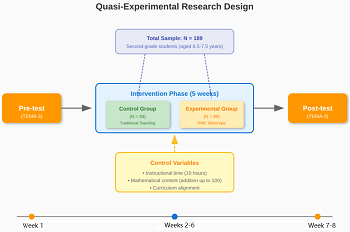
This study investigated the effectiveness of a didactic intervention utilizing a custom-developed tablet application, grounded in Realistic Mathematics Education (RME) principles, on second-grade students' addition skills (numbers up to 100). A quasi-experimental design with pre-test/post-test control group structure was employed. The sample consisted of 189 second-grade students (aged 6.5-7.5 years) from four public primary schools in Attica, Greece, during the 2022-2023 school year. Participants were assigned to either an experimental group (N = 96), receiving the RME-based tablet intervention for five weeks, or a control group (N = 93), receiving traditional instruction. Mathematical proficiency was assessed using an adapted version of the Test of Early Mathematics Ability, Third Edition (TEMA-3). Results from paired samples t-tests revealed significant improvements from pre-test to post-test for both the experimental group and control group on overall mathematics scores. However, a Mixed Repeated Measures ANOVA demonstrated a significant Time × Group interaction effect, indicating that the experimental group's improvement significantly exceeded that of the control group. These findings suggest that integrating RME principles with custom-designed tablet applications can substantially enhance young learners' mathematical understanding.
Article Details

This work is licensed under a Creative Commons Attribution-NonCommercial 4.0 International License.
References
- Aspiranti, K. B., & Larwin, K. H. (2021). Investigating the Effects of Tablet-Based Math Interventions: A Meta-Analysis. International Journal of Technology in Education and Science, 5(4), 629–647. https://doi.org/10.46328/ijtes.266
- Bliss, S. (2006). Test of Early Mathematics Ability–Third Edition. Journal of Psychoeducational Assessment, 24(1), 85–98. https://doi.org/10.1177/0734282905282839
- Cheung, A. C. K., & Slavin, R. E. (2013). The effectiveness of educational technology applications for enhancing mathematics achievement in K-12 classrooms: A meta-analysis. Educational Research Review, 9, 88–113. https://doi.org/10.1016/j.edurev.2013.01.001
- Claessens, A., Duncan, G., & Engel, M. (2009). Kindergarten skills and fifth-grade achievement: Evidence from the ECLS-K. Economics of Education Review, 28(4), 415–427. https://doi.org/10.1016/j.econedurev.2008.09.003
- Cohen, L., Manion, L., & Morrison, K. (2017). Research Methods in Education. Routledge. https://doi.org/10.4324/9781315456539
- Duncan, G. J., Dowsett, C. J., Claessens, A., Magnuson, K., Huston, A. C., Klebanov, P., Pagani, L. S., Feinstein, L., Engel, M., Brooks-Gunn, J., Sexton, H., Duckworth, K., & Japel, C. (2007). School readiness and later achievement. Developmental Psychology, 43(6), 1428–1446. https://doi.org/10.1037/0012-1649.43.6.1428
- Fauzan, A., Harisman, Y., Yerizon, Y., Suherman, S., Tasman, F., Nisa, S., Sumarwati, S., Hafizatunnisa, H., & Syaputra, H. (2024). Realistic mathematics education (RME) to improve literacy and numeracy skills of elementary school students based on teachers’ experience. Infinity Journal, 13(2), 301–316. https://doi.org/10.22460/infinity.v13i2.p301-316
- Fraenkel, J. R., Wallen, N. E., & Hyun, H. H. (2018). How to design and evaluate research in education (10th ed.). McGraw-Hill.
- Freudenthal, H. (1991). Revisiting mathematics education: China lectures. Kluwer Academic Publishers.
- Fuson, K. C. (2006). Research on Whole Number Addition and Subtraction. Handbook of Research on Mathematics Teaching and Learning, 243–275. https://doi.org/10.1108/978-1-60752-874-620251016
- Ginsburg, H. P., & Baroody, A. J. (2003). Test of Early Mathematics Ability (3rd ed.). PRO-ED.
- Gravemeijer, K. (1994). Developing realistic mathematics education. CD-B Press.
- Jordan, N. C., Kaplan, D., Ramineni, C., & Locuniak, M. N. (2009). Early math matters: Kindergarten number competence and later mathematics outcomes. Developmental Psychology, 45(3), 850–867. https://doi.org/10.1037/a0014939
- Outhwaite, L. A., Faulder, M., Gulliford, A., & Pitchford, N. J. (2019). Raising early achievement in math with interactive apps: A randomized control trial. Journal of Educational Psychology, 111(2), 284–298. https://doi.org/10.1037/edu0000286
- Outhwaite, L. A., Gulliford, A., & Pitchford, N. J. (2017). Closing the gap: Efficacy of a tablet intervention to support the development of early mathematical skills in UK primary school children. Computers & Education, 108, 43–58. https://doi.org/10.1016/j.compedu.2017.01.011
- Papadakis, S., Kalogiannakis, M., & Zaranis, N. (2016). Comparing Tablets and PCs in teaching Mathematics: An attempt to improve Mathematics Competence in Early Childhood Education. Preschool and Primary Education, 4(2), 241. https://doi.org/10.12681/ppej.8779
- Papadakis, S., Kalogiannakis, M., & Zaranis, N. (2021). Teaching mathematics with mobile devices and the Realistic Mathematical Education (RME) approach in kindergarten. Advances in Mobile Learning Educational Research, 1(1), 5–18. https://doi.org/10.25082/amler.2021.01.002
- Patton, E. W., Tissenbaum, M., & Harunani, F. (2019). MIT App Inventor: Objectives, Design, and Development. Computational Thinking Education, 31–49. https://doi.org/10.1007/978-981-13-6528-7_3
- Pitchford, N. J., Kamchedzera, E., Hubber, P. J., & Chigeda, A. L. (2018). Interactive Apps Promote Learning of Basic Mathematics in Children With Special Educational Needs and Disabilities. Frontiers in Psychology, 9. https://doi.org/10.3389/fpsyg.2018.00262
- Petousi, V., & Sifaki, E. (2020). Contextualising harm in the framework of research misconduct. Findings from discourse analysis of scientific publications. International Journal of Sustainable Development, 23(3/4), 149. https://doi.org/10.1504/ijsd.2020.115206
- Ricoy, M.-C., & Sánchez-Martínez, C. (2023). Tablet-Based Praxis Developed for Children in Primary Education Studying Natural Sciences and Mathematics. Children, 10(2), 250. https://doi.org/10.3390/children10020250
- Şanal, S. Ö., & Elmali, F. (2023). Effectiveness of realistic math education on mathematical problem-solving skills of students with learning disability. European Journal of Special Needs Education, 39(1), 109–126. https://doi.org/10.1080/08856257.2023.2191110
- Schacter, J., & Jo, B. (2017). Improving preschoolers’ mathematics achievement with tablets: a randomized controlled trial. Mathematics Education Research Journal, 29(3), 313–327. https://doi.org/10.1007/s13394-017-0203-9
- Shadish, W. R., Cook, T. D., & Campbell, D. T. (2002). Experimental and quasi-experimental designs for generalized causal inference. Houghton Mifflin.
- Skordialos, E. (2024). Empowering Mathematics Education in Greek Primary Schools: Bridging the Divide through ICT Integration and Interactive Boards for Enhanced Teacher ICT Literacy. European Journal of Education and Pedagogy, 5(2), 59–63. https://doi.org/10.24018/ejedu.2024.5.2.779
- Skordialos, E. (2024b). Enhancing primary school geometry education: A comprehensive exploration of the Van Hiele model and ICT integration. Science and Technology, 8(2), 1655-1659.
- Svane, R. P., Willemsen, M. M., Bleses, D., Krøjgaard, P., Verner, M., & Nielsen, H. S. (2023). A systematic literature review of math interventions across educational settings from early childhood education to high school. Frontiers in Education, 8. https://doi.org/10.3389/feduc.2023.1229849
- Tong, D. H., Loc, N. P., Uyen, B. P., & Cuong, P. H. (2020). Applying Experiential Learning to Teaching the Equation of a Circle: A Case Study. European Journal of Educational Research, volume-9-2020(volume9-issue1.html), 239–255. https://doi.org/10.12973/eu-jer.9.1.239
- Van de Walle, J. A., Karp, K. S., & Bay-Williams, J. M. (2018). Elementary and middle school mathematics: Teaching developmentally (10th ed.). Pearson.
- Van den Heuvel-Panhuizen, M., & Drijvers, P. (2020). Realistic Mathematics Education. Encyclopedia of Mathematics Education, 713–717. https://doi.org/10.1007/978-3-030-15789-0_170
- Vygotsky, L. S. (1978). Mind in society: The development of higher psychological processes. Harvard University Press.
- Yao, S.-Y., Muñez, D., Bull, R., Lee, K., Khng, K. H., & Poon, K. (2016). Rasch Modeling of the Test of Early Mathematics Ability–Third Edition With a Sample of K1 Children in Singapore. Journal of Psychoeducational Assessment, 35(6), 615–627. https://doi.org/10.1177/0734282916651021
- Zaranis, N., Kalogiannakis, M., & Papadakis, S. (2013). Using Mobile Devices for Teaching Realistic Mathematics in Kindergarten Education. Creative Education, 04(07), 1–10. https://doi.org/10.4236/ce.2013.47a1001
- Zaranis, N., Baralis, G., & Skordialos, E. (2015a). Comparing the effectiveness of using ICT for teaching addition in the first grade students based on Realistic Mathematics Education. In Proceedings of the 2nd International Conference on Internet, E-Learning and Education Technology (pp. 52-59). ICIEET.
- Zaranis, N., Baralis, G., & Skordialos, E. (2015b). The use of ICT in teaching subtraction to the first grade students. In Proceedings of the Fourteenth TheIIER International Conference (pp. 99-104). TheIIER. ISBN: 978-93-82702-72-6.
