
A Teacher's Concerns about AI in Primary School: Critical Thinking, Personal Data and the Fear of Cognitive Dependence
Article Sidebar
Main Article Content


Abstract
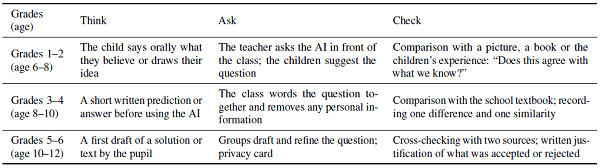
Generative artificial intelligence (AI) is already part of pupils' everyday lives and of school life. Written from the perspective of a primary school teacher and principal, this perspective paper examines three interrelated concerns of the author herself. These concerns arose from a wish to protect her pupils and led her to study the topic for her own professional development and to help her colleagues make teaching safer and better. They concern developing critical thinking towards AI-generated answers, protecting the personal data of minors, and the fear that excessive assistance from AI will weaken pupils' thinking. Drawing on a narrative, non-systematic review of recent research on cognitive offloading, the European and Greek regulatory framework, and illustrative examples from the author's own teaching practice and lesson scenarios for primary school, it argues that the fear of cognitive dependence is a plausible concern rather than an established finding for primary school pupils. The available evidence, which comes mainly from adolescents and adults, suggests that the form of AI support (whether it replaces the learner's effort or scaffolds it) may be an important factor. AI is regarded throughout as a valuable tool; the risk lies mainly in the way it is used. The classroom examples come from ordinary lessons whose only purpose was to teach pupils to question AI answers and to protect themselves when using AI. They were not planned as research, no research data were collected, and they are offered as the author's practitioner reflections, not as findings. The author's classroom experience illustrates that such activities can be implemented in ordinary primary school lessons, but their effects on pupils' critical thinking have not yet been evaluated. The paper relates the three concerns to long-standing educational principles, in particular Socratic questioning, Dewey's reflective thought and Vygotskian scaffolding. On this basis, it proposes a simple, as yet untested three-step classroom protocol (``think -- ask -- check''), age-appropriate data protection rules, and a role for school leadership, and outlines questions for future research.
Article Details

This work is licensed under a Creative Commons Attribution-NonCommercial 4.0 International License.
References
- Bastani, H., Bastani, O., Sungu, A., Ge, H., Kabakcı, Ö., & Mariman, R. (2025). Generative AI without guardrails can harm learning: Evidence from high school mathematics. Proceedings of the National Academy of Sciences, 122(26). https://doi.org/10.1073/pnas.2422633122
- Bjork, R. A. (1994). Memory and Metamemory Considerations in the Training of Human Beings. Metacognition, 185–206. https://doi.org/10.7551/mitpress/4561.003.0011
- Bruner, J. S. (1961). The act of discovery. Harvard Educational Review, 31(1), 21–32.
- Dahmani, L., & Bohbot, V. D. (2020). Habitual use of GPS negatively impacts spatial memory during self-guided navigation. Scientific Reports, 10(1). https://doi.org/10.1038/s41598-020-62877-0
- Dewey, J. (1910). How we think. (, Ed.). D C Heath. https://doi.org/10.1037/10903-000
- Facione, P. A. (1990). Critical thinking: A statement of expert consensus for purposes of educational assessment and instruction (The Delphi Report). The California Academic Press.
- Freire, P. (1970). Pedagogy of the oppressed (M. B. Ramos, Trans.). Herder and Herder.
- Gerlich, M. (2025). AI Tools in Society: Impacts on Cognitive Offloading and the Future of Critical Thinking. Societies, 15(1), 6. https://doi.org/10.3390/soc15010006
- Ji, Z., Lee, N., Frieske, R., Yu, T., Su, D., Xu, Y., Ishii, E., Bang, Y. J., Madotto, A., & Fung, P. (2023). Survey of Hallucination in Natural Language Generation. ACM Computing Surveys, 55(12), 1–38. https://doi.org/10.1145/3571730
- Kareli, F. (2026, November 20–22). Artificial intelligence as an assistive technology for the inclusion of students with learning difficulties and ADHD: Eleven examples of application in primary school [Unpublished conference paper, accepted for oral presentation; proceedings forthcoming]. 49th International Conference of Humanities and Social Sciences “Special Needs Sciences”, Institute of Culture, Democracy and Education, Patras, Greece (online). [In Greek]
- Kasneci, E., Sessler, K., Küchemann, S., Bannert, M., Dementieva, D., Fischer, F., Gasser, U., Groh, G., Günnemann, S., Hüllermeier, E., Krusche, S., Kutyniok, G., Michaeli, T., Nerdel, C., Pfeffer, J., Poquet, O., Sailer, M., Schmidt, A., Seidel, T., et al. (2023). ChatGPT for good? On opportunities and challenges of large language models for education. Learning and Individual Differences, 103, 102274. https://doi.org/10.1016/j.lindif.2023.102274
- Katsampoxaki-Hodgetts, K., Kotsidis, K., Papadakis, S., & Anastasiades, P. (2025). Reimagining preschool pedagogy: AI-enhanced teaching through multiliteracies-informed curriculum innovation. In V. Lamanauskas (Ed.), Science and technology education: Expectations and experiences (Proceedings of the 6th International Baltic Symposium on Science and Technology Education, BalticSTE2025) (pp. 104–119). Scientia Socialis. https://doi.org/10.33225/BalticSTE/2025.104
- Kosmyna, N., Hauptmann, E., Yuan, Y. T., Situ, J., Liao, X.-H., Beresnitzky, A. V., Braunstein, I., & Maes, P. (2025). Your brain on ChatGPT: Accumulation of cognitive debt when using an AI assistant for essay writing task [Preprint]. arXiv. https://doi.org/10.48550/arXiv.2506.08872
- Law. (2019). 4624/2019. Hellenic Data Protection Authority, measures for implementing Regulation (EU) 2016/679 and transposition of Directive (EU) 2016/680 into national law. Government Gazette of the Hellenic Republic, A 137, 29.08.2019. [In Greek]
- Lee, H. P., Sarkar, A., Tankelevitch, L., Drosos, I., Rintel, S., Banks, R., & Wilson, N. (2025). The impact of generative AI on critical thinking: Self-reported reductions in cognitive effort and confidence effects from a survey of knowledge workers. In Proceedings of the 2025 CHI conference on human factors in computing systems (pp. 1-22). https://doi.org/10.1145/3706598.3713778
- Livingstone, S., Stoilova, M., & Nandagiri, R. (2019). Children’s data and privacy online: Growing up in a digital age. An evidence review. London School of Economics and Political Science.
- Long, D., & Magerko, B. (2020). What is AI Literacy? Competencies and Design Considerations. Proceedings of the 2020 CHI Conference on Human Factors in Computing Systems, 1–16. https://doi.org/10.1145/3313831.3376727
- Miao, F., & Holmes, W. (2023). Guidance for generative AI in education and research. UNESCO. https://doi.org/10.54675/ewzm9535
- Miao, F., & Shiohira, K. (2024). AI competency framework for students. UNESCO Publishing. https://doi.org/10.54675/jkjb9835
- Ministerial Decision. (2026). 55909/Delta6/2026. Determination of issues relating to the use of artificial intelligence systems in the educational process and the protection of personal data. Government Gazette of the Hellenic Republic, B 2639, 12.05.2026. [In Greek]
- Montessori, M. (1912). The Montessori method (A. E. George, Trans.). Frederick A. Stokes.
- Parasuraman, R., & Manzey, D. H. (2010). Complacency and Bias in Human Use of Automation: An Attentional Integration. Human Factors: The Journal of the Human Factors and Ergonomics Society, 52(3), 381–410. https://doi.org/10.1177/0018720810376055
- Pestalozzi, J. H. (1894). How Gertrude teaches her children (L. E. Holland & F. C. Turner, Trans.). Swan Sonnenschein.
- Regulation (EU). (2016). 2016/679 of the European Parliament and of the Council of 27 April 2016 on the protection of natural persons with regard to the processing of personal data and on the free movement of such data (General Data Protection Regulation). Official Journal of the European Union, L 119, 4.5.2016.
- Regulation (EU) 2024/1689 of the European Parliament and of the Council of 13 June 2024 laying down harmonised rules on artificial intelligence (Artificial Intelligence Act). Official Journal of the European Union, L, 2024/1689, 12.7.2024.
- Risko, E. F., & Gilbert, S. J. (2016). Cognitive Offloading. Trends in Cognitive Sciences, 20(9), 676–688. https://doi.org/10.1016/j.tics.2016.07.002
- Sparrow, B., Liu, J., & Wegner, D. M. (2011). Google Effects on Memory: Cognitive Consequences of Having Information at Our Fingertips. Science, 333(6043), 776–778. https://doi.org/10.1126/science.1207745
- Uğraş, H., Uğraş, M., Papadakis, S., & Kalogiannakis, M. (2024). Innovative Early Childhood STEM Education with ChatGPT: Teacher Perspectives. Technology, Knowledge and Learning, 30(2), 809–831. https://doi.org/10.1007/s10758-024-09804-8
- UNICEF. (2021). Policy guidance on AI for children (Version 2.0). UNICEF Office of Global Insight and Policy.
- Vygotsky, L. S. (1978). Mind in society: The development of higher psychological processes. Harvard University Press.
- Wood, D., Bruner, J. S., & Ross, G. (1976). The Role of Tutoring in Problem Solving. Journal of Child Psychology and Psychiatry, 17(2), 89–100. Portico. https://doi.org/10.1111/j.1469-7610.1976.tb00381.x
- Zhai, C., Wibowo, S., & Li, L. D. (2024). The effects of over-reliance on AI dialogue systems on students’ cognitive abilities: a systematic review. Smart Learning Environments, 11(1). https://doi.org/10.1186/s40561-024-00316-7
