
Artificial Intelligence in Education: Opportunities, Risks, and Pedagogical Implications for Learning and Assessment
Article Sidebar
Main Article Content


Abstract
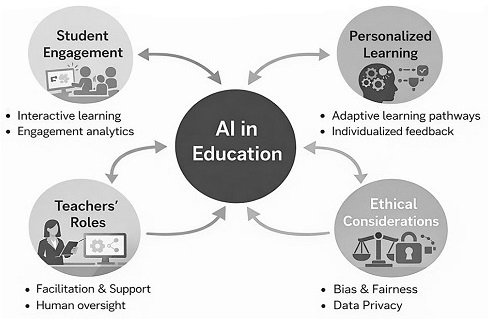
Generative artificial intelligence (AI) is changing teaching, learning, evaluation, and feedback methods in educational settings. An increasing body of research indicates that while AI-supported technologies improve efficiency, customisation, and access to learning resources, they may also reduce evidence of meaningful learning while simultaneously improving observable academic performance. Using interrelated pedagogical, cognitive, ethical, assessment, and policy viewpoints, this study critically investigates AI in education. The study provides an integrative understanding of AI integration in education by synthesizing literature from empirical investigations (n = 21), conceptual papers (n = 19), policy reports (n = 5), and one review study using a critical narrative review design. The results show that although AI improves feedback, student engagement, instructional support, and chances for adaptive learning, it also creates issues with cognitive dependence, academic integrity, algorithmic bias, data privacy, inequality, and assessment validity. The review's main conclusion is that there is a growing conflict between meaningful learning and visible academic achievement since AI-mediated outputs might not always demonstrate prolonged cognitive engagement or conceptual grasp. The study contends that pedagogical design, teacher involvement, AI literacy, institutional governance, and technological competence all play a role in the educational usefulness of AI. The paper emphasizes the necessity of learning and assessment systems that support responsible, egalitarian, and learner-centered AI integration in educational settings while preserving learner agency and making thinking visible.
Article Details

This work is licensed under a Creative Commons Attribution-NonCommercial 4.0 International License.
References
- Act, E. A. I. (2024). The EU Artificial Intelligence Act. European Union. https://www.wsgr.com
- Akgun, S., & Greenhow, C. (2021). Artificial intelligence in education: Addressing ethical challenges in K-12 settings. AI and Ethics, 2(3), 431–440. https://doi.org/10.1007/s43681-021-00096-7
- Alfiras, M. I. I., Emran, A. Q., & Mohamed, A. M. (2025). Ethics and governance of generative AI in education: a systematic review on responsible adoption. Discover Education, 5(1). https://doi.org/10.1007/s44217-025-01051-y
- Aravantinos, S., Lavidas, K., Komis, V., Karalis, T., & Papadakis, S. (2026). Artificial Intelligence in K-12 Education: A Systematic Review of Teachers’ Professional Development Needs for AI Integration. Computers, 15(1), 49. https://doi.org/10.3390/computers15010049
- Baker, R. S., & Hawn, A. (2021). Algorithmic Bias in Education. International Journal of Artificial Intelligence in Education, 32(4), 1052–1092. https://doi.org/10.1007/s40593-021-00285-9
- Baumeister, R. F., & Leary, M. R. (1997). Writing Narrative Literature Reviews. Review of General Psychology, 1(3), 311–320. https://doi.org/10.1037/1089-2680.1.3.311
- Bearman, M., Tai, J., Dawson, P., Boud, D., & Ajjawi, R. (2024). Developing evaluative judgement for a time of generative artificial intelligence. Assessment &Amp; Evaluation in Higher Education, 49(6), 893–905. https://doi.org/10.1080/02602938.2024.2335321
- Biesta, G. J. J. (2015). Beautiful Risk of Education (, Ed.). Routledge. https://doi.org/10.4324/9781315635866
- Boud, D., & Falchikov, N. (Eds.). (2007). Rethinking Assessment in Higher Education. Routledge. https://doi.org/10.4324/9780203964309
- Bulger, M. (2016). Personalized Learning: The Conversations We’re Not Having (, Ed.). Data & Society Research Institute. https://doi.org/10.69985/obue9001
- Carless, D. (2015). Excellence in University Assessment (, Ed.). Routledge. https://doi.org/10.4324/9781315740621
- Castro-Alonso, J. C., Ayres, P., & Sweller, J. (2019). Instructional Visualizations, Cognitive Load Theory, and Visuospatial Processing. Visuospatial Processing for Education in Health and Natural Sciences, 111–143. https://doi.org/10.1007/978-3-030-20969-8_5
- Cotton, D., Cotton, P., & Shipway, J. R. (2023). Chatting and Cheating. Ensuring academic integrity in the era of ChatGPT. https://doi.org/10.35542/osf.io/mrz8h
- Dwivedi, Y. K., Kshetri, N., Hughes, L., Slade, E. L., Jeyaraj, A., Kar, A. K., ... & Wright, R. (2023). Opinion Paper: “So what if ChatGPT wrote it?” Multidisciplinary perspectives on opportunities, challenges and implications of generative conversational AI for research, practice and policy. International journal of information management, 71, 102642. https://doi.org/10.1016/j.ijinfomgt.2023.102642
- Eaton, S. E. (2023). Postplagiarism: transdisciplinary ethics and integrity in the age of artificial intelligence and neurotechnology. International Journal for Educational Integrity, 19(1). https://doi.org/10.1007/s40979-023-00144-1
- Ellis, R., Han, F., & Cook, H. (2025). Qualitatively different teacher experiences of teaching with generative artificial intelligence. International Journal of Educational Technology in Higher Education, 22(1). https://doi.org/10.1186/s41239-025-00532-2
- European Commission. (2022). Ethical guidelines on the use of artificial intelligence and data in teaching and learning. https://education.ec.europa.eu/focus-topics/digital-education/actions/plan
- Floridi, L., Cowls, J., Beltrametti, M., Chatila, R., Chazerand, P., Dignum, V., ... & Vayena, E. (2018). AI4People--An ethical framework for a good AI society: Opportunities, risks, principles, and recommendations. Minds and machines, 28(4), 689-707. https://doi.org/10.1007/s11023-018-9482-5
- Giannakos, M., Azevedo, R., Brusilovsky, P., Cukurova, M., Dimitriadis, Y., Hernandez-Leo, D., Järvelä, S., Mavrikis, M., & Rienties, B. (2024). The promise and challenges of generative AI in education. Behaviour &Amp; Information Technology, 44(11), 2518–2544. https://doi.org/10.1080/0144929x.2024.2394886
- Grant, M. J., & Booth, A. (2009). A typology of reviews: an analysis of 14 review types and associated methodologies. Health Information &Amp; Libraries Journal, 26(2), 91–108. Portico. https://doi.org/10.1111/j.1471-1842.2009.00848.x
- Hariyanto, Kristianingsih, F. X. D., & Maharani, R. (2025). Artificial intelligence in adaptive education: a systematic review of techniques for personalized learning. Discover Education, 4(1). https://doi.org/10.1007/s44217-025-00908-6
- Holmes, W. (2020). Artificial Intelligence in Education. Encyclopedia of Education and Information Technologies, 88–103. https://doi.org/10.1007/978-3-030-10576-1_107
- Holmes, W., Porayska-Pomsta, K., Holstein, K., Sutherland, E., Baker, T., Shum, S. B., ... & Koedinger, K. R. (2022). Ethics of AI in education: Towards a community-wide framework. International Journal of Artificial Intelligence in Education, 32(3), 504-526. https://doi.org/10.1007/s40593-021-00239-1
- Holmes, W., & Tuomi, I. (2022). State of the art and practice in AI in education. European Journal of Education, 57(4), 542–570. Portico. https://doi.org/10.1111/ejed.12533
- Illeris, K. (Ed.). (2009). Contemporary Theories of Learning. Routledge. https://doi.org/10.4324/9780203870426
- Jauhiainen, J. S., & Garagorry Guerra, A. (2024). Generative AI and education: dynamic personalization of pupils’ school learning material with ChatGPT. Frontiers in Education, 9. https://doi.org/10.3389/feduc.2024.1288723
- Karakose, T., Tülübaş, T., Papadakis, S., & Yirci, R. (2023). Evaluating the Intellectual Structure of the Knowledge Base on Transformational School Leadership: A Bibliometric and Science Mapping Analysis. Education Sciences, 13(7), 708. https://doi.org/10.3390/educsci13070708
- Kasneci, E., Sessler, K., Küchemann, S., Bannert, M., Dementieva, D., Fischer, F., ... & Kasneci, G. (2023). ChatGPT for good? On opportunities and challenges of large language models for education. Learning and individual differences, 103, 102274. https://doi.org/10.1016/j.lindif.2023.102274
- Kizilcec, R. F., & Lee, H. (2022). Algorithmic fairness in education. The Ethics of Artificial Intelligence in Education, 174–202. https://doi.org/10.4324/9780429329067-10
- Lampropoulos, G., & Papadakis, S. (2025). The Educational Value of Artificial Intelligence and Social Robots. Social Robots in Education, 3–15. https://doi.org/10.1007/978-3-031-82915-4_1
- Laurillard, D. (2013). Teaching as a design science: Building pedagogical patterns for learning and technology. Routledge.
- Lavidas, K., Papadakis, S., Manesis, D., Grigoriadou, A. S., & Gialamas, V. (2022). The Effects of Social Desirability on Students’ Self-Reports in Two Social Contexts: Lectures vs. Lectures and Lab Classes. Information, 13(10), 491. https://doi.org/10.3390/info13100491
- Lee, D., Arnold, M., Srivastava, A., Plastow, K., Strelan, P., Ploeckl, F., Lekkas, D., & Palmer, E. (2024). The impact of generative AI on higher education learning and teaching: A study of educators’ perspectives. Computers and Education: Artificial Intelligence, 6, 100221. https://doi.org/10.1016/j.caeai.2024.100221
- Long, D., & Magerko, B. (2020). What is AI Literacy? Competencies and Design Considerations. Proceedings of the 2020 CHI Conference on Human Factors in Computing Systems, 1–16. https://doi.org/10.1145/3313831.3376727
- Luckin, R. (2018). Machine Learning and Human Intelligence. The future of education for the 21st century. UCL institute of education press.
- Luckin, R., & Holmes, W. (2016). Intelligence unleashed: An argument for AI in education.
- Mayer, R. E., & Fiorella, L. (2021). Introduction to Multimedia Learning. The Cambridge Handbook of Multimedia Learning, 3–16. https://doi.org/10.1017/9781108894333.003
- National Research Council, Board on Behavioral, Sensory Sciences, Committee on Developments in the Science of Learning with additional material from the Committee on Learning Research, & Educational Practice. (2000). How people learn: Brain, mind, experience, and school: Expanded edition (Vol. 1). National Academies Press.
- Ng, D. T. K., Leung, J. K. L., Su, J., Ng, R. C. W., & Chu, S. K. W. (2023). Teachers’ AI digital competencies and twenty-first century skills in the post-pandemic world. Educational Technology Research and Development, 71(1), 137–161. https://doi.org/10.1007/s11423-023-10203-6
- OECD. (2026). Digital Education Outlook 2026: AI and the future of learning. https://www.oecd.org/education/digital-education-outlook
- Perkins, M. (2023). Academic Integrity considerations of AI Large Language Models in the post-pandemic era: ChatGPT and beyond. Journal of University Teaching and Learning Practice, 20(2). https://doi.org/10.53761/1.20.02.07
- Regan, P. M., & Jesse, J. (2018). Ethical challenges of edtech, big data and personalized learning: twenty-first century student sorting and tracking. Ethics and Information Technology, 21(3), 167–179. https://doi.org/10.1007/s10676-018-9492-2
- Roe, J., & Perkins, M. (2024). Generative AI and agency in education: A critical scoping review and thematic analysis. arXiv preprint arXiv:2411.00631.
- Roorda, D. L., Koomen, H. M. Y., Spilt, J. L., & Oort, F. J. (2011). The Influence of Affective Teacher–Student Relationships on Students’ School Engagement and Achievement. Review of Educational Research, 81(4), 493–529. https://doi.org/10.3102/0034654311421793
- Rudolph, J., Tan, S., & Tan, S. (2023). ChatGPT: Bullshit spewer or the end of traditional assessments in higher education?. Journal of applied learning & teaching, 6(1), 342-363. https://doi.org/10.37074/jalt.2023.6.1.9
- Selwyn, N. (2019). Should Robots Replace Teachers?: AI and the Future of Education (Vol. 97). John Wiley & Sons.
- Slimi, Z. (2026). A systematic critical review of generative AI’s impact on authorship, pedagogy, and integrity (2023–2025). Frontiers in Education, 11. https://doi.org/10.3389/feduc.2026.1769680
- Snyder, H. (2019). Literature review as a research methodology: An overview and guidelines. Journal of Business Research, 104, 333–339. https://doi.org/10.1016/j.jbusres.2019.07.039
- Southworth, J., Migliaccio, K., Glover, J., Glover, J., Reed, D., McCarty, C., Brendemuhl, J., & Thomas, A. (2023). Developing a model for AI Across the curriculum: Transforming the higher education landscape via innovation in AI literacy. Computers and Education: Artificial Intelligence, 4, 100127. https://doi.org/10.1016/j.caeai.2023.100127
- Susnjak, T., & McIntosh, T. (2024). ChatGPT: The End of Online Exam Integrity? Education Sciences, 14(6), 656. https://doi.org/10.3390/educsci14060656
- UNESCO. (2023). Guidance for generative AI in education and research. https://www.unesco.org
- Uğraş, H., Uğraş, M., Papadakis, S., & Kalogiannakis, M. (2024). ChatGPT-Supported Education in Primary Schools: The Potential of ChatGPT for Sustainable Practices. Sustainability, 16(22), 9855. https://doi.org/10.3390/su16229855
- Van Dijk, J. (2020). The digital divide. John Wiley & Sons.
- Wentzel, K. R. (2010). Students' relationships with teachers. In Handbook of research on schools, schooling and human development (pp. 75-91). Routledge.
- Williamson, B., & Eynon, R. (2020). Historical threads, missing links, and future directions in AI in education. Learning, Media and Technology, 45(3), 223–235. https://doi.org/10.1080/17439884.2020.1798995
- World Bank. (2024). Artificial intelligence in education: Opportunities and challenges. https://www.worldbank.org
- Yirci, R., Karakose, T., Kocabas, I., Tülübaş, T., & Papadakis, S. (2023). A Bibliometric Review of the Knowledge Base on Mentoring for the Professional Development of School Administrators. Sustainability, 15(4), 3027. https://doi.org/10.3390/su15043027
- Zacharis, G., & Papadakis, S. (2025). Can AI Grade Like a Human? Validity, Reliability, and Fairness in University Coursework Assessment. Educational Process International Journal, 19(1). https://doi.org/10.22521/edupij.2025.19.591
- Zawacki-Richter, O., Marín, V. I., Bond, M., & Gouverneur, F. (2019). Systematic review of research on artificial intelligence applications in higher education – where are the educators? International Journal of Educational Technology in Higher Education, 16(1). https://doi.org/10.1186/s41239-019-0171-0
