
Tannin-Functionalized Hierarchical Porous Biochar from Lignocellulosic Waste for Simultaneous NH₄⁺ and NO₃⁻ Adsorption in Complex Wastewater via Ion-Exchange Synergy and Surface Complexation
Article Sidebar
Main Article Content


Abstract
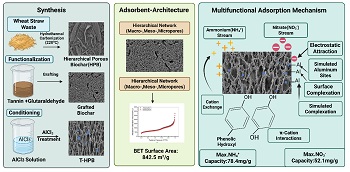
The unregulated release of nitrogenous compounds from agricultural and industrial waste continues to pose a significant challenge for environmental remediation because of the differing chemical properties of cationic ammonium and anionic nitrate. This study sought to create a multifunctional adsorbent for concurrent nitrogen recovery by engineering a tannin-functionalized hierarchical porous biochar (T-HPB) derived from lignocellulosic wheat straw residues. The synthesis entailed a two-step procedure, including hydrothermal carbonization at 220 °C, succeeded by chemical activation with phosphoric acid (H₃PO₄) to create a hierarchical porous structure. The obtained biochar was subsequently functionalized with Bayberry tannin via glutaraldehyde-assisted crosslinking. Characterization results confirmed the formation of a well-developed porous architecture with a Brunauer–Emmett–Teller surface area of 842.5 m²/g Scanning electron microscopy revealed a hierarchical network of interconnected macro- and mesopores. Batch adsorption experiments revealed that T-HPB attained maximum adsorption capacities of 78.4 mg/g for ammonium and 52.1 mg/g for nitrate at 25°C and pH 7.0. Kinetic analyses revealed that the adsorption process adhered to a pseudo-second-order model, achieving roughly 90% equilibrium within 120 minutes. Mechanistic studies employing X-ray photoelectron spectroscopy (XPS) and Fourier-transform infrared spectroscopy (FTIR) demonstrated that ammonium removal was predominantly influenced by cation exchange and π–cation interactions with phenolic hydroxyl groups, while nitrate adsorption was primarily governed by surface complexation and electrostatic attraction at positively charged nitrogen-containing sites. The results indicate that T-HPB is an efficient and sustainable adsorbent for the concurrent removal and recovery of nitrogen species from intricate wastewater systems.
Article Details

This work is licensed under a Creative Commons Attribution-NonCommercial 4.0 International License.
References
- Aman Prakash, Sofia Khanam. Nitrogen Pollution Threat to Mariculture and Other Aquatic Ecosystems: An Overview. Journal of Pharmacy and Pharmacology. 2021, 9(12). https://doi.org/10.17265/2328-2150/2021.12.005
- Kuriyama K, Hayashi K. Sustainable Agriculture and the Nitrogen Issue. Economics of Sustainable Agriculture. Published online 2025: 1-10. https://doi.org/10.1007/978-981-96-3502-3_1
- Wang Z, Zhang L, Zeng W, et al. A loading rate switch strategy for stable nitritation in mainstream municipal wastewater. Nature Sustainability. 2024, 7(3): 305-314. https://doi.org/10.1038/s41893-024-01276-z
- Zhou Y, Zhu Y, Zhu J, et al. A Comprehensive Review on Wastewater Nitrogen Removal and Its Recovery Processes. International Journal of Environmental Research and Public Health. 2023, 20(4): 3429. https://doi.org/10.3390/ijerph20043429
- Ojo OE, Oludolapo OA. Innovative Recovery Methods for Metals and Salts from Rejected Brine and Advanced Extraction Processes—A Pathway to Commercial Viability and Sustainability in Seawater Reverse Osmosis Desalination. Water. 2025, 17(21): 3141. https://doi.org/10.3390/w17213141
- Khandaker T, Islam T, Nandi A, et al. Biomass-derived carbon materials for sustainable energy applications: a comprehensive review. Sustainable Energy & Fuels. 2025, 9(3): 693-723. https://doi.org/10.1039/d4se01393j
- Luo L, Li J, Xing Z, et al. Biochar for Mitigating Nitrate Leaching in Agricultural Soils: Mechanisms, Challenges, and Future Directions. Water. 2025, 17(17): 2590. https://doi.org/10.3390/w17172590
- Guan X, Zhang B, Wang Z, et al. Natural polyphenol tannin-immobilized composites: rational design and versatile applications. Journal of Materials Chemistry B. 2023, 11(21): 4619-4660. https://doi.org/10.1039/d3tb00661a
- Wu W, Wang Y, Hu X. Mass transfer driven pore engineering of activated carbon from the activation of biomass. Green Chemistry. 2026, 28(8): 3486-3511. https://doi.org/10.1039/d5gc05946a
- Rowell C, Lam EY. Mobile-Phone Antenna Design. IEEE Antennas and Propagation Magazine. 2012, 54(4): 14-34. https://doi.org/10.1109/map.2012.6309152
- Takabi AS, Shirani M, Semnani A. Apple stem as a high performance cellulose based biosorbent for low cost and eco-friendly adsorption of crystal violet from aqueous solutions using experimental design: Mechanism, kinetic and thermodynamics. Environmental Technology & Innovation. 2021, 24: 101947. https://doi.org/10.1016/j.eti.2021.101947
- He X, Zheng N, Hu R, et al. Hydrothermal and Pyrolytic Conversion of Biomasses into Catalysts for Advanced Oxidation Treatments. Advanced Functional Materials. 2020, 31(7). https://doi.org/10.1002/adfm.202006505
- Jia W, Yu Z, Chen J, et al. Synergistic effect between biochar and nitrate fertilizer facilitated arsenic immobilization in an anaerobic contaminated paddy soil. Science of The Total Environment. 2024, 955: 177007. https://doi.org/10.1016/j.scitotenv.2024.177007
- Mao Y, Liu J, Lin Q, et al. Efficient removal of Cr(VI) and bisphenol A by a tannic acid-functionalized porous biochar. Materials Chemistry and Physics. 2024, 326: 129770. https://doi.org/10.1016/j.matchemphys.2024.129770
- Wang T, Xue L, Zheng L, et al. Biomass-derived N/S dual-doped hierarchically porous carbon material as effective adsorbent for the removal of bisphenol F and bisphenol S. Journal of hazardous materials. 2021, 416: 126126. https://doi.org/10.1016/j.jhazmat.2021.126126
- Zhang M, Song G, Gelardi DL, et al. Evaluating biochar and its modifications for the removal of ammonium, nitrate, and phosphate in water. Water Research. 2020, 186: 116303. https://doi.org/10.1016/j.watres.2020.116303
- Yao Y, Gao B, Zhang M, et al. Effect of biochar amendment on sorption and leaching of nitrate, ammonium, and phosphate in a sandy soil. Chemosphere. 2012, 89(11): 1467-1471. https://doi.org/10.1016/j.chemosphere.2012.06.002
- Elbana M, Gamal R, El-Shirbeny MA, et al. Mesoporous biochar reshapes soil water dynamics under shallow groundwater: interactions with nitrogen management. Frontiers in Soil Science. 2025, 5: 1718929. https://doi.org/10.3389/fsoil.2025.1718929
- Liu T, Fan X, Wu K, et al. Structural characteristics of biochars made from different parts of corn straw and their adsorption performances for methylene blue. Journal of Water Process Engineering. 2024, 68: 106562. https://doi.org/10.1016/j.jwpe.2024.106562
- Leng L, Xiong Q, Yang L, et al. An overview on engineering the surface area and porosity of biochar. Science of The Total Environment. 2021, 763: 144204. https://doi.org/10.1016/j.scitotenv.2020.144204
- Raveendran K. Pyrolysis characteristics of biomass and biomass components. Fuel. 1996, 75(8): 987-998. https://doi.org/10.1016/0016-2361(96)00030-0
- Yang H, Yan R, Chen H, et al. Characteristics of hemicellulose, cellulose and lignin pyrolysis. Fuel. 2007, 86(12-13): 1781-1788. https://doi.org/10.1016/j.fuel.2006.12.013
- Brebu M, Vasile C. Thermal degradation of lignin--a review. Cellulose Chemistry & Technology. 2010, 44(9): 353.
- Hatakeyama T, Hatakeyama H. Thermal properties of green polymers and biocomposites. Dordrecht: Springer Netherlands, 2004.
- Das C, Tamrakar S, Kiziltas A, et al. Incorporation of Biochar to Improve Mechanical, Thermal and Electrical Properties of Polymer Composites. Polymers. 2021, 13(16): 2663. https://doi.org/10.3390/polym13162663
- Aboughaly M, Babaei-Ghazvini A, Dhar P, et al. Enhancing the potential of polymer composites using biochar as a filler: a review. Polymers. 2023, 15(19): 3981. https://doi.org/10.3390/polym15193981
- Zhu Y, Liu S, Chen H, et al. Evaluating biochar for adsorption of ammonium nitrogen in wastewater: insights into modifications and mechanisms. Environmental Research. 2025, 277: 121615. https://doi.org/10.1016/j.envres.2025.121615
- Chang H, Yang X-y, Liang D, et al. Enhanced removal of ammonium nitrogen from aqueous solutions using a novel biochar derived from millet shells through both static adsorption and dynamic column experiments. Journal of Water Process Engineering. 2024, 58: 104848. https://doi.org/10.1016/j.jwpe.2024.104848
- Wang H, Chen Q, Liu R, et al. Enhanced removal performance and mechanism of NH4+/NO3- in Starch-FeS-biochar-amended vertical flow constructed wetlands under Pb stress. Journal of Water Process Engineering. 2023, 55: 104170. https://doi.org/10.1016/j.jwpe.2023.104170
- Nguyen V-T, Vo T-D-H, Tran T, et al. Biochar derived from the spent coffee ground for ammonium adsorption from aqueous solution. Case Studies in Chemical and Environmental Engineering. 2021, 4: 100141. https://doi.org/10.1016/j.cscee.2021.100141
- Wu J, Li K, Zhao Z. Innovative nitrogen-doped biochar-derived ball-milled defective in-situ amino biochar molecularly imprinted gels for selective removal of BPA: Theoretical simulation and mechanistic insights. Chemical Engineering Journal. 2025, 509: 161338. https://doi.org/10.1016/j.cej.2025.161338
- Zhang G, Huang F, Shi Y, et al. Integration of experimental and computational techniques to elucidate the Cu(II) adsorption mechanisms of nitrogen-doped chitosan microsphere biochars. Chemical Engineering Journal. 2025, 521: 166840. https://doi.org/10.1016/j.cej.2025.166840
- Berlin M, Suresh Kumar G. Numerical modelling on sorption kinetics of nitrogen species in wastewater-applied agricultural field. Applied Water Science. 2018, 8(8). https://doi.org/10.1007/s13201-018-0869-5
- Trazzi PA, Vashishtha M, Najser J, et al. Adsorption of Ammonium, Nitrate, and Phosphate on Hydrochars and Biochars. Applied Sciences. 2024, 14(6): 2280. https://doi.org/10.3390/app14062280
- He Z, Wang C, Cao H, et al. Nitrate absorption and desorption by biochar. Agronomy. 2023, 13(9): 2440. https://doi.org/10.3390/agronomy13092440
- Haghighi Mood S, Pelaez-Samaniego MR, Han Y, et al. Iron- and Nitrogen-Modified Biochar for Nitrate Adsorption from Aqueous Solution. Sustainability. 2024, 16(13): 5733. https://doi.org/10.3390/su16135733
- Eissa R, Jeyakumar L, McKenzie DB, et al. Influence of Biochar Feedstocks on Nitrate Adsorption Capacity. Earth. 2024, 5(4): 1080-1096. https://doi.org/10.3390/earth5040055
- Kohira Y, Fentie D, Lewoyehu M, et al. Elucidation of ammonium and nitrate adsorption mechanisms by water hyacinth biochar: effects of pyrolysis temperature. Environmental Science and Pollution Research. 2024, 32(2): 762-782. https://doi.org/10.1007/s11356-024-35808-z
- Chang J-H, Sivasubramanian P, Dong C-D, et al. Study on adsorption of ammonium and nitrate in wastewater by modified biochar. Bioresource Technology Reports. 2023, 21: 101346. https://doi.org/10.1016/j.biteb.2023.101346
