
Pharmaceutical Design, Formulation Optimization, and In Vitro Performance Profiling of Generic Lymecycline Capsules Using Validated Analytical Methods
Article Sidebar
Main Article Content


Abstract
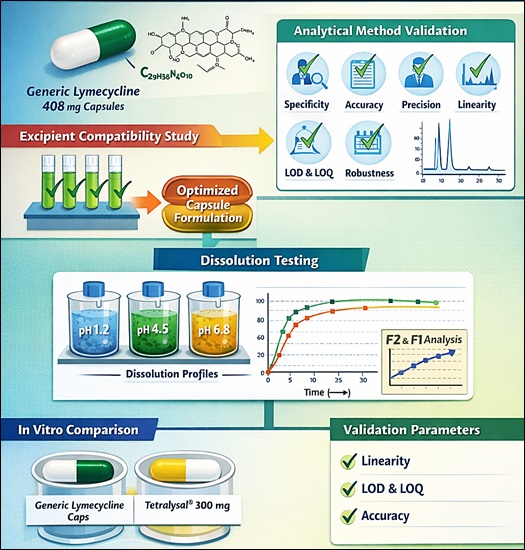
This study documents the stepwise development and evaluation of a generic Lymecycline 408 mg hard gelatin capsule manufactured locally in Pakistan. The formulation process began with the selection of suitable pharmacopeial excipients after conducting accelerated compatibility testing to ensure that no undesirable physical or chemical interactions occurred with the active ingredient. Based on these preliminary investigations, a stable capsule composition was finalized. The finished capsules were evaluated according to British Pharmacopoeia requirements. All tested quality attributes, including assay, dissolution behavior, content uniformity, and moisture content, were found to comply with the specified limits. These results confirmed the consistency and integrity of the developed dosage form. Quantitative analysis of Lymecycline was carried out using a high-performance liquid chromatography method that was validated prior to routine application. During validation, parameters such as specificity, precision under repeat and intermediate conditions, accuracy through recovery assessment, robustness against minor variations, and system suitability were carefully examined. The method demonstrated reliable and reproducible performance in line with internationally accepted regulatory standards. To assess comparative in-vitro performance, dissolution testing was performed using the USP paddle method in media representing gastric and intestinal pH conditions (pH 1.2, 4.5, and 6.8). In all cases, more than 85% of the drug was released within one hour. Statistical comparison with the reference product, Tetralysal® 300 mg, showed acceptable similarity and difference factor values, indicating comparable release profiles. Overall, the data support that the developed formulation performs equivalently to the reference product and may be considered suitable for local production and further regulatory processing.
Article Details

This work is licensed under a Creative Commons Attribution-NonCommercial 4.0 International License.
References
- Shanmuganathan DK, Sudesh S, Bejone SJ, et al. Teratogenicity of tetracyclines. World Journal of Pharmaceutical Research. 2025, 14(6): 737-749.
- Chopra I, Roberts M. Tetracycline Antibiotics: Mode of Action, Applications, Molecular Biology, and Epidemiology of Bacterial Resistance. , ed. Microbiology and Molecular Biology Reviews. 2001, 65(2): 232-260. https://doi.org/10.1128/mmbr.65.2.232-260.2001
- Demain AL. Antibiotics: Natural products essential to human health. , ed. Medicinal Research Reviews. 2009, 29(6): 821-842. https://doi.org/10.1002/med.20154
- Wiseman LR, Wagstaff AJ, Brogden RN, et al. Meropenem. , ed. Drugs. 1995, 50(1): 73-101. https://doi.org/10.2165/00003495-199550010-00007
- Leyden JJ. Therapy for Acne Vulgaris. Wood AJJ, ed. New England Journal of Medicine. 1997, 336(16): 1156-1162. https://doi.org/10.1056/nejm199704173361607
- Stachelek M, Zalewska M, Kawecka-Grochocka E, et al. Overcoming bacterial resistance to antibiotics: the urgent need – a review. , ed. Annals of Animal Science. 2021, 21(1): 63-87. https://doi.org/10.2478/aoas-2020-0098
- Fukuda, Y. New approaches to overcoming bacterial resistance. , ed. Drugs of the Future. 2009, 34(2): 127. https://doi.org/10.1358/dof.2009.34.2.1313642
- Galluccio G, D’Onghia M, Malvaso D, et al. Advances in the Pathogenesis and Treatment of Rosacea: A Phenotype-Based Therapeutic Approach. , ed. Cosmetics. 2024, 11(1): 11. https://doi.org/10.3390/cosmetics11010011
- Thiboutot D, Gollnick H, Bettoli V, et al. New insights into the management of acne: An update from the Global Alliance to Improve Outcomes in Acne Group. , ed. Journal of the American Academy of Dermatology. 2009, 60(5): S1-S50. https://doi.org/10.1016/j.jaad.2009.01.019
- Agwuh KN. Pharmacokinetics and pharmacodynamics of the tetracyclines including glycylcyclines. , ed. Journal of Antimicrobial Chemotherapy. 2006, 58(2): 256-265. https://doi.org/10.1093/jac/dkl224
- Chukwudi CU. rRNA Binding Sites and the Molecular Mechanism of Action of the Tetracyclines. , ed. Antimicrobial Agents and Chemotherapy. 2016, 60(8): 4433-4441. https://doi.org/10.1128/aac.00594-16
- Schreiner A, Digrams A. Pharmacokinetics of Lymecycline and Doxycycline in Serum and Suction Blister Fluid. , ed. Chemotherapy. Published online September 9, 2009: 261-265. https://doi.org/10.1159/000238345
- Abuelella KE, Mosallam S, Soliman SM, et al. Polymer-based biomaterials for wound healing: advances in natural, synthetic and hybrid biodegradable polymers for scar reduction and skin regeneration. Bulletin of Pharmaceutical Sciences Assiut University. 2025, 48(1): 135-174. https://doi.org/10.21608/bfsa.2025.354645.2412
- Christiansen CS, Høye S, Lindbaek M, et al. Acne management in Norway: GP and dermatologist prescriptions (2012–2019): a nationwide overview. , ed. BJGP Open. 2025, 9(3): BJGPO. https://doi.org/10.3399/bjgpo.2024.0211
- Auwal MA, Musa A, Awwalu S. Quality Assessment of Some Selected Generic Brands of Lincomycin Capsules Marketed in Gombe Metropolis. BIMA Journal of Science and Technology Gombe. 2026, 10(1A): 121-127. https://doi.org/10.64290/bima.v10i1A.1525
- Leyden JJ. A review of the use of combination therapies for the treatment of acne vulgaris. , ed. Journal of the American Academy of Dermatology. 2003, 49(3): S200-S210. https://doi.org/10.1067/s0190-9622(03)01154-x
- Zouboulis CC, Desai N, Emtestam L, et al. European S1 guideline for the treatment of hidradenitis suppurativa/acne inversa. , ed. Journal of the European Academy of Dermatology and Venereology. 2015, 29(4): 619-644. https://doi.org/10.1111/jdv.12966
- Marasca C, Tranchini P, Marino V, et al. The pharmacology of antibiotic therapy in hidradenitis suppurativa. , ed. Expert Review of Clinical Pharmacology. 2020, 13(5): 521-530. https://doi.org/10.1080/17512433.2020.1762571
- Drucker AM, Hollestein L, Na Y, et al. Association between antihypertensive medications and risk of skin cancer in people older than 65 years: a population-based study. , ed. Canadian Medical Association Journal. 2021, 193(15): E508-E516. https://doi.org/10.1503/cmaj.201971
- Xu W, Xu J, Huang D, et al. Acne vulgaris: advances in pathogenesis and prevention strategies. European Journal of Clinical Microbiology & Infectious Diseases. 2025, 44(3): 515-532. https://doi.org/10.1007/s10096-024-04984-8
- Diaz DA, Colgan ST, Langer CS, et al. Dissolution Similarity Requirements: How Similar or Dissimilar Are the Global Regulatory Expectations? , ed. The AAPS Journal. 2015, 18(1): 15-22. https://doi.org/10.1208/s12248-015-9830-9
- Bhujbal S, Rupenthal ID, Agarwal P. Development and validation of a stability-indicating HPLC method for assay of tonabersat in pharmaceutical formulations. , ed. Methods. 2024, 231: 178-185. https://doi.org/10.1016/j.ymeth.2024.10.001
- Salwa, Kumar L. Quality-by-design driven analytical method (AQbD) development and validation of HPLC–UV technique to quantify rivastigmine hydrogen tartrate in lipidic nanocarriers: Forced degradation, and assessment of drug content and in vitro release studies. , ed. Microchemical Journal. 2023, 193: 108944. https://doi.org/10.1016/j.microc.2023.108944
- Zulfiqar N, Yameen HM, Hoor DE, et al. Nanotechnology-Inspired Approaches for Improving the Stability of Cephradine Dry Suspension: The Role of Pharmaceutical Excipients. , ed. Mathews Journal of Pharmaceutical Science. 2025, 9(3). https://doi.org/10.30654/mjps.10056
