
Mobile Learning for Programming Education: A Case Study of SoloLearn and Self-Directed Learning Skills
Article Sidebar
Main Article Content


Abstract
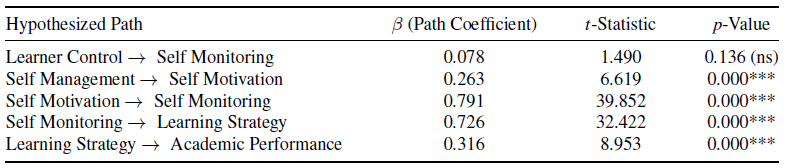
This study investigates how mobile learning supports self-directed learning (SDL) in programming education through a case study of SoloLearn. A cross-sectional survey of 708 undergraduate students at the University of Education, Winneba examined app usage, perceptions, and programming confidence, framed by Knowles' (1975) SDL Theory and Fredricks et al.'s (2004) Student Engagement Framework. Partial least squares structural equation modeling (PLS-SEM) revealed a sequential pathway from self-management to motivation, monitoring, strategy use, and perceived academic performance. Most participants (67.8%) reported increased confidence, while 60.3% reported improvements in real-world application skills, though challenges included limited advanced content, ad disruptions, and insufficient feedback. The findings suggest that SoloLearn effectively develops foundational SDL skills but requires adaptive features, project-based modules, and improved collaborative tools to support deeper learning. Results should be interpreted cautiously due to the single-institution, male-dominated sample. Overall, the study contributes to understanding how mobile learning platforms could support SDL in programming education and also offers practical insights for integrating such platforms into diverse instructional contexts.
Article Details

This work is licensed under a Creative Commons Attribution-NonCommercial 4.0 International License.
References
- Akter, S., Fosso Wamba, S., & Dewan, S. (2017). Why PLS-SEM is suitable for complex modelling? An empirical illustration in big data analytics quality. Production Planning &Amp; Control, 28(11-12), 1011–1021. https://doi.org/10.1080/09537287.2016.1267411
- Aleven, V., Blankestijn, J., Lawrence, L., Nagashima, T., & Taatgen, N. (2022). A Dashboard to Support Teachers During Students’ Self-paced AI-Supported Problem-Solving Practice. Educating for a New Future: Making Sense of Technology-Enhanced Learning Adoption, 16–30. https://doi.org/10.1007/978-3-031-16290-9_2
- Aleven, V., McLaren, B. M., Sewall, J., van Velsen, M., Popescu, O., Demi, S., Ringenberg, M., & Koedinger, K. R. (2016). Example-tracing tutors: intelligent tutor development for non-programmers. International Journal of Artificial Intelligence in Education, 26(2), 224-269. https://doi.org/10.1007/s40593-015-0088-2
- Alrasheedi, M., Capretz, L. F., & Raza, A. (2016). A systematic review of the critical factors for success of mobile learning in higher education (university students’ perspective). Computers in Human Behavior, 63, 538–544.
- Amro, J. S., & Romli, R. (2019). Investigation on the Learning Programming Techniques via Mobile Learning Application. 2019 4th International Conference and Workshops on Recent Advances and Innovations in Engineering (ICRAIE), 1–7. https://doi.org/10.1109/icraie47735.2019.9037764
- Bandura, A. (1997). Self-efficacy: The exercise of control. W. H. Freeman.
- Baruch, Y., & Holtom, B. C. (2008). Survey response rate levels and trends in organizational research. Human Relations, 61(8), 1139–1160. https://doi.org/10.1177/0018726708094863
- Braun, V., & Clarke, V. (2006). Using thematic analysis in psychology. Qualitative Research in Psychology, 3(2), 77–101. https://doi.org/10.1191/1478088706qp063oa
- Broadbent, J., & Poon, W. L. (2015). Self-regulated learning strategies & academic achievement in online higher education learning environments: A systematic review. The Internet and Higher Education, 27, 1-13. https://doi.org/10.1016/j.iheduc.2015.04.007
- Calderón-Garrido, D., Ramos-Pardo, F. J., & Suárez-Guerrero, C. (2022). The Use of Mobile Phones in Classrooms: A Systematic Review. International Journal of Emerging Technologies in Learning (iJET), 17(06), 194–210. https://doi.org/10.3991/ijet.v17i06.29181
- Calderon, I., Silva, W., & Feitosa, E. (2023). Active Learning Methodologies for Teaching Programming in Undergraduate Courses: A Systematic Mapping Study. Informatics in Education. https://doi.org/10.15388/infedu.2024.11
- Creswell, J. W., & Creswell, J. D. (2017). Research design: Qualitative, quantitative, and mixed methods approaches. Sage publications.
- Crompton, H., Burke, D., Jordan, K., & Wilson, S. W. G. (2021). Learning with technology during emergencies: A systematic review of K-12 education. British Journal of Educational Technology, 52(5), 1554–1574. https://doi.org/10.1111/bjet.13114
- Dahri, N. A., Al-Rahmi, W. M., Almogren, A. S., Yahaya, N., Vighio, M. S., Al-maatuok, Q., Al-Rahmi, A. M., & Al-Adwan, A. S. (2023). Acceptance of Mobile Learning Technology by Teachers: Influencing Mobile Self-Efficacy and 21st-Century Skills-Based Training. Sustainability, 15(11), 8514. https://doi.org/10.3390/su15118514
- Deng, R., & Gao, Y. (2023). Using learner reviews to inform instructional video design in MOOCs. Behavioral Sciences, 13(4), 330. https://doi.org/10.3390/bs13040330
- D’Mello, S. K., Lehman, B., Pekrun, R., & Graesser, A. (2014). Confusion can be beneficial for learning. Learning and Instruction, 29, 153–170. https://doi.org/10.1016/j.learninstruc.2012.05.003
- Faber, T. J. E., Dankbaar, M. E. W., van den Broek, W. W., Bruinink, L. J., Hogeveen, M., & van Merriënboer, J. J. G. (2024). Effects of adaptive scaffolding on performance, cognitive load and engagement in game-based learning: a randomized controlled trial. BMC Medical Education, 24(1). https://doi.org/10.1186/s12909-024-05698-3
- Fredricks, J. A., Blumenfeld, P. C., & Paris, A. H. (2004). School Engagement: Potential of the Concept, State of the Evidence. Review of Educational Research, 74(1), 59–109. https://doi.org/10.3102/00346543074001059
- Gašević, D., Siemens, G., & Rosé, C. P. (2017). Guest editorial: Special section on learning analytics. IEEE Transactions on Learning Technologies, 10(1), 3-5.
- Garrison, D. R. (1997). Self-Directed Learning: Toward a Comprehensive Model. Adult Education Quarterly, 48(1), 18–33. https://doi.org/10.1177/074171369704800103
- Giannakos, M., Cukurova, M., & Papavlasopoulou, S. (2022). Sensor-based analytics in education: Lessons learned from research in multimodal learning analytics. In The multimodal learning analytics handbook (pp. 329-358). Cham: Springer International Publishing.
- Hair, J. F., Hult, G. T. M., Ringle, C. M., Sarstedt, M., Danks, N. P., & Ray, S. (2021). Partial Least Squares Structural Equation Modeling (PLS-SEM) Using R. In (Editor), Classroom Companion: Business. Springer International Publishing. https://doi.org/10.1007/978-3-030-80519-7
- Hair, J. F., Risher, J. J., Sarstedt, M., & Ringle, C. M. (2019). When to use and how to report the results of PLS-SEM. European Business Review, 31(1), 2–24. https://doi.org/10.1108/ebr-11-2018-0203
- Henseler, J., Ringle, C. M., & Sarstedt, M. (2014). A new criterion for assessing discriminant validity in variance-based structural equation modeling. Journal of the Academy of Marketing Science, 43(1), 115–135. https://doi.org/10.1007/s11747-014-0403-8
- Ifenthaler, D. (2021). Learning analytics for school and system management. OECD Digital Education Outlook, 161.
- Ifenthaler, D., & Schumacher, C. (2016). Student perceptions of privacy principles for learning analytics. Educational Technology Research and Development, 64(5), 923-938. https://doi.org/10.1007/s11423-016-9477-y
- Ifenthaler, D., & Yau, J. Y. K. (2020). Towards comparative learning analytics: A framework for analysing digital learning traces across contexts. Educational Technology Research and Development, 68(3), 1027-1049. https://doi.org/10.1007/s11423-020-09788-z
- Knowles, M. S. (1975). Self-directed learning (Vol. 291). New York: association press.
- Koedinger, K. R., Carvalho, P. F., Liu, R., & McLaughlin, E. A. (2023). An astonishing regularity in student learning rate. Proceedings of the National Academy of Sciences, 120(13). https://doi.org/10.1073/pnas.2221311120
- Kovanović, V., Joksimović, S., Gašević, D., Siemens, G., & Hatala, M. (2015). What public media reveals about MOOCs: A systematic analysis of news reports. British Journal of Educational Technology, 46(3), 510-527. https://doi.org/10.1111/bjet.12277
- Kovanović, V., Joksimović, S., Poquet, O., Čukić, I., Gašević, D., Dawson, S., & Siemens, G. (2018). Exploring development of social capital in a CMOOC through language and discourse. Internet and Higher Education, 36, 54-64. https://doi.org/10.1016/j.iheduc.2017.09.004
- Kukulska-Hulme, A., Bossu, C., Charitonos, K., Coughlan, T., & Ferguson, R. (2023). Innovating Pedagogy 2023: Open University Innovation Report 11. The Open University.
- Margulieux, L. E., Morrison, B. B., & Decker, A. (2019). Design and pilot testing of subgoal labeled worked examples for five core concepts in CS1. In Proceedings of the 2019 ACM Conference on Innovation and Technology in Computer Science Education (pp. 31-37). https://doi.org/10.1145/3304221.3319756
- Nye, B. D., Pavlik, P. I., & Olney, A. M. (2018). Help-seeking sequences in open-ended tutoring activities. In Proceedings of the 11th International Conference on Educational Data Mining (EDM) (pp. 212–219).
- Oyelere, S. S., Suhonen, J., Wajiga, G. M., & Sutinen, E. (2017). Design, development, and evaluation of a mobile learning application for computing education. Education and Information Technologies, 23(1), 467–495. https://doi.org/10.1007/s10639-017-9613-2
- Prinsloo, P., Khalil, M., & Slade, S. (2024). Learning analytics as data ecology: a tentative proposal. Journal of Computing in Higher Education, 36, 154–182. https://doi.org/10.1007/s12528-023-09355-4
- Podsakoff, P. M., MacKenzie, S. B., Lee, J.-Y., & Podsakoff, N. P. (2003). Common method biases in behavioral research: A critical review of the literature and recommended remedies. Journal of Applied Psychology, 88(5), 879–903. https://doi.org/10.1037/0021-9010.88.5.879
- Roll, I., Russell, D. M., & Gašević, D. (2021). Analytics-based adaptive scaffolding for self-regulated learning at scale. In LAK21: 11th International Conference on Learning Analytics and Knowledge (pp. 198–207). ACM.
- Ryan, R. M., & Deci, E. L. (2017). Self-determination theory: Basic psychological needs in motivation, development, and wellness. Guilford Press.
- Sailer, M., & Homner, L. (2019). The Gamification of Learning: a Meta-analysis. Educational Psychology Review, 32(1), 77–112. https://doi.org/10.1007/s10648-019-09498-w
- Salleh, A. M., Desa, M. M., & Tuit, R. M. (2013). The Relationship between the Learning Ecology System and Students’ Engagement: A Case Study in Selangor. Asian Social Science, 9(12). https://doi.org/10.5539/ass.v9n12p110
- Schnieder, M., & Williams, S. (2023). Educational Mobile Apps for Programming in Python: Review and Analysis. Education Sciences, 13(1), 66. https://doi.org/10.3390/educsci13010066
- Shin, W. S., & Kang, M. (2015). The use of a mobile learning management system at an online university and its effect on learning satisfaction and achievement. The International Review of Research in Open and Distributed Learning, 16(3). https://doi.org/10.19173/irrodl.v16i3.1984
- Spirina, Ye. A. (2024). Interactive mobile platforms for programming training: Effect on personnel training for the IT industry. Electronic Library of Belarusian National Technical University.
- Sweller, J. (1988). Cognitive Load During Problem Solving: Effects on Learning. Cognitive Science, 12(2), 257–285. Portico. https://doi.org/10.1207/s15516709cog1202_4
- Taub, M., Azevedo, R., Rajendran, R., Cloude, E. B., Biswas, G., & Price, M. J. (2022). How are students' emotions related to the accuracy of cognitive and metacognitive processes during learning with an intelligent tutoring system? Learning and Instruction, 84, 101734. https://doi.org/10.1016/j.learninstruc.2019.04.001
- Wang, X., Liu, Q., Pang, H., Tan, S. C., Lei, J., Wallace, M. P., & Li, L. (2023). What matters in AI-supported learning: A study of human-AI interactions in language learning using cluster analysis and epistemic network analysis. Computers &Amp; Education, 194, 104703. https://doi.org/10.1016/j.compedu.2022.104703
- Wold, H. (1982). Soft modeling: the basic design and some extensions. Systems under indirect observation, Part II, 2, 36-37.
- Wood, D., Bruner, J. S., & Ross, G. (1976). THE ROLE OF TUTORING IN PROBLEM SOLVING *. Journal of Child Psychology and Psychiatry, 17(2), 89–100. Portico. https://doi.org/10.1111/j.1469-7610.1976.tb00381.x
- Zheng, G., Wang, Y., & Du, J. (2026). A dual-path framework for enhancing student engagement and learning outcomes in sports education: Integrating technology acceptance, self-regulation, and self-efficacy. PLoS One, 21(3), e0345809. https://doi.org/10.1371/journal.pone.0345809
- Zimmerman, B. J. (2002). Becoming a Self-Regulated Learner: An Overview. Theory into Practice, 41(2), 64–70. https://doi.org/10.1207/s15430421tip4102_2
