
Offline-Priority Embodied AI Feedback in Rural Physical Education: Effects on Task-Specific Body-Awareness Expression and Standing Long Jump Performance
Article Sidebar
Main Article Content


Abstract
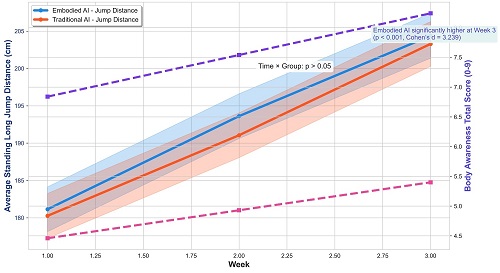
In rural low-resource physical education settings, whether an offline-priority embodied AI feedback protocol is feasible and can improve students' task-specific expression of bodily sensations still requires empirical testing. This quasi-experimental study involved 72 first-year rural high school students (36 males and 36 females) randomly assigned to either the embodied AI group or the traditional AI feedback group. Both groups completed a 3-week standing long jump intervention (one 45--60 minute class per week, with 8 attempts per class). The experimental group used an offline-priority mobile learning ecosystem---teacher smartphone rapid key frame capture, data cable offline upload, local server AI processing, and iFlyTek voice input---to guide the "awareness--prediction--re-practice'' loop, while the control group received only traditional technical feedback. The teacher circulated between the two groups during instruction. Linear mixed-effects models and Bootstrap mediation analysis were employed to examine the effects. Results showed that standing long jump distance improved by approximately 13% in both groups (embodied AI group: +13.13%; traditional AI group: +13.11%), with a non-significant time × group interaction (p > 0.05). However, the embodied AI group demonstrated significantly higher task-specific body-awareness expression scores than the control group (Cohen's d = 3.239, p < 0.001). Mediation analysis indicated that task-specific body-awareness expression did not significantly mediate the relationship between group assignment and improvement in jump performance. The findings suggest that an offline-priority embodied AI feedback protocol is feasible in rural low-resource environments and effectively enhances students' ability to describe, monitor, and predict bodily sensations in the specific context of standing long jump practice. However, it did not produce superior short-term gains in standing long jump performance compared with traditional AI feedback. Because the embodied protocol necessarily involved more dialogue turns and reflection time, future studies should employ yoked designs to isolate the independent effects of feedback type and interaction dosage.
Article Details

This work is licensed under a Creative Commons Attribution-NonCommercial 4.0 International License.
References
- Anderson, J. R. (1982). Acquisition of cognitive skill. Psychological Review, 89(4), 369–406. https://doi.org/10.1037/0033-295x.89.4.369
- Chen, R., Wu, Y., Chen, Z., & Zhou, P. (2025). Advancing educational equity in rural China: the impact of AI devices on teaching quality and learning outcomes for sustainable development. Frontiers in Psychology, 16. https://doi.org/10.3389/fpsyg.2025.1588047
- Clark, A. (2008). Supersizing the Mind. https://doi.org/10.1093/acprof:oso/9780195333213.001.0001
- Drolia, M., Papadakis, S., Sifaki, E., & Kalogiannakis, M. (2022). Mobile Learning Applications for Refugees: A Systematic Literature Review. Education Sciences, 12(2), 96. https://doi.org/10.3390/educsci12020096
- Faella, P., Digennaro, S., & Iannaccone, A. (2025). Educational practices in motion: a scoping review of embodied learning approaches in school. Frontiers in Education, 10. https://doi.org/10.3389/feduc.2025.1568744
- Fitts, P. M., & Posner, M. I. (1967). Human performance. Brooks/Cole.
- Han, Y., Syed Ali, S. K. B., & Ji, L. (2022). Feedback for Promoting Motor Skill Learning in Physical Education: A Trial Sequential Meta-Analysis. International Journal of Environmental Research and Public Health, 19(22), 15361. https://doi.org/10.3390/ijerph192215361
- He, X., & Wei, L. (2025). Real-time feedback enhances motor learning and motivation in youth team sports through augmented reality tools. Frontiers in Psychology, 16. https://doi.org/10.3389/fpsyg.2025.1661936
- Liang, C., Zhi, J., Su, C., Xue, W., Liu, Z., & Ye, H. (2025). A Study on the Effects of Embodied and Cognitive Interventions on Adolescents’ Flow Experience and Cognitive Patterns. Behavioral Sciences, 15(6), 768. https://doi.org/10.3390/bs15060768
- López Costa, M. (2025). Artificial Intelligence and Data Literacy in Rural Schools’ Teaching Practices: Knowledge, Use, and Challenges. Education Sciences, 15(3), 352. https://doi.org/10.3390/educsci15030352
- Ma, J., Ma, L., Qi, S., Zhang, B., & Ruan, W. (2025). A practical study of artificial intelligence-based real-time feedback in online physical education teaching. Smart Learning Environments, 12(1). https://doi.org/10.1186/s40561-025-00411-3
- Musculus, L., Tünte, M. R., Raab, M., & Kayhan, E. (2021). An Embodied Cognition Perspective on the Role of Interoception in the Development of the Minimal Self. Frontiers in Psychology, 12. https://doi.org/10.3389/fpsyg.2021.716950
- Samala, A. D., Papadakis, S., & Rawas, S. (2025). Global Insights into Mobile Learning in Higher Education: A PRISMA-Guided Bibliometric Analysis from 2007 to 2023. International Journal of Educational Reform. https://doi.org/10.1177/10567879251341869
- Tohănean, D. I., Vulpe, A. M., Mijaica, R., & Alexe, D. I. (2025). Embedding Digital Technologies (AI and ICT) into Physical Education: A Systematic Review of Innovations, Pedagogical Impact, and Challenges. Applied Sciences, 15(17), 9826. https://doi.org/10.3390/app15179826
- Uğraş, H., Uğraş, M., Papadakis, S., & Kalogiannakis, M. (2024). ChatGPT-Supported Education in Primary Schools: The Potential of ChatGPT for Sustainable Practices. Sustainability, 16(22), 9855. https://doi.org/10.3390/su16229855
- Varela, F. J., Rosch, E., & Thompson, E. (1991). The embodied mind: Cognitive science and human experience. MIT Press. https://doi.org/10.7551/mitpress/6730.001.0001
