
A WeChat-Delivered Offline AI Toolchain for Hardware Simulation Teaching in Rural High Schools: An Exploratory Feasibility Pilot
Article Sidebar
Main Article Content


Abstract
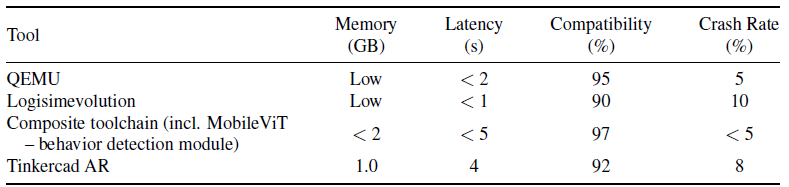
Rural high schools in low-resource environments face substantial barriers to AI-enhanced hardware simulation, including limited network bandwidth (e.g., 2G), low-specification devices (memory below 4 GB), and a lack of localized offline tools. This exploratory feasibility pilot study proposes and preliminarily evaluates a low-resource open-source AI simulation toolchain. The toolchain incorporates a MobileViT behaviour detection module and integrates it with open-source tools such as QEMU, Logisim-evolution, Tinkercad AR, MagicSchool.ai, and Blender to create a WeChat-delivered, offline AI-supported composite toolchain. The toolchain was delivered via WeChat to 25 students at a rural high school in central China over an 8-week A/B testing intervention. It was optimized for offline compatibility, localization training based on rural agricultural scenarios, and privacy protection through anonymous IDs. The study employed exploratory descriptive statistical methods. In this n = 25 exploratory feasibility pilot, descriptive statistics revealed positive descriptive trends in the experimental group for learning efficiency, test accuracy, and participation rate (task completion time reduced by approximately 30%, accuracy rate approximately +25%, participation rate approximately +28%). All statistical results are exploratory findings and require further validation with larger samples. Preliminary observations of the composite toolchain are directionally consistent with certain assumptions of Cognitive Load Theory (CLT) and Self-Determination Theory (SDT). This study provides an exploratory feasibility description of a WeChat-delivered, offline AI-supported toolchain for hardware simulation teaching in rural high schools. Rather than offering evidence of effectiveness, it identifies practical design considerations, implementation challenges, and preliminary descriptive trends that may inform future large-scale research in resource-constrained educational settings.
Article Details

This work is licensed under a Creative Commons Attribution-NonCommercial 4.0 International License.
References
- Chen, C.-H., & Chang, C.-L. (2024). Effectiveness of AI-assisted game-based learning on science learning outcomes, intrinsic motivation, cognitive load, and learning behavior. Education and Information Technologies, 29(14), 18621–18642. https://doi.org/10.1007/s10639-024-12553-x
- Chen, R., Wu, Y., Chen, Z., & Zhou, P. (2025). Advancing educational equity in rural China: the impact of AI devices on teaching quality and learning outcomes for sustainable development. Frontiers in Psychology, 16. https://doi.org/10.3389/fpsyg.2025.1588047
- Drolia, M., Papadakis, S., Sifaki, E., & Kalogiannakis, M. (2022). Mobile Learning Applications for Refugees: A Systematic Literature Review. Education Sciences, 12(2), 96. https://doi.org/10.3390/educsci12020096
- Holmes, W., & Miao, F. (2023). Guidance for generative AI in education and research. Unesco Publishing.
- Lavidas, K., Papadakis, S., Manesis, D., Grigoriadou, A. S., & Gialamas, V. (2022). The Effects of Social Desirability on Students’ Self-Reports in Two Social Contexts: Lectures vs. Lectures and Lab Classes. Information, 13(10), 491. https://doi.org/10.3390/info13100491
- Liu, G. L., Darvin, R., & Ma, C. (2025). Exploring AI-mediated informal digital learning of English (AI-IDLE): A mixed-method investigation of Chinese EFL learners’ AI adoption and experiences. Computer Assisted Language Learning, 38(7), 1632-1660. https://doi.org/10.1080/09588221.2024.2310288
- Ma, N., & Zhong, Z. (2025). A Meta‐Analysis of the Impact of Generative Artificial Intelligence on Learning Outcomes. Journal of Computer Assisted Learning, 41(5), e70117. https://doi.org/10.1111/jcal.70117
- Maslej, N., Fattorini, L., Perrault, R., Gil, Y., Parli, V., Kariuki, N., ... & Oak, S. (2025). Artificial intelligence index report 2025. arXiv preprint arXiv:2504.07139. https://doi.org/10.48550/arXiv.2504.07139
- Ministry of Education of the People’s Republic of China. (2024). Official data on artificial intelligence application in rural basic education schools. MOE Press Release, December 1. https://en.moe.gov.cn/news/press_releases/202412/t20241201_1165337.html
- Papadakis, S., & Lampropoulos, G. (Eds.). (2024). Intelligent Educational Robots. https://doi.org/10.1515/9783111352695
- Papadakis, S., & Orfanakis, V. (2018). Comparing novice programing environments for use in secondary education: App Inventor for Android vs. Alice. International Journal of Technology Enhanced Learning, 10(1/2), 44. https://doi.org/10.1504/ijtel.2018.088333
- Papadakis, S. (2018). Is Pair Programming More Effective than Solo Programming for Secondary Education Novice Programmers? International Journal of Web-Based Learning and Teaching Technologies, 13(1), 1–16. https://doi.org/10.4018/ijwltt.2018010101
- Sanasintani, S. (2023). Revitalizing the higher education curriculum through an artificial intelligence approach: An overview. Journal of Social Science Utilizing Technology, 1(4), 239-248. https://doi.org/10.70177/jssut.v1i4.670
- Song, Y., Weisberg, L. R., Zhang, S., Tian, X., Boyer, K. E., & Israel, M. (2024). A framework for inclusive AI learning design for diverse learners. Computers and Education: Artificial Intelligence, 6, 100212. https://doi.org/10.1016/j.caeai.2024.100212
- Tahiru, F. (2021). AI in education: A systematic literature review. Journal of Cases on Information Technology, 23(1), 1-20. https://doi.org/10.4018/JCIT.2021010101
- Wang, X., Young, G. W., Iqbal, M. Z., & Guckin, C. M. (2024). The potential of extended reality in Rural Education’s future–perspectives from rural educators. Education and Information Technologies, 29(7), 8987-9011. https://doi.org/10.1007/s10639-023-12169-7
- Zhang, H. L., & Leong, W. Y. (2024). Transforming rural and underserved schools with AI-powered education solutions. ASM Science Journal, 19, 1895. https://doi.org/10.32802/asmscj.2023.1895
