
Capacity Building for Sustainability and Circular Economy: Identifying Educational Barriers and Opportunities in Asia
Article Sidebar
Main Article Content


Abstract
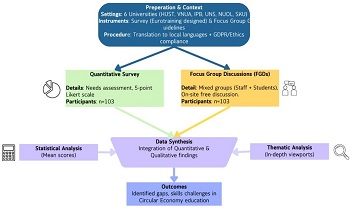
The transition from a linear to a circular economy (CE) is a pressing imperative for Southeast Asia, a region facing rapid industrialization and environmental risks. This study, part of the CEBCAT project, examines the current state of higher education in Indonesia, Laos, and Vietnam with respect to CE and sustainability. The purpose was to identify existing knowledge and ability gaps and instructional problems, thereby informing the development of a master's curriculum in CE and sustainability. Using a mixed-methods approach across six partner universities in Asia, data were collected from 103 individuals, including students, academic staff, and industry professionals. The findings reveal that, although there is a foundational awareness of sustainability, a deep conceptual understanding of the circular economy is limited. Critical skill gaps were identified in practical application, environmental impact assessment, and digital literacy, and a strong preference for experiential learning over purely theoretical or online instruction. However, the study highlights significant institutional barriers, including limited funding, outdated resources, and heavy faculty workloads. Effective CE capacity building requires a shift toward interdisciplinary, practice-based curricula supported by robust industry partnerships and institutional investment.
Article Details

This work is licensed under a Creative Commons Attribution-NonCommercial 4.0 International License.
References
- Amara, D. B., & Qiao, J. (2024). Path to Sustainability Transition: Can the Balanced Combination of Eco-Innovation, Foreign Investments, and Carbon Emissions Pave the Way for Economic Growth and Environmental Harmony? https://doi.org/10.21203/rs.3.rs-3955029/v1
- Bridges, W., & Mitchell, S. (2000). Leading transition: A new model for change. Leader to leader, 16(3), 30-36.
- Buyukyazici, D., & Quatraro, F. (2025). The skill requirements of the circular economy. Ecological Economics, 232, 108559. https://doi.org/10.1016/j.ecolecon.2025.108559
- Campos‐Romero, H., & Rodil‐Marzábal, Ó. (2024). Environmental effects of growth and global value chains: The case of East and Southeast Asian economies. Sustainable Development, 32(4), 4114–4134. Portico. https://doi.org/10.1002/sd.2877
- Campos-Romero, H., & Rodil-Marzábal, Ó. (2025). Dimensions of Sustainability: Assessing the Impact of Technology Intensity and Global Value Chains in East and Southeast Asia. Revista de Economía Mundial, 69, 119–144. https://doi.org/10.33776/rem.vi69.8326
- Chatzopoulos, A., Karaflis, A., Kalogiannakis, M., Tzerachoglou, A., Cheirchanteri, G., Sfyroera, E., & Sklavounou, E.-O. (2023). Evaluation of Google Play educational apps for early childhood education. Advances in Mobile Learning Educational Research, 3(2), 770–778. https://doi.org/10.25082/amler.2023.02.004
- Dutt, S., Purwanto, P., & Sudarno, S. (2025). Synergizing Circular Economy and Eco-Industrial Park Concepts: A Literature-Based Exploration for Advancing Inclusive and Sustainable Industrial Development in Indonesia. E3S Web of Conferences, 650, 02013. https://doi.org/10.1051/e3sconf/202565002013
- Garcia-Saravia Ortiz-de-Montellano, C., Ghannadzadeh, A., & van der Meer, Y. (2023). The CIRCULAR pathway: a new educational methodology for exploratory circular value chain redesign. Frontiers in Sustainability, 4. https://doi.org/10.3389/frsus.2023.1197659
- Giardino, A., Pelli, M., Raitzer, D. A., Bosello, F., Campagnolo, L., & Mansi, G. (2024). Asia-Pacific Climate Report 2024. https://iris.unive.it/handle/10278/5084976
- Herrador, M., & Van, M. L. (2024). Circular economy strategies in the ASEAN region: A comparative study. Science of The Total Environment, 908, 168280. https://doi.org/10.1016/j.scitotenv.2023.168280
- Hien, N. P., Hong Vinh, C. T., Phuong Mai, V. T., & Kim Xuyen, L. T. (2020). Remittances, real exchange rate and the Dutch disease in Asian developing countries. The Quarterly Review of Economics and Finance, 77, 131–143. https://doi.org/10.1016/j.qref.2019.10.006
- Huo, J., & Peng, C. (2023). Depletion of natural resources and environmental quality: Prospects of energy use, energy imports, and economic growth hindrances. Resources Policy, 86, 104049. https://doi.org/10.1016/j.resourpol.2023.104049
- Indiran, L., Rizkiyah, E., Zhang, N., & Ung, E. N. (2025). Students’ Knowledge, Attitude and Behavior Towards Circular Economy Among Asian Countries. PaperASIA, 41(2b), 82–94. https://doi.org/10.59953/paperasia.v41i2b.408
- Javed, T., Said, F., Zainal, D., & Jalil, A. A. (2024). Circular Economy Implementation Status of Selected ASEAN Countries. Sage Open, 14(1). https://doi.org/10.1177/21582440231216261
- Kalogiannakis, M., Zourmpakis, A. I., Menšíková, M., Lategan, F., Patelarou, A., Patelarou, E., Ljubišić, N. B., Ampartzaki, M., Sifaki, E., Papadourakis, G., & Gonianakis, E. (2023). Use of an e-toolkit in the development of digital competencies in Weeks of International Teaching. Advances in Mobile Learning Educational Research, 3(1), 702–717. https://doi.org/10.25082/amler.2023.01.019
- Kirchherr, J., Yang, N.-H. N., Schulze-Spüntrup, F., Heerink, M. J., & Hartley, K. (2023). Conceptualizing the Circular Economy (Revisited): An Analysis of 221 Definitions. Resources, Conservation and Recycling, 194, 107001. https://doi.org/10.1016/j.resconrec.2023.107001
- Kirchherr, J., & Piscicelli, L. (2019). Towards an Education for the Circular Economy (ECE): Five Teaching Principles and a Case Study. Resources, Conservation and Recycling, 150, 104406. https://doi.org/10.1016/j.resconrec.2019.104406
- Kormos, E., & Wisdom, K. (2023). Digital divide and teaching modality: It’s role in technology and instructional strategies. Education and Information Technologies, 28(8), 9985–10003. https://doi.org/10.1007/s10639-022-11488-5
- Lacy, P., & Rutqvist, J. (2015). The Roots of the Circular Economy. Waste to Wealth, 19–23. https://doi.org/10.1057/9781137530707_2
- Layyinah, S. Q., Sinaga, P., & Amprasto, A. (2024). The Effectiveness of Mobile Learning Teaching Materials for Education on Sustainable Development in Eco-Friendly Technology to Improve Environmental Literacy. Prisma Sains: Jurnal Pengkajian Ilmu dan Pembelajaran Matematika dan IPA IKIP Mataram, 12(3), 509-518. https://10.33394/j-ps.v12i3.12004
- Lindgren, P. (2024). Circular and Sustainable Multi Business Model Innovation and Development: Journal of Mobile Multimedia, 111–156. https://doi.org/10.13052/jmm1550-4646.2015
- Liu, Q., Trevisan, A. H., Yang, M., & Mascarenhas, J. (2022). A framework of digital technologies for the circular economy: Digital functions and mechanisms. Business Strategy and the Environment, 31(5), 2171–2192. Portico. https://doi.org/10.1002/bse.3015
- Machell, J., & Saunders, M. (2000). Quality, qualifications and the attribution of value in work based learning. Quality Management and Qualification Needs 2, 227–241. https://doi.org/10.1007/978-3-642-57644-7_11
- Maketo, L., Issa, T., Issa, T., & Nau, S. Z. (2023). M-Learning adoption in higher education towards SDG4. Future Generation Computer Systems, 147, 304–315. https://doi.org/10.1016/j.future.2023.05.010
- Miatto, A., Dawson, D., Nguyen, P. D., Kanaoka, K. S., & Tanikawa, H. (2021). The urbanisation-environment conflict: Insights from material stock and productivity of transport infrastructure in Hanoi, Vietnam. Journal of Environmental Management, 294, 113007. https://doi.org/10.1016/j.jenvman.2021.113007
- Nguyen, T. P. L. (2023). Integrating circular economy into STEM education: A promising pathway toward circular citizenship development. Frontiers in Education, 8. https://doi.org/10.3389/feduc.2023.1063755
- Ng, C. F. (2021). The Physical Learning Environment of Online Distance Learners in Higher Education – A Conceptual Model. Frontiers in Psychology, 12. https://doi.org/10.3389/fpsyg.2021.635117
- Nunes, B. T., Pollard, S. J. T., Burgess, P. J., Ellis, G., De los Rios, I. C., & Charnley, F. (2018). University Contributions to the Circular Economy: Professing the Hidden Curriculum. Sustainability, 10(8), 2719. https://doi.org/10.3390/su10082719
- Papadakis, S., & Kalogiannakis, M. (2019). Evaluating a Course for Teaching Advanced Programming Concepts with Scratch to Preservice Kindergarten Teachers: A Case Study in Greece. Early Childhood Education. https://doi.org/10.5772/intechopen.81714
- Patelarou, A., Zourmpakis, A.-I., Menšíková, M., Ljubišić, N. B., Ampartzaki, M., Sifaki, E., Papadourakis, G. M., Papadakis, S. E., Kalogiannakis, M., & Patelarou, E. (2022). Teaching and learning in the content of International Mobility: An overview of the existing evidence. Advances in Mobile Learning Educational Research, 2(2), 427–434. https://doi.org/10.25082/amler.2022.02.011
- Petousi, V., & Sifaki, E. (2020). Contextualising harm in the framework of research misconduct. Findings from discourse analysis of scientific publications. International Journal of Sustainable Development, 23(3/4), 149. https://doi.org/10.1504/ijsd.2020.115206
- Pieroni, M. P. P., McAloone, T. C., & Pigosso, D. C. A. (2019). Business model innovation for circular economy and sustainability: A review of approaches. Journal of Cleaner Production, 215, 198–216. https://doi.org/10.1016/j.jclepro.2019.01.036
- Plakitsi, K., Spyrtou, A., Klonari, K., Kalogiannakis, M., Malandrakis, G., Papadopoulou, P., Stamoulis, E., Soulios, J., Piliouras, P., & Kolios, N. (2014). New Greek Science Curriculum (NGSC) for Primary Education: Promoting Educational Innovation Under Hard Conditions. In C.-P. Constantinou, N. Papadouris, & A. Hadjigeorgiou (Eds.), Proceedings of the ESERA 2013 Conference: Science Education Research for Evidence-based Teaching and Coherence in Learning, (J. Dillon & A. Redfors, co-editors for Strand 10: Science curriculum and educational policy) Nicosia, Cyprus, 2-7 September 2013.
- Poultsakis, S., Papadakis, S., Kalogiannakis, M., & Psycharis, S. (2021). The management of Digital Learning Objects of Natural Sciences and Digital Experiment Simulation Tools by teachers. Advances in Mobile Learning Educational Research, 1(2), 58–71. https://doi.org/10.25082/amler.2021.02.002
- Rachmad, Y. E. (2025). Danantara’s Role in Human Capital Development: Investing in Indonesia’s Future Workforce. The United Nations Global Compact.
- Rae, D. (2010). Universities and enterprise education: responding to the challenges of the new era. Journal of Small Business and Enterprise Development, 17(4), 591–606. https://doi.org/10.1108/14626001011088741
- Saunders, M., & Machell, J. (2000). Understanding emerging trends in higher education curricula and work connections. Higher Education Policy, 13(3), 287–302. https://doi.org/10.1016/s0952-8733(00)00013-1
- Serrano-Bedia, A.-M., & Perez-Perez, M. (2022). Transition towards a circular economy: A review of the role of higher education as a key supporting stakeholder in Web of Science. Sustainable Production and Consumption, 31, 82–96. https://doi.org/10.1016/j.spc.2022.02.001
- Soudachanh, S., & Salhofer, S. P. (2024). E-waste management in Vientiane Capital, Laos. In Proceedings of the Annual Conference of Japan Society of Material Cycles and Waste Management 3RINCs 2024 (p. 27). Japan Society of Material Cycles and Waste Management.
- SwitchAsia. (2022). Country profile: Lao PDR. https://www.switch-asia.eu/countries/southeast-asia/laos
- Tavani, S., Billi, A., Corradetti, A., Mercuri, M., Bosman, A., Cuffaro, M., Seers, T., & Carminati, E. (2022). Smartphone assisted fieldwork: Towards the digital transition of geoscience fieldwork using LiDAR-equipped iPhones. Earth-Science Reviews, 227, 103969. https://doi.org/10.1016/j.earscirev.2022.103969
- Tran, P. M., Nguyen, T., Nguyen, H.-D., Thinh, N. A., Lam, N. D., Huyen, N. T., & Khuc, V. Q. (2024). Improving Green Literacy and Environmental Culture Associated with Youth Participation in the Circular Economy: A Case Study of Vietnam. Urban Science, 8(2), 63. https://doi.org/10.3390/urbansci8020063
- Tura, N., Hanski, J., Ahola, T., Ståhle, M., Piiparinen, S., & Valkokari, P. (2019). Unlocking circular business: A framework of barriers and drivers. Journal of Cleaner Production, 212, 90–98. https://doi.org/10.1016/j.jclepro.2018.11.202
- Uğraş, H., Uğraş, M., Papadakis, S., & Kalogiannakis, M. (2024). ChatGPT-Supported Education in Primary Schools: The Potential of ChatGPT for Sustainable Practices. Sustainability, 16(22), 9855. https://doi.org/10.3390/su16229855
- Voulvoulis, N. (2022). Transitioning to a sustainable circular economy: The transformation required to decouple growth from environmental degradation. Frontiers in Sustainability, 3. https://doi.org/10.3389/frsus.2022.859896
- Wang, H., Wang, P., Zhang, X., Chen, W.-Q., Tzachor, A., Fishman, T., Schandl, H., Acuto, M., Yang, Y., Lu, Y., Böcher, C., Ma, F., Zhang, C., Yue, Q., Du, T., Liu, J., & Zhu, Y.-G. (2024). Substantial increase in China’s manufactured sand supply since 2010. Nature Geoscience, 17(9), 833–836. https://doi.org/10.1038/s41561-024-01501-6
- Wardani, D. K., Sabandi, M., Kardiyem, K., & Indira, F. R. (2025). Circular economy awareness of students in higher education: the assessment of knowledge, attitudes, and behavior. Journal of Education and Learning (EduLearn), 19(2), 988–997. https://doi.org/10.11591/edulearn.v19i2.21432
- Khan, H. H. A., Yusof, N. M., Anuar, A., Zawawi, A. A., & Vivekanantharasa, R. (2025). Circular Economy in Practice: Barriers, Challenges, and Strategic Implications. International Journal of Research and Innovation in Social Science, 9(10), 950–958. https://doi.org/10.47772/ijriss.2025.910000083
- Zeng, H., Chen, X., Xiao, X., & Zhou, Z. (2017). Institutional pressures, sustainable supply chain management, and circular economy capability: Empirical evidence from Chinese eco-industrial park firms. Journal of Cleaner Production, 155, 54–65. https://doi.org/10.1016/j.jclepro.2016.10.093
