
Technology Integration to Enhance the Speaking Proficiency of English Language Learners: A Systematic Review
Article Sidebar
Main Article Content


Abstract
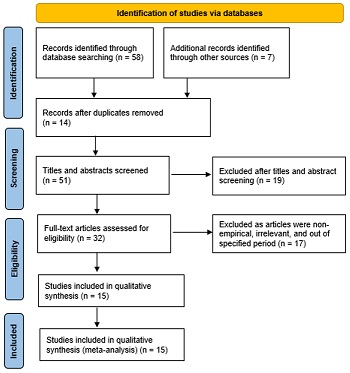
English language proficiency, particularly speaking, is essential for learners to engage meaningfully in the language classroom. This article reports review results from research published between 2019 and 2025 (n = 15) on the perceptions and experiences of English language learners regarding the influence of mobile technology integration on speaking proficiency. We downloaded articles from established databases, search engines, and journals to conduct thematic synthesis, drawing on the Preferred Reporting Items for Systematic Reviews and Meta-Analysis (PRISMA) framework to identify themes. Review results indicated that learners across contexts reported an improvement in their language proficiency when mobile technology was integrated into speaking practice. Although there were challenges, such as technical, socio-emotional, quality, and voice-recognition issues, the strategies learners used proved effective. Similarly, upon reviewing the methodological trends concerning this issue, it was found that mixed methods were predominantly used as the research approach, interviews were employed for data collection, and thematic analysis was utilized to analyze the data. The findings guide practitioners and policymakers in developing classroom strategies, teaching-learning approaches, and mobile technology policies that support the improvement of learners' speaking proficiency.
Article Details

This work is licensed under a Creative Commons Attribution-NonCommercial 4.0 International License.
References
- Adhikari, Y. N. (2021). Integrating Technology into English Language Teaching in Nepal: Student and Teacher Perspectives. Prithvi Academic Journal, 4, 107–120. https://doi.org/10.3126/paj.v4i0.37052
- Benek, K. (2025). EFL Learners’ and Teachers’ Perceptions of AI-Powered Language Learning Technologies: Benefits and Challenges. International Journal of Instruction, 18(2), 103–120. https://doi.org/10.29333/iji.2025.1827a
- Bernacki, M. L., Greene, J. A., & Crompton, H. (2020). Mobile technology, learning, and achievement: Advances in understanding and measuring the role of mobile technology in education. Contemporary Educational Psychology, 60, 101827. https://doi.org/10.1016/j.cedpsych.2019.101827
- Bin-Hady, W. R. A., & Al-Tamimi, N. O. M. (2021). The use of technology in informal English language learning: evidence from Yemeni undergraduate students. Learning and Teaching in Higher Education: Gulf Perspectives, 17(2), 107–120. https://doi.org/10.1108/lthe-09-2020-0037
- Chan, I., & Law, R. (2021). Mobile Technology. Encyclopedia of Tourism, 1–2. https://doi.org/10.1007/978-3-319-01669-6_721-1
- Hyeon Choi, S., & Sinwongsuwat, K. (2024). Vlogging: An Alternative to Role-play in Improving EFL Learners’ Conversation Skills. REFLections, 31(2), 353–385. https://doi.org/10.61508/refl.v31i2.273312
- Ding, J., & Sazalli, N. (2024). Behavioral Intention of Chinese College Students Use Social Media to Improve English Speaking Skills: Based on the Technology Acceptance Model and Self-Determination Theory. International Journal of Academic Research in Progressive Education and Development, 13(2). https://doi.org/10.6007/ijarped/v13-i2/21123
- Ghimire, P. R., & Neupane, B. P. (2024). Teachers’ Perception and Experiences on Artificial Intelligence (AI) Integration in English Language Teaching and Learning. Lumbini Journal of Language and Literature, 4(1), 104–116. https://doi.org/10.3126/ljll.v4i1.73918
- Ghimire, P. R., Neupane, B. P., & Dahal, N. (2024). Generative AI and AI Tools in English Language Teaching and Learning: An Exploratory Research. English Language Teaching Perspectives, 9(1–2), 30–40. https://doi.org/10.3126/eltp.v9i1-2.68716
- Hinkel, E. (2020). Teaching Academic L2 Writing. Routledge. https://doi.org/10.4324/9780429437946
- Karakose, T., Papadakis, S., Tülübaş, T., & Polat, H. (2022). Understanding the Intellectual Structure and Evolution of Distributed Leadership in Schools: A Science Mapping-Based Bibliometric Analysis. Sustainability, 14(24), 16779. https://doi.org/10.3390/su142416779
- Karakose, T., Tülübaş, T., Papadakis, S., & Yirci, R. (2023). Evaluating the Intellectual Structure of the Knowledge Base on Transformational School Leadership: A Bibliometric and Science Mapping Analysis. Education Sciences, 13(7), 708. https://doi.org/10.3390/educsci13070708
- Khadka, B. K., & Shahi, D. K. (2025). English teachers' knowledge of using ICT in English language teaching in Nepal. American Journal of STEM Education, 4, 27-46. https://ojed.org/STEM/article/view/7408
- Khanh, N. V., & Le, T. B. (2023). EFL Tertiary Students’ Perception and Practice with Language Learning Beyond the Classroom: The Case of Vietnam. European Journal of English Language Teaching, 8(3). https://doi.org/10.46827/ejel.v8i3.4888
- Lavidas, K., Papadakis, S., Manesis, D., Grigoriadou, A. S., & Gialamas, V. (2022). The Effects of Social Desirability on Students’ Self-Reports in Two Social Contexts: Lectures vs. Lectures and Lab Classes. Information, 13(10), 491. https://doi.org/10.3390/info13100491
- Lavidas, K., Petropoulou, A., Papadakis, S., Apostolou, Z., Komis, V., Jimoyiannis, A., & Gialamas, V. (2022). Factors Affecting Response Rates of the Web Survey with Teachers. Computers, 11(9), 127. https://doi.org/10.3390/computers11090127
- Lin, J.-J., & Lin, H. (2019). Mobile-assisted ESL/EFL vocabulary learning: a systematic review and meta-analysis. Computer Assisted Language Learning, 32(8), 878–919. https://doi.org/10.1080/09588221.2018.1541359
- Madhavi, E., Sivapurapu, L., Koppula, V., Rani, P. E., & Sreehari, V. (2023). Developing learners’ english speaking skills using ict and ai tools. Journal of Advanced Research in Applied Sciences and Engineering Technology, 32(2), 142-153. https://doi.org/10.37934/araset.32.2.142153
- Mahmood, I., Memon, S. S., & Qureshi, S. (2023). An Action Research to Improve Speaking Skills of English Language Learners Through Technology Mediated Language Learning. Academy of Education and Social Sciences Review, 3(4), 429–439. https://doi.org/10.48112/aessr.v3i4.633
- Majid, S. N. A., & Salam, A. R. (2021). A Systematic Review of Augmented Reality Applications in Language Learning. International Journal of Emerging Technologies in Learning (IJET), 16(10), 18. https://doi.org/10.3991/ijet.v16i10.17273
- Neupane, B. P., Paudel, P., Dahal, N., Karki, S., Paudel, G. R., Ghimire, P., & Thapa, B. (2025). English Language Teaching in the Age of Artificial Intelligence: Tools, Techniques, and Methodologies. Advances in Mobile Learning Educational Research, 5(1), 1356–1369. https://doi.org/10.25082/amler.2025.01.011
- Nguyen, T. T. T. (2024). Using Flipgrid Videos to Enhance Speaking and Presenting in English for Non-Native Learners. International Journal of Engineering Pedagogy (IJEP), 14(2), 100–111. https://doi.org/10.3991/ijep.v14i2.43813
- Page, M. J., McKenzie, J. E., Bossuyt, P. M., Boutron, I., Hoffmann, T. C., Mulrow, C. D., Shamseer, L., Tetzlaff, J. M., Akl, E. A., Brennan, S. E., Chou, R., Glanville, J., Grimshaw, J. M., Hróbjartsson, A., Lalu, M. M., Li, T., Loder, E. W., Mayo-Wilson, E., McDonald, S., … Moher, D. (2021). The PRISMA 2020 statement: an updated guideline for reporting systematic reviews. BMJ, n71. https://doi.org/10.1136/bmj.n71
- PRISMA Statement. (n.d.). PRISMA 2020 checklist. https://www.prisma-statement.org/prisma-2020-checklist
- PRISMA Statement. (n.d.). PRISMA statement. https://www.prisma-statement.org
- Shrestha, P. (1970). The Potential of Mobile Technologies for (English) Language Learning in Nepal. Journal of NELTA, 16(1–2), 107–113. https://doi.org/10.3126/nelta.v16i1-2.6134
- Shrestha, S. (2016). Exploring mobile learning opportunities and challenges in Nepal: The potential of open-source platforms [Doctoral thesis], University of West London. https://repository.uwl.ac.uk/id/eprint/2962
- Singh, R. (2019). Students’ perspectives on technology integration in ELT. Journal of NELTA, 24(1–2), 95–106. https://doi.org/10.3126/nelta.v24i1-2.27682
- Sumartono, S. (2023). Empowering Gen Z: Enhancing English Speaking Skills Through Technology and Authentic Communication. NextGen Education Review Journal, 1(2), 1–9. https://doi.org/10.58660/nextgen.v1i2.34
- Tiwari, H. P. (2023). English Proficiency Aspirations among Nepalese EFL Students. Tamaddun, 22(2), 239–247. https://doi.org/10.33096/tamaddun.v22i2.577
- Toleuzhan, A., Sarzhanova, G., Romanenko, S., Uteubayeva, E., & Karbozova, G. (2022). The Educational Use of YouTube Videos in Communication Fluency Development in English: Digital Learning and Oral Skills in Secondary Education. International Journal of Education in Mathematics, Science and Technology, 11(1), 198–221. https://doi.org/10.46328/ijemst.2983
- Wang, W., Zou, B., & Xue, S. (2023). AI technology used as a tool for enhancing university students’ English speaking skills: perceptions and practices. Seventh International Conference on Mechatronics and Intelligent Robotics (ICMIR 2023), 97. https://doi.org/10.1117/12.2689728
- Wati, S. O., Budiyanti, K., Mizkat, E., Juita, N., & Ardi, H. (2024). Exploring the Benefits and Challenges of Social Media in English Language Learning: Insights from English Education Students. Journal of English Language and Education, 9(3), 38–45. https://doi.org/10.31004/jele.v9i3.505
- Yirci, R., Karakose, T., Kocabas, I., Tülübaş, T., & Papadakis, S. (2023). A Bibliometric Review of the Knowledge Base on Mentoring for the Professional Development of School Administrators. Sustainability, 15(4), 3027. https://doi.org/10.3390/su15043027
