
Exploring 360° Camera Deployment in a STEM Rotation-Station Laboratory: Pre-service Teachers’ Perceptions
Article Sidebar
Main Article Content


Abstract
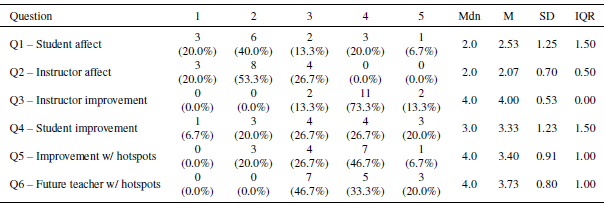
360° cameras allow for comprehensive spatial coverage in classroom settings; however, the use of these devices in STEM teacher education labs has not been adequately investigated. This exploratory study (N = 16 pre-service teachers) aimed to investigate the perceptions of pre-service teachers on the use of a 360° camera installed in a university STEM rotation-station laboratory equipped with Arduino, BBC micro:bit, Makey-Makey, and Raspberry Pi devices. A researcher-designed questionnaire was used to collect data on pre-service teachers’ perceptions on the three aspects of the 360° camera’s use in a STEM teacher education setting: (a) the observer effect, (b) the value of the 360° camera for teacher improvement, and (c) the potential of interactive hotspot annotations on the video feed. The results revealed minimal perceived reactivity: 60.0% of participants reported no/minimal effect on themselves, and 73.3% perceived no/minimal effect on the instructor. The value of the 360° camera for improvement was highly endorsed by the pre-service teachers; likewise, the potential of interactive hotspot annotations on the video feed for prospective teacher practice was highly appreciated by the pre-service teachers. Three themes were found to be relevant to the pre-service teacher perceptions on the use of the 360° camera in a STEM teacher education setting: complete spatial coverage, potential to monitor engagement, and potential for reflective improvement. Data on course evaluation and self-assessed knowledge confirmed the authentic and engaging nature of the setting for pre-service teacher learning. The findings should be viewed with caution as they are based on self-report data collected from a small sample of convenience; therefore, more research should be conducted to corroborate these findings using more objective methods and larger and more diverse samples.
Article Details

This work is licensed under a Creative Commons Attribution-NonCommercial 4.0 International License.
References
- Allen, D. W., & Eve, A. W. (1968). Microteaching. Theory Into Practice, 7(5), 181–185. https://doi.org/10.1080/00405846809542153
- Atal, D., Admiraal, W., & Saab, N. (2023). 360° Video in teacher education: A systematic review of why and how it is used in teacher education. Teaching and Teacher Education, 135, 104349. https://doi.org/10.1016/j.tate.2023.104349
- Balzaretti, N., Ciani, A., Cutting, C., O’Keeffe, L., & White, B. (2019). Unpacking the Potential of 360degree Video to Support Pre-Service Teacher Development. Research on Education and Media, 11(1), 63–69. https://doi.org/10.2478/rem-2019-0009
- Blomberg, G., Renkl, A., Gamoran Sherin, M., Borko, H., & Seidel, T. (2013). Five research-based heuristics for using video in pre-service teacher education. Journal for educational research online, 5(1), 90-114. https://doi.org/10.25656/01:8021
- Braun, V., & Clarke, V. (2006). Using thematic analysis in psychology. Qualitative Research in Psychology, 3(2), 77–101. https://doi.org/10.1191/1478088706qp063oa
- Braun, V., & Clarke, V. (2019). Reflecting on reflexive thematic analysis. Qualitative Research in Sport, Exercise and Health, 11(4), 589–597. https://doi.org/10.1080/2159676x.2019.1628806
- Crompton, H. (2013). A historical overview of m-learning: Toward learner-centered education. In Z. L. Berge & L. Y. Muilenburg (Eds.), Handbook of mobile learning (pp. 3–14). Routledge.
- Draghina, M., Vettermann, L., Geier, C., Fahrner, U., & Strehl, B. (2023). Enriched 360-degree videos in teacher education. Proposal of expert-based hotspots in 360-degree environments via eye-tracking and retrospective thinking aloud. Bad Heilbrunn: Klinkhardt. https://doi.org/10.35468/6066-enriched-en
- Eiselen, R., & van Huyssteen, G. B. (2023). A Comparison of Statistical Tests for Likert-Type Data: The Case of Swearwords. Journal of Open Humanities Data, 9. https://doi.org/10.5334/johd.132
- Evi-Colombo, A., Cattaneo, A., & Bétrancourt, M. (2020). Technical and pedagogical affordances of video annotation: A literature review. Journal of Educational Multimedia and Hypermedia, 29(3), 193-226.
- Ferdig, R. E., & Kosko, K. W. (2020). Implementing 360 Video to Increase Immersion, Perceptual Capacity, and Teacher Noticing. TechTrends, 64(6), 849–859. https://doi.org/10.1007/s11528-020-00522-3
- Ferdig, R. E., Kosko, K. W., & Gandolfi, E. (2023). Exploring the relationships between teacher noticing, ambisonic audio, and variance in focus when viewing 360 video. Educational Technology Research and Development, 71(3), 881–899. https://doi.org/10.1007/s11423-023-10215-2
- Fokides, E., & Arvaniti, P. A. (2020). Evaluating the effectiveness of 360 videos when teaching primary school subjects related to environmental education. Journal of Pedagogical Research, 4(3), 203–222. https://doi.org/10.33902/jpr.2020063461
- Fokides, E., & Vlachopoulou, C. (2024). Little Learners Go 360: Evaluating the Impact of 360° Videos on Kindergarten Students’ Understanding of Wild Animals. Applied Sciences, 14(14), 5996. https://doi.org/10.3390/app14145996
- Gandolfi, E., Kosko, K. W., & Ferdig, R. E. (2021). Situating presence within extended reality for teacher training: Validation of the extended Reality Presence Scale (XRPS) in preservice teacher use of immersive 360 video. British Journal of Educational Technology, 52(2), 824-841. https://doi.org/10.1111/bjet.13058
- Gaudin, C., & Chaliès, S. (2015). Video viewing in teacher education and professional development: A literature review. Educational Research Review, 16, 41–67. https://doi.org/10.1016/j.edurev.2015.06.001
- Gold, B., & Windscheid, J. (2020). Observing 360-degree classroom videos – Effects of video type on presence, emotions, workload, classroom observations, and ratings of teaching quality. Computers & Education, 156, 103960. https://doi.org/10.1016/j.compedu.2020.103960
- Gunnarsson, K. U., Collier, E. S., & Bendtsen, M. (2025). Research participation effects and where to find them: a systematic review of studies on alcohol. Journal of Clinical Epidemiology, 179, 111668. https://doi.org/10.1016/j.jclinepi.2025.111668
- Hamel, C., Viau-Guay, A., & Nkuyubwatsi, B. (2019). Using video to support teachers’ reflective practice: A literature review. Cogent Education, 6(1). https://doi.org/10.1080/2331186x.2019.1673689
- Hodges, S., Sentance, S., Finney, J., & Ball, T. (2020). Physical Computing: A Key Element of Modern Computer Science Education. Computer, 53(4), 20–30. https://doi.org/10.1109/mc.2019.2935058
- Jiang, Z., Zhang, Y., & Chiang, F. (2024). Meta‐analysis of the effect of 360‐degree videos on students’ learning outcomes and non‐cognitive outcomes. British Journal of Educational Technology, 55(6), 2423–2456. Portico. https://doi.org/10.1111/bjet.13464
- Julious, S. A. (2005). Sample size of 12 per group rule of thumb for a pilot study. Pharmaceutical Statistics, 4(4), 287–291. Portico. https://doi.org/10.1002/pst.185
- Kalogiannakis, M., & Papadakis, S. (2019). Pre-service kindergarten teachers acceptance of “ScratchJr” as a tool for learning and teaching computational thinking and Science education. The Journal of Emergent Science, 15, 31–34.
- Kalogiannakis, M., & Papadakis, S. (2020). The Use of Developmentally Mobile Applications for Preparing Pre-Service Teachers to Promote STEM Activities in Preschool Classrooms. Mobile Learning Applications in Early Childhood Education, 82–100. https://doi.org/10.4018/978-1-7998-1486-3.ch005
- Kosko, K. W., Ferdig, R. E., & Zolfaghari, M. (2020). Preservice Teachers’ Professional Noticing When Viewing Standard and 360 Video. Journal of Teacher Education, 72(3), 284–297. https://doi.org/10.1177/0022487120939544
- Kosko, K. W., Heisler, J., & Gandolfi, E. (2022). Using 360-degree video to explore teachers’ professional noticing. Computers & Education, 180, 104433. https://doi.org/10.1016/j.compedu.2022.104433
- McCambridge, J., Witton, J., & Elbourne, D. R. (2014). Systematic review of the Hawthorne effect: New concepts are needed to study research participation effects. Journal of Clinical Epidemiology, 67(3), 267–277. https://doi.org/10.1016/j.jclinepi.2013.08.015
- McFadden, J., Ellis, J., Anwar, T., & Roehrig, G. (2013). Beginning Science Teachers’ Use of a Digital Video Annotation Tool to Promote Reflective Practices. Journal of Science Education and Technology, 23(3), 458–470. https://doi.org/10.1007/s10956-013-9476-2
- Muresherwa, E., & Jita, L. C. (2022). The Value of a Pilot Study in Educational Research Learning: In Search of a Good Theory-Method Fit. Journal of Educational and Social Research, 12(2), 220. https://doi.org/10.36941/jesr-2022-0047
- Papadakis, S., & Kalogiannakis, M. (2017). Mobile educational applications for children: what educators and parents need to know. International Journal of Mobile Learning and Organisation, 11(3), 256. https://doi.org/10.1504/ijmlo.2017.085338
- Papadakis, S., & Kalogiannakis, M. (2022). Learning Computational Thinking Development in Young Children With Bee-Bot Educational Robotics. Research Anthology on Computational Thinking, Programming, and Robotics in the Classroom, 926–947. https://doi.org/10.4018/978-1-6684-2411-7.ch040
- Petousi, V., & Sifaki, E. (2020). Contextualising harm in the framework of research misconduct. Findings from discourse analysis of scientific publications. International Journal of Sustainable Development, 23(3/4), 149. https://doi.org/10.1504/ijsd.2020.115206
- Qian, J., Shang, J., & Qin, L. (2025). A systematic scoping review of 360-degree videos in teacher education. Journal of Research in Innovative Teaching & Learning, 18(1), 20–38. https://doi.org/10.1108/jrit-03-2023-0029
- Rich, P. J., & Hannafin, M. (2009). Video Annotation Tools. Journal of Teacher Education, 60(1), 52–67. https://doi.org/10.1177/0022487108328486
- Roche, L., Kittel, A., Cunningham, I., & Rolland, C. (2021). 360° Video Integration in Teacher Education: A SWOT Analysis. Frontiers in Education, 6. https://doi.org/10.3389/feduc.2021.761176
- Rosendahl, P., & Wagner, I. (2024). 360° videos in education – A systematic literature review on application areas and future potentials. Education and Information Technologies, 29(2), 1319–1355. https://doi.org/10.1007/s10639-022-11549-9
- Ruangsomboon, O., Lima, J. P., Eltorki, M., & Worster, A. (2024). Methodological standards in the design and reporting of pilot and feasibility studies in emergency medicine literature: a systematic review. BMJ Open, 14(11), e082648. https://doi.org/10.1136/bmjopen-2023-082648
- Seidel, T., Stürmer, K., Blomberg, G., Kobarg, M., & Schwindt, K. (2011). Teacher learning from analysis of videotaped classroom situations: Does it make a difference whether teachers observe their own teaching or that of others? Teaching and Teacher Education, 27(2), 259–267. https://doi.org/10.1016/j.tate.2010.08.009
- Sentance, S., & Csizmadia, A. (2017). Computing in the curriculum: Challenges and strategies from a teacher’s perspective. Education and Information Technologies, 22(2), 469–495. https://doi.org/10.1007/s10639-016-9482-0
- Sherin, M. G., & van Es, E. A. (2009). Effects of Video Club Participation on Teachers’ Professional Vision. Journal of Teacher Education, 60(1), 20–37. https://doi.org/10.1177/0022487108328155
- Snelson, C., & Hsu, Y.-C. (2019). Educational 360-Degree Videos in Virtual Reality: a Scoping Review of the Emerging Research. TechTrends, 64(3), 404–412. https://doi.org/10.1007/s11528-019-00474-3
- Sotiropoulos, D. I., & Pikoula, F. I. (2018). Augmented and Virtual Reality as the New Dimensions in Education. In Proceedings of the Neos Paidagogos Conference, Athens, April 28–29, 2018 (pp. 851–859). https://www.researchgate.net/publication/356634064
- Sotiropoulos, D., Raikou, N., & Kalogiannakis, M. (2025). Views of future Special Education teachers on teaching Natural Sciences during Practicum. Review of Science, Mathematics and ICT Education, 19(2), 137-159. http://doi.org/10.26220/rev.5423
- Theelen, H., van den Beemt, A., & den Brok, P. (2019). Using 360‐degree videos in teacher education to improve preservice teachers’ professional interpersonal vision. Journal of Computer Assisted Learning, 35(5), 582–594. Portico. https://doi.org/10.1111/jcal.12361
- Theelen, H., van den Beemt, A., & Brok, P. den. (2020). Developing preservice teachers’ interpersonal knowledge with 360-degree videos in teacher education. Teaching and Teacher Education, 89, 102992. https://doi.org/10.1016/j.tate.2019.102992
- Tripp, T. R., & Rich, P. J. (2012). The influence of video analysis on the process of teacher change. Teaching and Teacher Education, 28(5), 728–739. https://doi.org/10.1016/j.tate.2012.01.011
- Walshe, N., & Driver, P. (2019). Developing reflective trainee teacher practice with 360-degree video. Teaching and Teacher Education, 78, 97–105. https://doi.org/10.1016/j.tate.2018.11.009
- Zahle, J. (2023). Reactivity and good data in qualitative data collection. European Journal for Philosophy of Science, 13(1). https://doi.org/10.1007/s13194-023-00514-z
- Zourmpakis, A. I., Kalogiannakis, M., & Papadakis, S. (2023). A review of the literature for designing and developing a framework for adaptive gamification in physics education. The international handbook of physics education research: Teaching physics, 5-1. https://doi.org/10.1063/9780735425712_005
