
Beyond Adoption: Investigating Long-Term Digital Library Service Usage in Higher Learning Institutions
Article Sidebar
Main Article Content


Abstract
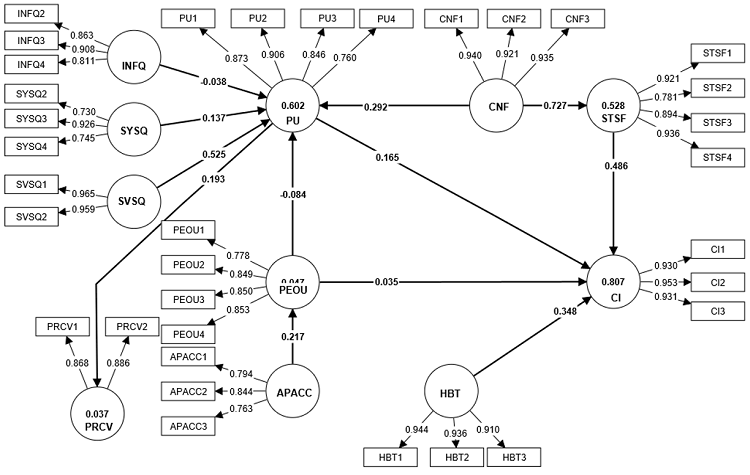
The growth of wireless technologies and ubiquitous mobile devices has transformed the way library resources and services are delivered to users. Most libraries have adopted mobile library applications (MLA) to improve their service delivery. Despite such widespread adoption, little attention has been paid to the long-term viability of MLAs for service provision. Accordingly, this study investigates mobile library application continuance usage intention among users of Higher Learning Institutions (HLIs) in Tanzania. This study integrates the Expectation Confirmation Model, Technology Acceptance Model, and Information System Success Model to explore library users’ continuance intention toward MLAs. Furthermore, the integrated framework is extended by incorporating perceived value and application accessibility, while the moderating role of habit on continuance usage behaviour is also examined. A random sampling method was adopted to collect 361 valid and complete responses from libraries across Tanzanian HLIs for data analysis. Partial Least Squares Structural Equation Modelling (PLS-SEM) was employed to test the proposed hypothetical relationships. The results reveal that perceived usefulness, user satisfaction, and habit exert significant positive effects on users’ continuance usage of MLAs in HLIs. Moreover, service quality and system quality significantly affect perceived usefulness, and perceived usefulness in turn significantly influences perceived value. In addition, confirmation is found to positively affect both perceived usefulness and user satisfaction with MLA usage, whereas application accessibility significantly impacts perceived ease of use. This study yields theoretical contributions and practical implications, which facilitate subsequent scholarly research on MLAs, and support policymakers and service providers in formulating sustainable strategies for digital library services within HLIs.
Article Details

This work is licensed under a Creative Commons Attribution-NonCommercial 4.0 International License.
References
- Aeni Hidayah, N., Hasanati, N., Novela Putri, R., Fiqry Musa, K., Nihayah, Z., & Muin, A. (2020). Analysis Using the Technology Acceptance Model (TAM) and Delone & McLean Information System (D&M IS) Success Model of AIS Mobile User Acceptance. 2020 8th International Conference on Cyber and IT Service Management (CITSM), 1–4. https://doi.org/10.1109/citsm50537.2020.9268859
- Agag, G., & El-Masry, A. A. (2016). Understanding the determinants of hotel booking intentions and moderating role of habit. International Journal of Hospitality Management, 54, 52–67. https://doi.org/10.1016/j.ijhm.2016.01.007
- Anderson, J. C., & Gerbing, D. W. (1988). Structural equation modeling in practice: A review and recommended two-step approach. Psychological Bulletin, 103(3), 411. https://doi.org/10.1037/0033-2909.103.3.411
- Bervell, B., Nyagorme, P., Armah, J. K., Arthur-Nyarko, E., Arkorful, V., & Eduafo Arthur, B. (2024). Modeling the Determinants of Students’ Satisfaction and Continuance-Intention Toward a Mathematics and Science Distance Education Program. Sage Open, 14(1). https://doi.org/10.1177/21582440241234743
- Bhattacherjee, A. (2001). Understanding Information Systems Continuance: An Expectation-Confirmation Model1. MIS Quarterly, 25(3), 351–370. https://doi.org/10.2307/3250921
- Cheng, Y.-M. (2020). Quality antecedents and performance outcome of cloud-based hospital information system continuance intention. Journal of Enterprise Information Management, 33(3), 654–683. https://doi.org/10.1108/jeim-04-2019-0107
- Cheung, C. M. K., & Limayem, M. (2005). The role of Habit in Information Systems Continuance: Examining the Evolving Relationship Between Intention and Usage. Association for Information Systems - 26th International Conference on Information Systems, ICIS 2005: Forever New Frontiers, 471–482.
- Chiu, C.-M., & Huang, H.-Y. (2015). Examining the antecedents of user gratification and its effects on individuals' social network services usage: the moderating role of habit. European Journal of Information Systems, 24, 411-430. https://doi.org/10.1057/ejis.2014.9
- Cohen, J. (1988). Statistical power analysis for the behavioral sciences. (2nd Ed.). Lawrence Erlbaum Associates.
- Culnan, M. J. (1984). The dimensions of accessibility to online information: implications for implementing office information systems. ACM Transactions on Information Systems, 2(2), 141–150. https://doi.org/10.1145/521.523
- Dash, G., Akmal, S., & Chakraborty, D. (2023). A Study on Adoption of Mobile Learning Apps (MLA): Development of an Integrated Framework in a Multinational Context. Indian Journal of Marketing, 53(5), 8. https://doi.org/10.17010/ijom/2023/v53/i5/172724
- Davis, F. D. (1989a). Perceived Usefulness, Perceived Ease of Use, and User Acceptance of Information Technology. MIS Quarterly, 13(3), 319–340. https://doi.org/10.2307/249008
- Davis, F. D. (1989b). Technology acceptance model: TAM. Al-Suqri, MN, Al-Aufi, AS: Information Seeking Behavior and Technology Adoption, 205, 219.
- Deja, M., Rak, D., & Bell, B. (2021). Digital transformation readiness: perspectives on academia and library outcomes in information literacy. The Journal of Academic Librarianship, 47(5), 102403. https://doi.org/10.1016/j.acalib.2021.102403
- Delone, W. H., & McLean, E. R. (2003). The DeLone and McLean model of information systems success: a ten-year update. Journal of Management Information Systems, 19(4), 9-30. https://doi.org/10.1080/07421222.2003.11045748
- Dhiman, N., & Jamwal, M. (2022). Tourists’ post-adoption continuance intentions of chatbots: integrating task–technology fit model and expectation–confirmation theory. Foresight, 25(2), 209–224. https://doi.org/10.1108/fs-10-2021-0207
- Fornell, C., & Larcker, D. F. (1981). Structural Equation Models with Unobservable Variables and Measurement Error: Algebra and Statistics. Journal of Marketing Research, 18(3), 382–388. https://doi.org/10.1177/002224378101800313
- Foroughi, B., Yadegaridehkordi, E., Iranmanesh, M., Sukcharoen, T., Ghobakhlo, M., & Nilashi, M. (2023). Determinants of continuance intention to use food delivery apps: findings from PLS and fsQCA. International Journal of Contemporary Hospitality Management, 36(4), 1235–1261. https://doi.org/10.1108/ijchm-10-2022-1209
- Gardner, B. (2014). A review and analysis of the use of ‘habit’ in understanding, predicting and influencing health-related behaviour. Health Psychology Review, 9(3), 277–295. https://doi.org/10.1080/17437199.2013.876238
- Gupta, A., Dhiman, N., Yousaf, A., & Arora, N. (2020). Social comparison and continuance intention of smart fitness wearables: an extended expectation confirmation theory perspective. Behaviour & Information Technology, 40(13), 1341–1354. https://doi.org/10.1080/0144929x.2020.1748715
- Hair, J. F., Hult, G. T. M., Ringle, C. M., & Sarstedt, M. (2016). A primer on partial least squares structural equation modeling (PLS-SEM) (2nd ed.). SAGE Publications.
- Hair, J. F., Risher, J. J., Sarstedt, M., & Ringle, C. M. (2019). When to use and how to report the results of PLS-SEM. European Business Review, 31(1), 2–24. https://doi.org/10.1108/ebr-11-2018-0203
- Halilovic, S., & Cicic, M. (2013). Antecedents of information systems user behaviour – extended expectation-confirmation model. Behaviour & Information Technology, 32(4), 359–370. https://doi.org/10.1080/0144929x.2011.554575
- Hamad, F., Farajat, S., & Hamarsha, A. (2018). Awareness and adoption of mobile technologies in the delivery of services in academic libraries in Jordan. Global Knowledge, Memory and Communication, 67(6/7), 438–457. https://doi.org/10.1108/gkmc-12-2017-0103
- Henseler, J., Ringle, C. M., & Sinkovics, R. R. (2009). The use of partial least squares path modeling in international marketing. New Challenges to International Marketing, 277–319. https://doi.org/10.1108/s1474-7979(2009)0000020014
- Henseler, J., Ringle, C. M., & Sarstedt, M. (2014). A new criterion for assessing discriminant validity in variance-based structural equation modeling. Journal of the Academy of Marketing Science, 43(1), 115–135. https://doi.org/10.1007/s11747-014-0403-8
- Hoard, B. R. (2025). The acceptance, use, and perceptions of metamorphic testing for a sample of open-source software developers. Cogent Engineering, 12(1). https://doi.org/10.1080/23311916.2025.2522652
- Homburg, C., Klarmann, M., & Vomberg, A. (Eds.). (2020). Handbook of Market Research. Springer Nature Switzerland. https://doi.org/10.1007/978-3-319-05542-8
- Hong, S. H., & Yu, J. H. (2018). Identification of external variables for the Technology Acceptance Model(TAM) in the assessment of BIM application for mobile devices. IOP Conference Series: Materials Science and Engineering, 401, 012027. https://doi.org/10.1088/1757-899x/401/1/012027
- Joo, S., & Yeon Lee, J. (2011). Measuring the usability of academic digital libraries: Instrument development and validation. The Electronic Library, 29(4), 523-537. https://doi.org/10.1108/02640471111156777
- Karahanna, E., & Straub, D. W. (1999). The psychological origins of perceived usefulness and ease-of-use. Information & Management, 35(4), 237–250. https://doi.org/10.1016/s0378-7206(98)00096-2
- Karami, M., Eyüpoğlu, Ş. Z., & Ertugan, A. (2023). The Influence of Relational Benefits on Behavioral Intention and the Moderating Role of Habit: A Study in a Personal Service Business. Behavioral Sciences, 13(7), 565. https://doi.org/10.3390/bs13070565
- Khomo, M. P., Naicker, N., Chisita, C. T., & Rajkoomar, M. (2023). Factors contributing to the successful development and use of mobile digital libraries: a systematic literature review. Digital Library Perspectives, 39(3), 353–370. https://doi.org/10.1108/dlp-08-2022-0062
- Kim, S., Jang, S., Choi, W., Youn, C., & Lee, Y. (2021). Contactless service encounters among Millennials and Generation Z: the effects of Millennials and Gen Z characteristics on technology self-efficacy and preference for contactless service. Journal of Research in Interactive Marketing, 16(1), 82–100. https://doi.org/10.1108/jrim-01-2021-0020
- Kurniawan, A. C., Rachmawati, N. L., Ayu, M. M., Ong, A. K. S., & Redi, A. A. N. P. (2024). Determinants of satisfaction and continuance intention towards online food delivery service users in Indonesia post the COVID-19 pandemic. Heliyon, 10(1), e23298. https://doi.org/10.1016/j.heliyon.2023.e23298
- Legramante, D., Azevedo, A., & Azevedo, J. M. (2023). Integration of the technology acceptance model and the information systems success model in the analysis of Moodle’s satisfaction and continuity of use. The International Journal of Information and Learning Technology, 40(5), 467–484. https://doi.org/10.1108/ijilt-12-2022-0231
- Limayem, M., Hirt, S. G., & Cheung, C. M. K. (2007). How Habit Limits the Predictive Power of Intention: The Case of Information Systems Continuance1. MIS Quarterly, 31(4), 705–737. https://doi.org/10.2307/25148817
- Liu, Y., Fu, Y., Liang, Z., & Liu, Y. (2023). Factors influencing the adoption of public mobile libraries in China: a stimulus–response perspective. The Electronic Library, 42(1), 37–59. https://doi.org/10.1108/el-06-2023-0143
- Ly, H. T. N., Khuong, N. V., & Son, T. H. (2022). DETERMINANTS AFFECT MOBILE WALLET CONTINUOUS USAGE IN COVID 19 PANDEMIC: EVIDENCE FROM VIETNAM. Cogent Business & Management, 9(1). https://doi.org/10.1080/23311975.2022.2041792
- M Ayyoub, A. A., Abu Eidah, B. A., Khlaif, Z. N., Ahmad EL-Shamali, M., & Sulaiman, M. R. (2023). Understanding online assessment continuance intention and individual performance by integrating task technology fit and expectancy confirmation theory. Heliyon, 9(11), e22068. https://doi.org/10.1016/j.heliyon.2023.e22068
- Mentzer, J. T., & Lambert, D. M. (2014). Estimating NonResponse Bias in Mail Surveys: A Replication Study. Marketing Horizons: A 1980’s Perspective, 222–224. https://doi.org/10.1007/978-3-319-10966-4_50
- Mi Alnaser, F., Rahi, S., Alghizzawi, M., & Ngah, A. H. (2023). Does artificial intelligence (AI) boost digital banking user satisfaction? Integration of expectation confirmation model and antecedents of artificial intelligence enabled digital banking. Heliyon, 9(8), e18930. https://doi.org/10.1016/j.heliyon.2023.e18930
- Mishra, A., Shukla, A., Rana, N. P., Currie, W. L., & Dwivedi, Y. K. (2023). Re-examining post-acceptance model of information systems continuance: A revised theoretical model using MASEM approach. International Journal of Information Management, 68, 102571. https://doi.org/10.1016/j.ijinfomgt.2022.102571
- Mohammadi, H. (2015). Investigating users’ perspectives on e-learning: An integration of TAM and IS success model. Computers in Human Behavior, 45, 359–374. https://doi.org/10.1016/j.chb.2014.07.044
- Molinillo, S., Rejón‐Guardia, F., Anaya‐Sánchez, R., & Liébana‐Cabanillas, F. (2023). Impact of perceived value on intention to use voice assistants: The moderating effects of personal innovativeness and experience. Psychology & Marketing, 40(11), 2272–2290. Portico. https://doi.org/10.1002/mar.21887
- Mwogosi, A., & Mambile, C. (2024). Insights into the current state of electronic health records adoption and utilisation in Tanzanian public primary healthcare facilities: a survey study. Records Management Journal, 35(1), 75–93. https://doi.org/10.1108/rmj-04-2023-0023
- Nazir, S., Khadim, S., Ali Asadullah, M., & Syed, N. (2023). Exploring the influence of artificial intelligence technology on consumer repurchase intention: The mediation and moderation approach. Technology in Society, 72, 102190. https://doi.org/10.1016/j.techsoc.2022.102190
- Ng, S. L., Rezaei, S., Valaei, N., & Iranmanesh, M. (2022). Modelling services continuance intention: evidence from apps stores. Asia-Pacific Journal of Business Administration, 16(2), 256–281. https://doi.org/10.1108/apjba-08-2021-0408
- Nguyen, G.-D., & Dao, T.-H. T. (2024). Factors influencing continuance intention to use mobile banking: an extended expectation-confirmation model with moderating role of trust. Humanities and Social Sciences Communications, 11(1). https://doi.org/10.1057/s41599-024-02778-z
- Nguyen, T. T. U., Van Nguyen, P., Huynh, H. T. N., Truong, G. Q., & Do, L. (2024). Unlocking e-government adoption: Exploring the role of perceived usefulness, ease of use, trust, and social media engagement in Vietnam. Journal of Open Innovation: Technology, Market, and Complexity, 10(2), 100291. https://doi.org/10.1016/j.joitmc.2024.100291
- Obeid, A., Ibrahim, R., & Fadhil, A. (2024). Extended Model of Expectation Confirmation Model to Examine Users’ Continuous Intention Toward the Utilization of E-Learning Platforms. IEEE Access, 12, 40752–40764. https://doi.org/10.1109/access.2024.3373190
- Pentang, J. (2023). Quantitative research instrumentation for educators.
- Podsakoff, P. M., MacKenzie, S. B., Lee, J.-Y., & Podsakoff, N. P. (2003). Common method biases in behavioral research: A critical review of the literature and recommended remedies. Journal of Applied Psychology, 88(5), 879–903. https://doi.org/10.1037/0021-9010.88.5.879
- Polas, M. R. H. (2025). Common Method Bias in Social and Behavioral Research: Strategic Solutions for Quantitative Research in the Doctoral Research. Journal of Comprehensive Business Administration Research. https://doi.org/10.47852/bonviewjcbar52024285
- Prasetyo, Y. T., Ong, A. K. S., Concepcion, G. K. F., Navata, F. M. B., Robles, R. A. V., Tomagos, I. J. T., Young, M. N., Diaz, J. F. T., Nadlifatin, R., & Redi, A. A. N. P. (2021). Determining Factors Affecting Acceptance of E-Learning Platforms during the COVID-19 Pandemic: Integrating Extended Technology Acceptance Model and DeLone & McLean IS Success Model. Sustainability, 13(15), 8365. https://doi.org/10.3390/su13158365
- Rafique, H., Anwer, F., Shamim, A., Minaei-Bidgoli, B., Qureshi, M. A., & Shamshirband, S. (2018). Factors Affecting Acceptance of Mobile Library Applications: Structural Equation Model. Libri, 68(2), 99–112. https://doi.org/10.1515/libri-2017-0041
- Rafique, H., Alroobaea, R., Munawar, B. A., Krichen, M., Rubaiee, S., & Bashir, A. K. (2021). Do digital students show an inclination toward continuous use of academic library applications? A case study. The Journal of Academic Librarianship, 47(2), 102298. https://doi.org/10.1016/j.acalib.2020.102298
- Riana, D., Hidayanto, A. N., Hadianti, S., & Napitupulu, D. (2021). Integrative Factors of E-Health Laboratory Adoption: A Case of Indonesia. Future Internet, 13(2), 26. https://doi.org/10.3390/fi13020026
- Rousset, S., Charrier, L., Bersia, M., Comoretto, R. I., & Dalmasso, P. (2025). Enhancing representativeness in population-based surveys to improve data quality and decision-making. Scientific Reports, 15(1). https://doi.org/10.1038/s41598-025-17298-2
- Sachdev, S. B., & Verma, H. V. (2004). Relative importance of service quality dimensions: A multisectoral study. Journal of services research, 4(1), 93.
- Sarstedt, M., Ringle, C. M., & Hair, J. F. (2017). Handbook of Market Research. In A. Homburg, C., Klarmann, M. and Vomberg (Ed.), Handbook of Market Research. Springer International Publishing AG. https://doi.org/10.1007/978-3-319-05542-8
- Selya, A. S., Rose, J. S., Dierker, L. C., Hedeker, D., & Mermelstein, R. J. (2012). A Practical Guide to Calculating Cohen’s f2, a Measure of Local Effect Size, from PROC MIXED. Frontiers in Psychology, 3. https://doi.org/10.3389/fpsyg.2012.00111
- Sharifi Fard, S., Alkelani, A. M., & Tamam, E. (2019). Habit as a moderator of the association of utilitarian motivation and hedonic motivation with purchase intention: Implications for social networking websites. Cogent Social Sciences, 5(1). https://doi.org/10.1080/23311886.2019.1674068
- Sharma, P. N., Liengaard, B. D., Hair, J. F., Sarstedt, M., & Ringle, C. M. (2022). Predictive model assessment and selection in composite-based modeling using PLS-SEM: extensions and guidelines for using CVPAT. European Journal of Marketing, 57(6), 1662–1677. https://doi.org/10.1108/ejm-08-2020-0636
- Shmueli, G., Sarstedt, M., Hair, J. F., Cheah, J.-H., Ting, H., Vaithilingam, S., & Ringle, C. M. (2019). Predictive model assessment in PLS-SEM: guidelines for using PLSpredict. European Journal of Marketing, 53(11), 2322–2347. https://doi.org/10.1108/ejm-02-2019-0189
- Siva Sree, G., Ramlal, P., & Yadav, R. (2025). Trainees’ experienced vocational education and training quality: formative assessment of scale development and validation. International Journal of Educational Management, 39(4), 916–936. https://doi.org/10.1108/ijem-09-2023-0429
- Sreelakshmi, C. ., & Prathap, S. K. (2020). Continuance adoption of mobile-based payments in Covid-19 context: an integrated framework of health belief model and expectation confirmation model. International Journal of Pervasive Computing and Communications, 16(4), 351-369. https://doi.org/10.1108/IJPCC-06-2020-0069
- Stone, R. W., & Baker-Eveleth, L. (2013). Students’ expectation, confirmation, and continuance intention to use electronic textbooks. Computers in Human Behavior, 29(3), 984–990. https://doi.org/10.1016/j.chb.2012.12.007
- Sujood, & Pancy. (2024). Travelling with open eyes! A study to measure consumers’ intention towards experiencing immersive technologies at tourism destinations by using an integrated model of TPB, TAM captured through the lens of S-O-R. International Journal of Contemporary Hospitality Management, 36(11), 3906–3929. https://doi.org/10.1108/ijchm-11-2023-1771
- Tait, E., Martzoukou, K., & Reid, P. (2016). Libraries for the future: the role of IT utilities in the transformation of academic libraries. Palgrave Communications, 2(1). https://doi.org/10.1057/palcomms.2016.70
- Tam, C., Santos, D., & Oliveira, T. (2018). Exploring the influential factors of continuance intention to use mobile Apps: Extending the expectation confirmation model. Information Systems Frontiers, 22(1), 243–257. https://doi.org/10.1007/s10796-018-9864-5
- TCU. (2023). Vital Stats on University Education in Tanzania 2022.
- Tessema, W. M., & Cavus, N. (2024). Determining information system end-user satisfaction and continuance intension with a unified modeling approach. Scientific Reports, 14(1). https://doi.org/10.1038/s41598-024-57218-4
- Thong, J. Y. L., Hong, W., & Tam, K.-Y. (2002). Understanding user acceptance of digital libraries: what are the roles of interface characteristics, organizational context, and individual differences? International Journal of Human-Computer Studies, 57(3), 215–242. https://doi.org/10.1016/s1071-5819(02)91024-4
- Tyagi, S. K., Sharma, S. K., & Gaur, A. (2022). Determinants of continuous usage of library resources on handheld devices: findings from PLS-SEM and fuzzy sets (fsQCA). The Electronic Library, 40(4), 393–412. https://doi.org/10.1108/el-02-2022-0026
- van Ginkel, J. R., Linting, M., Rippe, R. C. A., & van der Voort, A. (2019). Rebutting Existing Misconceptions About Multiple Imputation as a Method for Handling Missing Data. Journal of Personality Assessment, 102(3), 297–308. https://doi.org/10.1080/00223891.2018.1530680
- Wang, Y.-S., Yeh, C.-H., & Liao, Y.-W. (2013). What drives purchase intention in the context of online content services? The moderating role of ethical self-efficacy for online piracy. International Journal of Information Management, 33(1), 199–208. https://doi.org/10.1016/j.ijinfomgt.2012.09.004
- Wang, X., Li, J., Yang, M., Chen, Y., & Xu, X. (2018). An empirical study on the factors influencing mobile library usage in IoT era. Library Hi Tech, 36(4), 605–621. https://doi.org/10.1108/lht-01-2018-0008
- Wu, L.-Y., Chen, K.-Y., Chen, P.-Y., & Cheng, S.-L. (2014). Perceived value, transaction cost, and repurchase-intention in online shopping: A relational exchange perspective. Journal of Business Research, 67(1), 2768–2776. https://doi.org/10.1016/j.jbusres.2012.09.007
- Wu, P., Zhang, R., Zhu, X., & Liu, M. (2022). Factors Influencing Continued Usage Behavior on Mobile Health Applications. Healthcare, 10(2), 208. https://doi.org/10.3390/healthcare10020208
- Xu, F., & Du, J. T. (2018). Factors influencing users’ satisfaction and loyalty to digital libraries in Chinese universities. Computers in Human Behavior, 83, 64–72. https://doi.org/10.1016/j.chb.2018.01.029
- Yang, H., Yu, J., Zo, H., & Choi, M. (2016). User acceptance of wearable devices: An extended perspective of perceived value. Telematics and Informatics, 33(2), 256–269. https://doi.org/10.1016/j.tele.2015.08.007
- Yang, Z., Zhou, Q., Chiu, D. K. W., & Wang, Y. (2022). Exploring the factors influencing continuous usage intention of academic social network sites. Online Information Review, 46(7), 1225–1241. https://doi.org/10.1108/oir-01-2021-0015
- Yao, M., & Xu, Y. (Calvin). (2021). Method Bias Mechanisms and Procedural Remedies. Sociological Methods & Research, 53(1), 235–278. https://doi.org/10.1177/00491241211043141
- Ye, J.-H., Lee, Y.-S., Wang, C.-L., Nong, W., Ye, J.-N., & Sun, Y. (2023). The Continuous Use Intention for the Online Learning of Chinese Vocational Students in the Post-Epidemic Era: The Extended Technology Acceptance Model and Expectation Confirmation Theory. Sustainability, 15(3), 1819. https://doi.org/10.3390/su15031819
- Yip, K. H. T., Lo, P., Ho, K. K. W., & Chiu, D. K. W. (2020). Adoption of mobile library apps as learning tools in higher education: a tale between Hong Kong and Japan. Online Information Review, 45(2), 389–405. https://doi.org/10.1108/oir-07-2020-0287
